

India’s top domestic robots company just made a bold move into education, and students across the country are already taking notice. Milagrow Education has rolled out a full suite of robotics and artificial intelligence training programs designed to turn curious learners into job-ready tech professionals. With the global AI talent gap widening at an alarming rate, the timing could not be sharper.
A Program Built for Every Kind of Learner
Milagrow Education is the academics arm of Milagrow HumanTech, India’s No. 1 domestic robots company, and it brings more than 14 years of real-world robotics experience directly into the classroom.
The new program is not built for one type of student. It covers a wide range, from young kids just discovering STEM to high schoolers looking for a tech edge, all the way to working adults who want to switch careers.
The course lineup is structured around four named tracks. These include Spark Builders for beginners, Tech Tinkerers and Code Mavens for intermediate learners, and AI Pioneers for those ready to go deep into advanced robotics and machine learning. Each course runs 54 classes across 90 hours of learning time, giving students enough room to genuinely build skills rather than just skim the surface.
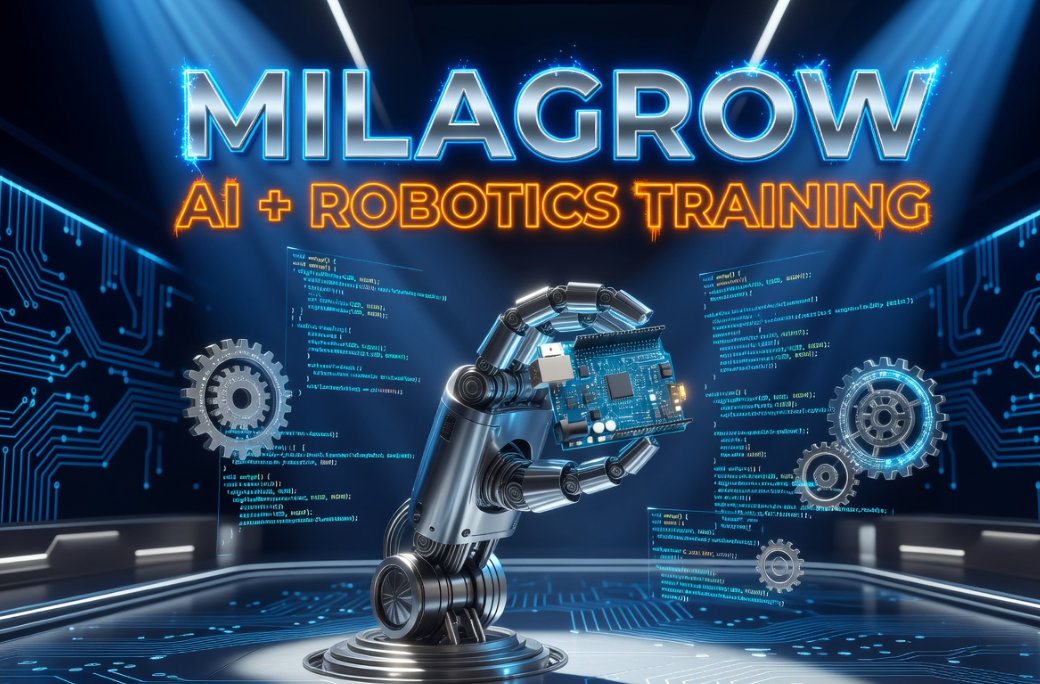
The curriculum is split across two core areas:
- Robotics Track: Covers foundational principles like sensors, actuators, and motors, then progresses into autonomous navigation, industrial robotics, and modern automation techniques.
- AI Track: Dives into machine learning, neural networks, and deep learning algorithms, with real-world applications ranging from autonomous vehicles to predictive healthcare systems.
Hands-On Learning That Actually Sticks
One of the biggest problems with tech education in India has always been the gap between what students learn and what industries actually need. Milagrow’s approach tackles this head-on.
Students work directly with Milagrow Robotic Kits and Arduino hardware from day one. They are not just reading about robotics. They are building obstacle-avoiding robots, coding smart street lights, designing automatic doors, and programming four-wheel drive vehicles with their own hands.
The learning flow follows a clear path from theory into practice:
Theoretical Concepts → Simulation and Coding → Hardware Integration → Prototype Testing
This method has already earned strong responses at institutions including Shiv Nadar University, IILM University, and K.R. Mangalam University. Milagrow recently led a hands-on AI and robotics workshop at IILM University on National Technology Day in May 2025. Their camp at IILM Gurugram drew more than 150 students in a single session.
Students have worked on projects like smart city infrastructure models, AI-powered apps, and automation workflows that mirror real manufacturing challenges. The goal is not just technical output. It is the experimental mindset that gets built along the way.
The Staggering Demand Behind This Move
This launch does not exist in a vacuum. The data around AI and robotics jobs tells a story that is hard to ignore.
The global demand for robotics engineers with AI experience rose by 33% in 2025 compared to the previous year. The AI robots market, valued at $14.45 billion in 2024, is projected to hit $33.6 billion by 2029, growing at nearly 18% annually. Global venture capital investment in AI robotics startups alone hit a record $13.9 billion in 2025.
Here is where it gets personal for students. The World Economic Forum’s Future of Jobs Report 2025 found that advances in AI will create 19 million new jobs over the next five years, even as 9 million are displaced. The problem is that the talent is simply not there to fill these roles.
“The global AI talent shortage has reached critical levels, with demand exceeding supply by 3.2:1 across key roles.”
By 2030, the world will need 4.2 million AI professionals but forecasts show only 2.1 million qualified candidates available. That gap is not a statistic. It is an opportunity for every student who chooses to start learning today.
Why India Needs This Program Right Now
India is moving fast on AI education at a policy level. The Council for Indian School Certificate Examinations added robotics and AI to its school curriculum starting in the 2025-26 academic year. The Indian government has plans to introduce AI as part of the school curriculum from Grade 3 starting with the 2026-27 academic year, aligned with the National Education Policy 2020.
But government policy and classroom reality are two very different things. Putting AI on a syllabus means little without the tools, trained educators, and hands-on infrastructure to back it up. That is exactly the gap Milagrow Education is stepping into.
Milagrow HumanTech itself has been building robots since 2011. It launched India’s first floor cleaning robot, the RedHawk, and later expanded into swimming pool cleaning robots, lawn mowing robots, and AI-equipped consumer robots. That manufacturing DNA is now feeding directly into how they teach.
The courses and certifications are built by industry professionals and software engineers from top-tier institutions, ensuring the curriculum stays relevant to what companies are actually hiring for. An industry-ready certification is part of the package, which matters enormously in a job market that is increasingly skill-based rather than degree-based.
Mentorship That Goes Beyond the Textbook
Knowing how to code a robot is one thing. Knowing how to work in a team, pitch a concept, and handle real project pressure is another. Milagrow Education’s programs address both.
Faculty members bring professional backgrounds in robotics engineering, AI development, and industrial automation directly into the classroom. They guide students not just on circuits and algorithms but on project management, troubleshooting, and figuring out where careers in this field can realistically go.
The programs also focus on collaborative projects that mirror actual industry challenges. Students build AI-powered apps, design automation workflows, and develop smart city infrastructure concepts. These are not toy projects. They are practice runs for the work environment waiting on the other side of graduation.
Broader professional skills including team collaboration and entrepreneurship are woven into the curriculum deliberately. The reasoning is straightforward. The fastest-growing AI roles in the world today require not just technical expertise but the human skills that machines still cannot replace.
Milagrow Education’s launch arrives at a moment when the need for structured, credible, hands-on AI and robotics training has never been more urgent. For a generation of students staring down one of the most rapidly shifting job markets in history, programs like this are not just useful. They may be the difference between being left behind and being the ones who build what comes next. The question is not whether to learn AI and robotics. It is whether you start today or wait until everyone else already has. What do you think about India’s push into robotics and AI education? Drop your thoughts in the comments below.