

China’s factories continued to churn out goods at a brisk pace in April, offering a dose of optimism for an economy still wrestling with global trade tensions and patchy domestic demand.
The National Bureau of Statistics reported a 6.1% year-on-year rise in industrial output last month. It wasn’t quite as fast as March’s 7.7%, but it beat analyst expectations and showed manufacturers are far from hitting the brakes.
Industrial Output Outpaces Forecasts, Again
Industrial output wasn’t supposed to come in this hot. Analysts polled by Bloomberg had penciled in a 5.7% rise. Beijing casually brushed that aside with a 6.1% print.
That’s not just noise — it’s a signal. Despite slower momentum from the previous month, China’s factories are still running strong. Manufacturing continues to be the backbone, especially when other parts of the economy are coughing and sputtering a bit.
A one-percentage-point drop from March may raise eyebrows. But in this case, the slowdown is more of a cool breeze than a warning siren.
Industrial production remains one of China’s few economic engines still firing on most cylinders.
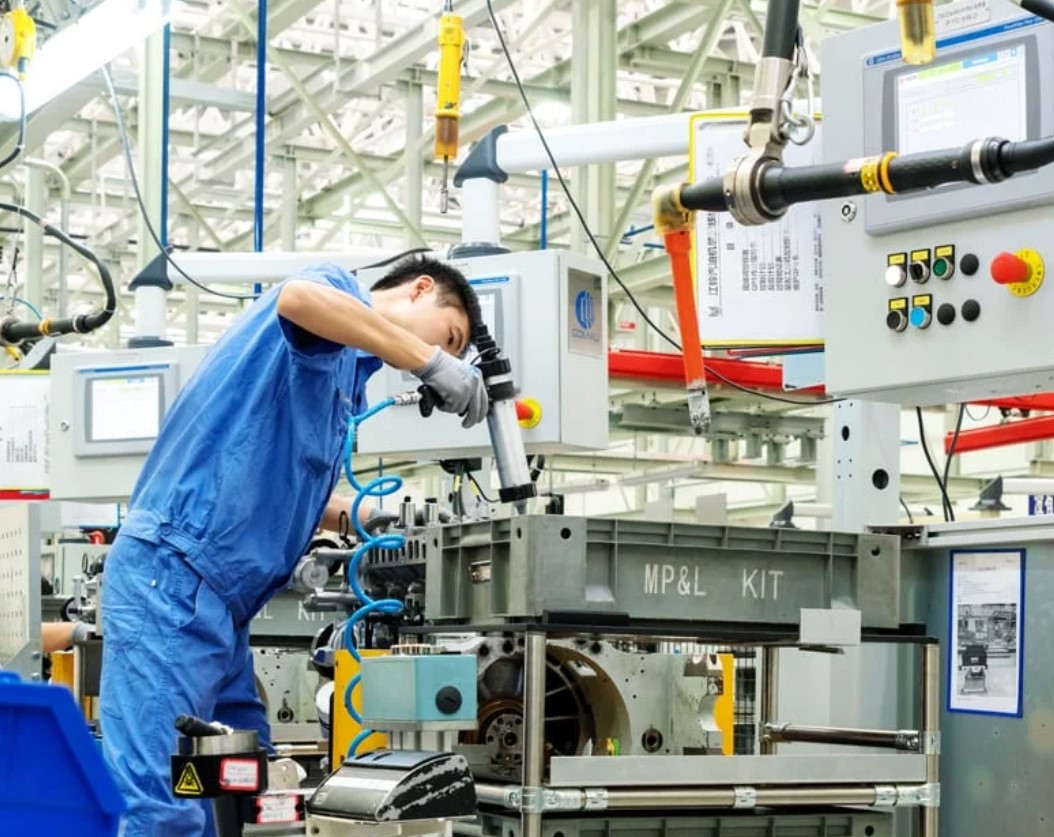
Consumers Aren’t Exactly Lining Up at the Cash Register
If factories are pushing harder, shoppers are being more cautious.
Retail sales rose just 5.1% in April. That’s down from March’s 5.9% gain. And economists? They were betting on something stronger. Turns out, Chinese consumers aren’t feeling quite as spend-happy as expected.
It’s not exactly a disaster — but it’s a slowdown. A softer labor market? Maybe. Low confidence? Probably. Or maybe just the usual April lull?
Here’s what that looks like in numbers:
| Economic Indicator | April 2025 | March 2025 | Analyst Expectations |
|---|---|---|---|
| Industrial Output (YoY) | 6.1% | 7.7% | 5.7% |
| Retail Sales (YoY) | 5.1% | 5.9% | 5.5%-5.7% |
| Fixed-Asset Investment (YTD YoY) | 4.0% | 4.5% | 4.3% |
| Urban Unemployment Rate | 5.1% | 5.2% | — |
So yeah — mixed bag.
And speaking of mixed…
Investment Slows While Jobs Get Slight Boost
Fixed-asset investment — think roads, bridges, factories — grew by just 4% in the first four months of the year. That’s slower than the 4.5% growth seen previously. Not a nosedive, but definitely not full throttle either.
Yet here’s the twist: the urban unemployment rate dropped. Just slightly, to 5.1% from March’s 5.2%. But it counts.
Two things are happening at once: less investment, but more jobs. It’s weird. But then again, China’s economy often defies simple logic.
And it’s not all gloom. Job numbers show the labor market isn’t folding under pressure — not yet, at least.
Trade Tensions Still Loom Large
Even as the factories hum along, that whole China-U.S. trade drama continues to hang in the air like smog over Beijing on a bad day.
Yes, there was a truce in May. But “truce” doesn’t mean “peace.” Companies still aren’t fully convinced it’s safe to spend big again. No one wants to be caught mid-project when another round of tariffs drops from the sky.
Yet, despite that, China’s industrial machine has kept going. It hasn’t collapsed under the weight of tariffs. It hasn’t frozen in place waiting for Washington’s next move.
That’s more than just luck. It’s resilience. Quiet, steady resilience.
And businesses? They’re adjusting:
Many Chinese exporters have started rerouting goods to Southeast Asia and Europe
Firms are diversifying supply chains to limit U.S. exposure
Manufacturing clusters are focusing more on domestic tech and green energy
Adapt or die, as the saying goes.
Exports Shift Direction as Analysts Rework Growth Forecasts
April’s export data turned out to be another surprise. Exports beat expectations, thanks in large part to China turning to new markets. Less going to the U.S., more to Southeast Asia and parts of Europe.
There’s a recalibration going on.
And international analysts have noticed. Goldman Sachs, among others, has nudged its 2025 China growth forecast up. That’s a vote of confidence, even if the number is still under Beijing’s target of “around 5%.”
Economists are betting the truce with the U.S. will hold long enough to delay further stimulus. That gives China a bit of breathing room — maybe not much, but enough to adjust strategy and keep the wheels turning.
One economist from a major U.S. bank put it bluntly: “They’ve bought time. Now they need to buy growth.”
Fair point.







![gain Rise in Gold Rate in India After Falling Rs 21,200/24K; Will Gold Price Today Jump or Drop on 28 March? By Harshika Yadav Published: Saturday, March 28, 2026, 6:55 [IST] preference Add as a preferred source on Google Gold rates in India witnessed a modest recovery on March 27, 2026, after a sharp fall in the previous session, indicating a cautious stabilisation in the bullion market. The yellow metal had dropped by Rs 212 per gram (or Rs 21,200 per 100 grams) of 24 Karat (24K) earlier, but managed to regain some ground. Gold Price Updates as US-Iran Tensions Ease; Pakistan, Turkiye & Egypt Step Up Mediation Efforts The rise in yellow metal follows easing geopolitical concerns after US President Donald Trump signalled a delay in potential military action against Iran's energy infrastructure by 10 days, pushing the deadline to April 6. This development, along with ongoing diplomatic efforts, has helped support safe-haven demand. gold Rate Today Further adding to market sentiment, Pakistan's Foreign Minister Ishaq Dar confirmed that Islamabad is acting as an intermediary between the United States and Iran, relaying messages as part of efforts to de-escalate tensions. Countries like Türkiye and Egypt are also reportedly supporting the mediation process, offering some relief to global financial markets. Gold Rate in India: Check Latest 22K, 24K & 18K Gold Prices Per Gram 24 Karat Gold Rate Today in India In the 24 Karat segment, at the time of writing, the rate for 1 gram stood at Rs 14,471, rising by Rs 16 from Rs 14,455. For 8 grams, the price increased to Rs 1,15,768, up by Rs 128. The rate for 10 grams climbed to Rs 1,44,710, reflecting a gain of Rs 160, while 100 grams of 24 Karat gold were priced at Rs 14,47,100, marking an increase of Rs 1,600. 22 Karat Gold Rate Today in India The price of one gram of 22K stood at Rs 13,265, gaining Rs 15 from the previous session. For 8 grams, the rate rose to Rs 1,06,120, registering an increase of Rs 120. The cost of 10 grams advanced to Rs 1,32,650, up by Rs 150, while 100 grams were priced at Rs 13,26,500, reflecting a gain of Rs 1,500. 18 Karat Gold Rate Today in India The rate for one gram of 18K stood at Rs 10,853, up by Rs 12. For 8 grams, the price moved up to Rs 86,824, marking a gain of Rs 96. The rate for 10 grams climbed to Rs 1,08,530, increasing by Rs 120, while 100 grams were valued at Rs 10,85,300, reflecting an uptick of Rs 1,200. Latest MCX Gold Price In the domestic futures market, gold on the Multi Commodity Exchange (MCX) held firm above the Rs 1,44,500 level as per latest trading record, supported largely by the weakness in the Indian rupee, which continues to cushion local prices despite global volatility. Latest Spot Gold Rate The rebound in domestic gold rates comes alongside a recovery in international markets, where gold moved above the $4,400 per ounce mark. What Lies Ahead for Gold Prices? Check Gold Rate Prediction Jateen Trivedi, VP - Research Analyst (Commodity and Currency), LKP Securities, said, "Gold remained slightly positive, trading above $4,425 with highs near $4,475, supported by initial optimism around US-Iran talks. However, the sharp rise in crude continues to signal underlying market stress and inflation risks." From a technical perspective, he explained, "Technically, support is seen near Rs 1,42,000, while resistance is placed around Rs 1,46,500. Overall, gold is expected to remain volatile with limited upside unless clarity emerges on inflation and geopolitics."](https://keralanews247.com/wp-content/uploads/2026/03/rupee-and-dollar-scaled-120x86.png)