

On Saturday, October 7, 2023, the Palestinian militant group Hamas launched a surprise attack on Israel, firing thousands of rockets from the Gaza Strip and sending gunmen across the border to enter Israeli towns and military bases. The attack was the largest and most coordinated by Hamas in its history, and caught Israel off guard.
According to the Israeli military, Hamas fired about 5,000 rockets in the first barrage, targeting cities and towns across southern and central Israel. The rockets triggered sirens and caused panic among Israeli civilians, who rushed to shelters or safe rooms. Some rockets reached as far as Tel Aviv and Jerusalem, where explosions could be heard.
The rocket fire also served as a cover for an unprecedented infiltration of Hamas fighters into Israel. The militants breached the hi-tech security fence that surrounds the Gaza Strip at multiple locations, using explosives, wire cutters, and powered parachutes. Some also attempted to enter by sea using motorboats.
The infiltrators attacked Israeli communities near the border with Gaza, killing and capturing civilians and soldiers. They also raided several military installations, including the Erez border crossing, the Zikim base, and the Gaza division headquarters at Reim. Hamas claimed to have taken 52 hostages back to Gaza, including members of the Israeli forces.
Israel retaliates with airstrikes and mobilizes reserves
Israel declared a state of war and vowed to respond with full force to the Hamas attack. Prime Minister Benjamin Netanyahu said that Israel would reduce Hamas hideouts in Gaza to rubble and that Palestinians would pay a heavy price. He also called for a mass mobilization of army reserves to join the fight.
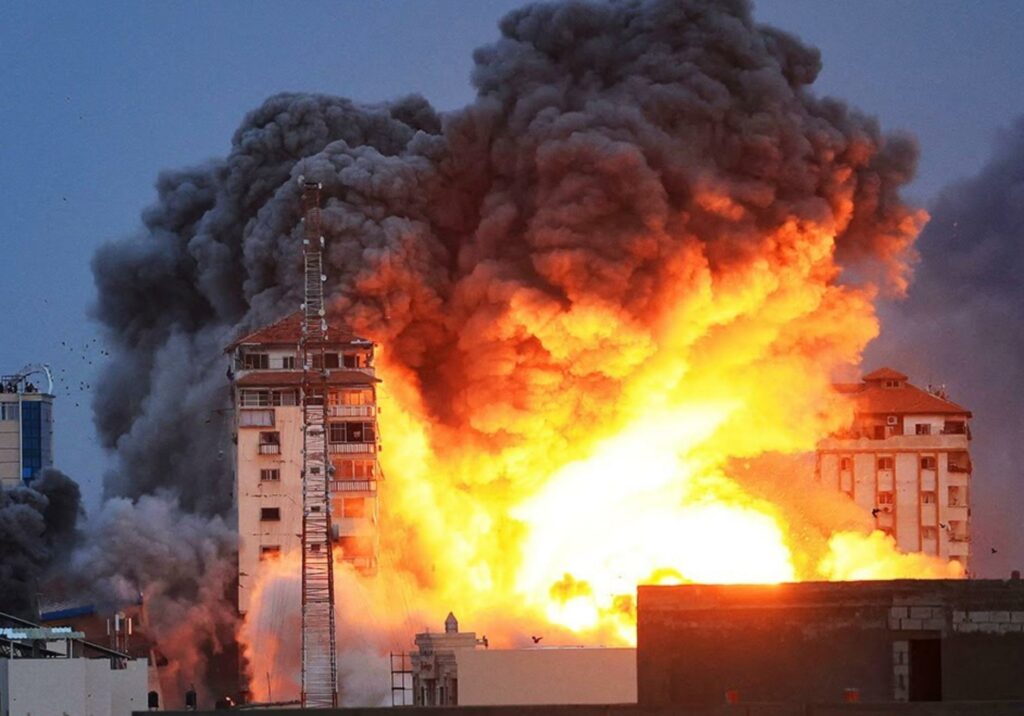
Israel launched a series of airstrikes against targets of Iran-backed Hamas in the blockaded coastal enclave, where black smoke billowed into the sky. The airstrikes hit several buildings in the center of Gaza City, including Palestine Tower, an 11-story building that houses Hamas radio stations. Israel also targeted military positions, the homes of Hamas leaders, and Hamas-run banks.
They also indicated that it may launch a ground invasion of Gaza, although this would carry huge risks both for Israeli troops and for the hostages being held by Hamas. Israel cut off electricity and fuel supplies to Gaza, which may soon affect the medical facilities that are already under extreme pressure from the casualties.
Casualties mount on both sides amid fears of wider conflict
The attack by Hamas and the retaliation by Israel resulted in hundreds of deaths and injuries on both sides. According to Magen David Adom, Israel’s national emergency service, at least 300 Israelis were killed and over 1,000 were wounded by rocket fire or gunshots. Among the dead were one paramedic and several foreign nationals.
According to the Ministry of Health in Gaza, at least 232 Palestinians were killed and over 1,600 were injured by Israeli airstrikes. Among the dead were two men who were killed when an Israeli missile hit the Indonesian hospital in Beit Lahiya, northern Gaza. The hospital also suffered damage to its oxygen station. Several Palestinian paramedics were also injured when an Israeli missile hit an ambulance near Nasser Hospital in Khan Yunis, southern Gaza.
The escalation has raised fears of a wider conflict between Israel and its enemies in the region, especially Iran, which backs Hamas and other militant groups. The United States, Germany, and other western powers expressed their support for Israel’s right to defend itself, while calling for restraint and de-escalation. The United Nations Security Council held an emergency meeting to discuss the crisis.
The conflict has also sparked protests and clashes in other parts of the occupied Palestinian territory (oPt), including the West Bank and East Jerusalem. According to the Palestine Red Crescent Society (PRCS), at least 23 Palestinians were injured by Israeli forces during confrontations in multiple locations.
Background and implications of the conflict
The conflict originated with the election of the Islamist political party Hamas in 2005 and 2006 in the Gaza Strip and escalated with the split of the Palestinian Authority (PA) government into the Fatah-led government in the West Bank and the Hamas-led government in Gaza. The following year, Hamas violently ousted Fatah from Gaza after Fatah lost the election to Hamas.
Since then, Israel has imposed a blockade on Gaza, restricting the movement of people and goods in and out of the territory. Israel says the blockade is necessary to prevent weapons smuggling and attacks by Hamas. However, human rights groups say it amounts to collective punishment and has created a humanitarian crisis for Gaza’s two million residents.
The blockade has also fueled recurrent cycles of violence between Israel and Palestinian armed groups in Gaza. The last major escalation was in 2014, when Israel launched a 51-day military operation in Gaza, killing over 2,200 Palestinians and injuring over 11,000. Sixty-six Israeli soldiers and six civilians were also killed, and over 500 were wounded.
The current attack by Hamas represents a large failure of Israeli intelligence and a major challenge to its deterrence. It also shows the increasing capabilities and confidence of Hamas, which has been smuggling weapons and developing its own arsenal despite the blockade. Hamas has said it is prepared for a war with Israel and has vowed to continue its “retaliatory attacks”.
The attack also poses a dilemma for Israel, which faces international pressure to avoid civilian casualties and collateral damage in Gaza, while trying to stop the rocket fire and rescue the hostages. A ground invasion would be costly and risky, but airstrikes may not be enough to achieve Israel’s goals.
The attack also has implications for the internal Palestinian politics, as it may boost Hamas’s popularity and legitimacy among Palestinians, especially after the recent postponement of the PA elections by President Mahmoud Abbas. Hamas may also seek to leverage the hostages for political gains, such as easing the blockade or releasing Palestinian prisoners.
The attack also affects the prospects for peace between Israel and the Palestinians, which have been stalled for years. The attack may further erode the trust and confidence between the two sides, and undermine the efforts of the international community to revive the peace process based on a two-state solution.