
NEWS
NHS Galleri Blood Test Misses Its Main Trial Goal
NHS-Galleri trial papers show no late-stage cancer drop, while a US panel still voted that Galleri’s benefits outweigh its risks.

The NHS-Galleri trial did not cut late-stage cancer overall after three yearly blood tests in 142,250 adults, according to papers published on 22 September 2026. The New England Journal of Medicine and Nature Medicine give the first peer-reviewed look at GRAIL’s Galleri test in NHS screening. A US advisory panel voted the next day that the test’s benefits outweigh its risks, with no approval attached.
Galleri looks in blood for a shared methylation signal from many tumour types and names a likely origin so doctors know where to scan. The NHS trial was the first randomised test of that idea at population scale. It was funded by GRAIL.
The Trial Missed the Goal It Was Built Around
Peter Sasieni, a statistician, led the New England Journal paper with Richard Neal of the University of Exeter Medical School and Charles Swanton of the Francis Crick Institute among the authors. People aged 50 to 77 in eight English regions gave blood at up to three yearly visits. After the first draw they were assigned at random, 71,122 to have the sample tested and 71,128 to have it stored. Staff and volunteers were not told the assignment at the start.
The main goal was a lower rate of stage 3 or 4 disease among 12 cancers that often turn up late. After three screening rounds and at least a year of follow-up after the last third visit, the authors did not observe a lower incidence rate. The rate ratio, test group versus control, was 1.03 (0.92 to 1.14, P=0.63).
LATE-STAGE COUNTS IN THE 12 CANCERS
| Measure | Test group | Control group | Rate ratio (95% CI) |
|---|---|---|---|
| Stage 3 and 4 combined | 706 | 688 | 1.03 (0.92 to 1.14) |
| Stage 4 only | 342 | 397 | 0.86 (0.74 to 1.00) |
| Stage 1 and 2 | 647 | 559 | 1.16 (1.03 to 1.30) |
A pre-set secondary look at stage 4 alone found a rate ratio of 0.86 (0.74 to 1.00), which is a 14% lower incidence of the most advanced disease. Stage 1 and 2 diagnoses were 16% higher in the tested group. Less than 1% of people had a trial-related side effect, and none was serious, the journal said.
The official trial site puts the same finding in plainer words: the trial did not meet its main goal. Investigators have pointed to more stage 3 diagnoses in the first round as the reason the combined late-stage count did not fall. Stage 4 diagnoses were 9% lower in that first round, 22% lower in the second, and 26% lower in the third, in the same 12 cancers.
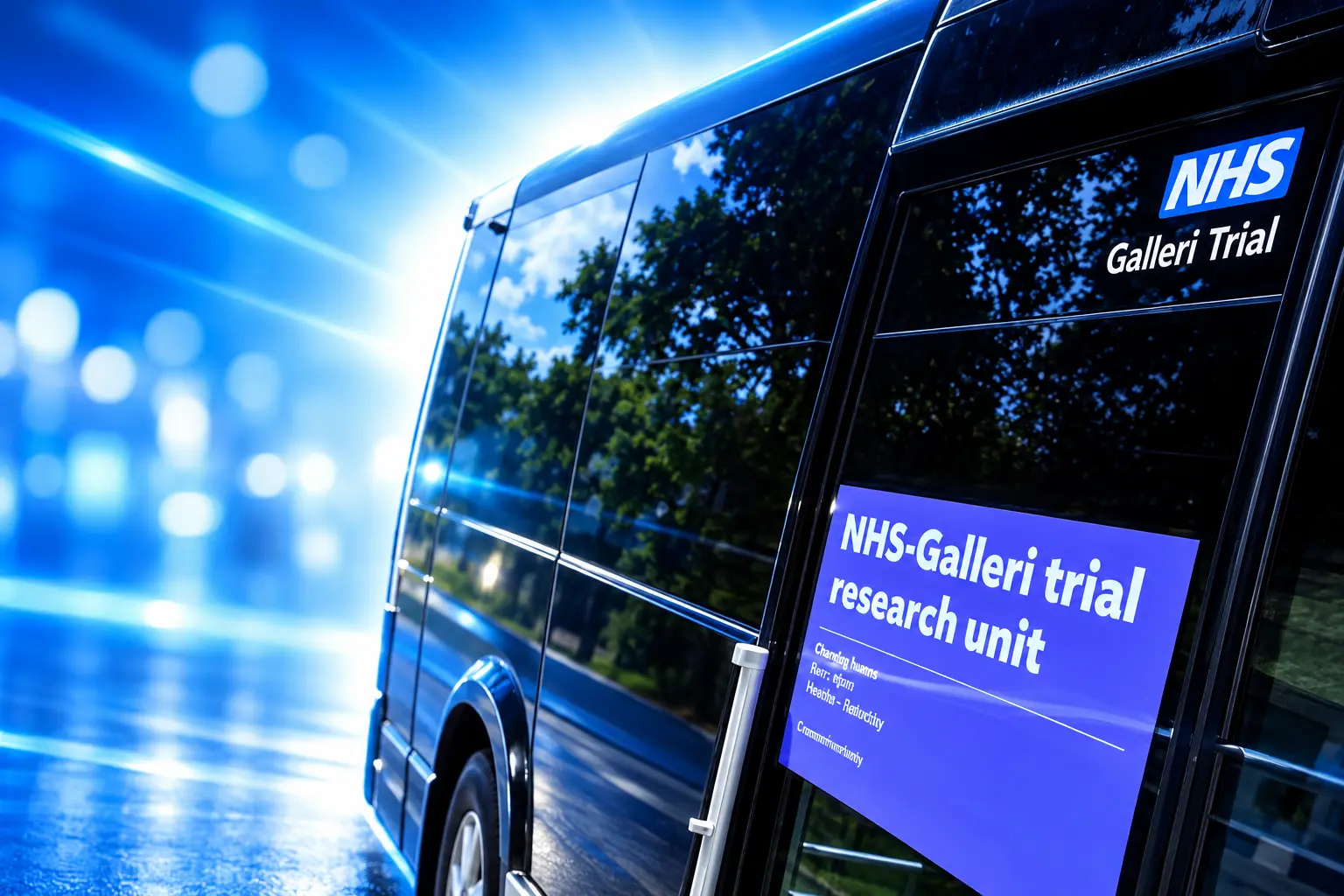
Eight English Regions and 142,250 Volunteers
Recruitment ran from 31 August 2021 to 16 July 2022. Some 142,826 people consented; 142,250 were randomised after the baseline blood draw. About 88% came back through three annual rounds. The test-performance group in round one had a median age of 66, was 50.2% female, and was 93.6% White, in line with that age band in England. More people came from the most deprived fifth of neighbourhoods than from the least.
NHS cancer alliances in Cheshire and Merseyside, the East of England, the East Midlands, Greater Manchester, Kent and Medway, the North, South East London, and the West Midlands ran the clinics. Positive results went into standard NHS pathways, with the predicted origin used to choose scans. Control samples stayed in storage. Volunteers will not be told which group they were in, even after the trial ends, so that knowledge cannot change how they use the NHS.
Only about 6% of cancers in England in 2020 were found through the usual screening programmes. The 12 cancers in the main goal were chosen because they grow fast and are often found late. Together they account for a large share of cancer deaths in Britain and the United States.
TWELVE CANCERS IN THE PRIMARY GOAL
- Anus
- Bladder
- Bowel
- Head and neck
- Liver and bile duct
- Lung
- Lymphoma
- Oesophagus
- Ovary
- Pancreas
- Plasma cell neoplasm
- Stomach
Those types sat at the centre of the missed goal. Separate analyses looked at all routinely staged cancers, and at how people reached a diagnosis, including screening, GP referral, and A&E.
The Test Caught About One in Three Cancers
The Nature Medicine paper, with Neal as an author, reports how the test behaved in the group whose blood was actually read. Those figures were pre-set secondary measures and were not put through hypothesis tests. In round one, 722 of 70,325 people (1.03%) got a cancer-signal result. The share with a positive result was 0.80% in round two and 0.90% in round three.
GALLERI PERFORMANCE BY SCREENING ROUND
| Round | People tested | Positive results | Share positive | Share of positives with cancer (PPV) | Primary cancers found | People tested to find one cancer |
|---|---|---|---|---|---|---|
| 1 | 70,325 | 722 | 1.03% | 58.0% | 419 | 168 |
| 2 | 64,498 | 518 | 0.80% | 50.4% | 261 | 247 |
| 3 | 62,323 | 561 | 0.90% | 45.8% | 257 | 243 |
Across the three rounds, 937 people had a primary cancer found after a positive Galleri result. The chance that a positive result was cancer fell as the rounds went on, which is what you would expect once the first sweep has already pulled out many of the hidden cases. Predicted origin of the signal was right in 91.1% to 93.6% of those cancers, which is high enough to point a clinic at the right organ most of the time.
On the other side of the ledger, episode sensitivity ranged from 26.7% to 37.2% for all cancers diagnosed in the year after each blood draw, and from 47.6% to 63.4% for the 12 pre-set types. Specificity sat between 99.50% and 99.60%. A negative result is therefore usual in people who do not have cancer. A negative result is also usual in people who do, because the test still misses most cancers that are present.
That gap is the practical limit of a blood signal that is stronger when tumours are larger. A person who pays for this test and is told there is no signal has not been given a clean bill of health. They have been told the signal was not seen.
Why Stage 4 Dropped While the Main Result Did Not
Bundling stage 3 with stage 4 hid two moves that ran in opposite directions. The test pulled some cancers forward, so more disease was labelled stage 3, especially at the first screen, when hidden cases were still sitting in the population. At the same time, fewer people reached stage 4, and that gap widened in the later rounds.
Investigators also reported four times as many cancers found through screening when Galleri sat on top of the usual breast, bowel, cervical, and high-risk lung programmes, and 25% fewer cancers found through emergency presentation. Cancers found in A&E tend to do worse and cost more. Those routes are not the main goal, and they are not deaths.
A stage-shift endpoint was always a substitute. The trial was kept shorter and cheaper than a mortality study, and the combined late-stage target was lined up with NHS ambitions to find cancer earlier. The substitute can move because a test finds extra cancers that might never have killed anyone, or because it truly intercepts lethal disease. The papers cannot yet separate those two stories. Overdiagnosis is listed among the results still to come.
The publication of these two papers in two world-leading journals marks a major milestone for the NHS-Galleri trial and for the clinical evaluation of MCED tests. As the world’s first randomised controlled trial of an MCED test, NHS-Galleri provides the first evidence of its kind on whether using the test can change when and how cancer is diagnosed.
Professor Richard Neal, Co-Chief Investigator, University of Exeter Medical School
Neal is right that the design is new. The milestone and the missed goal are the same dataset.
The 2020 NHS Deal Goes to a Steering Group
GRAIL, based in Sunnyvale, California, with UK operations, struck a partnership with NHS England in November 2020. The randomised trial was the public test of a product already sold in the United States as a laboratory developed test, without FDA approval. GRAIL’s 2025 annual report says the NHS will weigh the full results, plus budget, politics, value for money, and how hard a rollout would be, before it decides whether to put Galleri into the service.
FROM THE PARTNERSHIP TO THE PAPERS
- November 2020: GRAIL and NHS England agree a partnership that includes a large randomised trial of Galleri.
- 31 August 2021: Recruitment opens in mobile clinics across eight regions.
- 16 July 2022: Recruitment closes after 10.5 months.
- May 2024: After a look at first-year data, NHS England declines to start a large pilot and waits for the three-year results.
- 29 January 2026: GRAIL files a premarket approval application in the United States, using PATHFINDER 2 and the NHS prevalent round, plus a bridging study to a newer test version.
- February 2026: GRAIL tells investors the three-year trial missed the combined stage 3 and 4 goal and reports a stage 4 fall in later rounds.
- May 2026: Swanton presents the full three-round readout at the American Society of Clinical Oncology.
- 22 September 2026: The New England Journal of Medicine and Nature Medicine publish the first papers.
- 23 September 2026: An FDA advisory panel votes on safety, effectiveness, and benefit versus risk.
Under the NHS contract, GRAIL wrote, the results met certain success criteria and missed others. The company and NHS England are to sit as a joint steering committee and talk about how, if at all, to offer the test, and to which groups. That is a commercial fork dressed as a scientific one. The service that ran the experiment now has to decide whether a miss on the goal it set still earns a place on the screening list.
US Advisers Split 6-4 on Whether the Test Works
The Molecular and Clinical Genetics Devices Panel of the FDA’s Medical Devices Advisory Committee met on 23 September 2026, the day after the papers. Ten voting members were asked three questions on screening adults aged 50 and older. They voted 10-0 that Galleri is safe, 6 to 4 that it is effective, and 7-2 with one abstention that the benefits of Galleri outweigh its risks. The agency is not bound by the panel. GRAIL said a final PMA decision is expected in the coming months. Galleri received Breakthrough Device designation in 2018.
Josh Ofman, GRAIL’s chief executive, said the vote “reinforces the strength of Galleri’s clinical evidence” and that the test is meant to sit beside, not replace, usual screening. The panel’s own split cuts against that certainty. Several members who voted yes still said they wanted deaths, not detections. Stanley Lipkowitz, of the National Cancer Institute, voted no on effectiveness and said that as an oncologist he looks for outcomes, which this file does not yet hold.
WHERE EXPERTS DISAGREE
- GRAIL and Ofman: The package of stage 4 decline, more early-stage finds, and a low false-alarm rate is enough to add multi-cancer testing to usual screening.
- Panel majority on benefit-risk: Catching cancers that have no screening test justifies use in people 50 and older, with the test kept as an add-on and with follow-up studies after any approval.
- Dissent on effectiveness: A miss on combined late-stage incidence, sensitivity near one in three, and no mortality result yet do not show that people live longer.
In the United States the test is already sold privately as a laboratory test, with some employers paying and no broad Medicare cover. A 2026 law created a Medicare category for multi-cancer tests, with coverage able to start as early as 2029 if CMS writes a national decision after FDA approval. That market does not wait for an NHS steering group. Demand for a blood test that names dozens of cancers is already running ahead of proof that late-stage disease, or deaths, will fall.
Cancer Deaths Have Not Been Counted Yet
Nature Medicine lists the work still in the file: use of NHS clinics and scans after a positive result, how anxious people feel when a signal is found, cancer-specific deaths, and whether extra early diagnoses include cancers that would never have caused harm. NHS England said as far back as 2024 that cancer-specific mortality would be analysed after five years of follow-up. That clock has not finished.
WHAT WE KNOW
- The main goal: Combined stage 3 and 4 incidence in the 12 cancers did not fall after three yearly tests.
- Stage 4: Incidence was lower in the tested group, with a larger gap in later rounds, as a secondary result without a published P value in the journal paper.
- Accuracy: Most people without cancer got a negative result; most people with cancer also got a negative result.
WHAT IS UNCONFIRMED
- Deaths: No cancer-mortality comparison between the two groups has been published.
- Harm from extra finds: Overdiagnosis and the full cost of follow-up scans and biopsies are still being measured.
- NHS use: No decision has been taken on offering Galleri as a screening programme, a narrower pilot, or not at all.
The NHS will study the papers before it decides how, or whether, a test like this belongs in routine care. GRAIL is waiting on an FDA decision in the coming months. The people who gave blood in those eight regions still will not be told which group they were in.
Disclaimer: This article is news reporting on published trial papers and a regulator advisory vote. It is for information only and is not medical advice, a screening recommendation, or a judgement on whether any person should have a multi-cancer blood test. Readers should speak to a qualified doctor or oncologist, and follow NHS or local screening guidance, before seeking or skipping any test. Figures, vote tallies, and programme status are those given in the cited papers, company filings, and official statements as of the dates named above and may change as follow-up and regulator reviews continue.

OpenAI’s Agent Monitor Waited During the Hugging Face Breach

Brent Hits $116 as Recovered Gulf Oil Draws Attacks

Hellebuyck Lands in New Jersey on a Five-Year Cup Bet

Xbox Plans Three More Layoff Rounds Before Helix

OpenAI’s $30 Billion Round Ties UAE Cash to Gulf Compute

Consumer Sentiment Falls to 51.7 as Future Outlook Darkens

Pluto’s Heart Glacier Still Pushes Liquid Nitrogen Upward

The Extra Heat Month Hits Children Where Care Is Thinnest

Take-Two Subpoenas Microsoft While GTA 6 Preorders Soar

Abbott Pays $670 Million to Exit a Missouri Food Verdict
-
 BUSINESS2 months ago
Consumer Sentiment Falls to 51.7 as Future Outlook Darkens
-
 NEWS2 months ago
Pluto’s Heart Glacier Still Pushes Liquid Nitrogen Upward
-
 NEWS2 months ago
The Extra Heat Month Hits Children Where Care Is Thinnest
-
 GAMING2 months ago
Take-Two Subpoenas Microsoft While GTA 6 Preorders Soar
-
 BUSINESS2 months ago
Abbott Pays $670 Million to Exit a Missouri Food Verdict
-
 NEWS2 months ago
UMMC Will Rebuild 30-Year-Old Cancer Labs With $2.4 Million
-

 ENTERTAINMENT2 months ago
Netflix Weighs Hosting Peacock and Fox One in Its App
-

 GAMING2 months ago
GTA 6’s 80-Hour Run Counts Goals That Change the Story