
ENTERTAINMENT
Paramount Keeps Warner After States Trade a Breakup for Quotas
Twelve states dropped their block on Paramount’s $110 billion Warner Bros. buy after film quotas, locked lots, and an owner-picked CNN-CBS board replaced a breakup.

Paramount Skydance settled a 12-state antitrust suit on September 21, clearing its $110 billion purchase of Warner Bros. Discovery without selling CNN, CBS, or a studio. The pact still needs a judge’s signature, and Paramount is racing to finish before an October 1 ticking fee of about $7 million a day.
What the states took instead is a five-year rulebook on how many films the combined company must release, how much extra it must spend in the United States, and who sits on a new board that will watch CBS News and CNN.
A Five-Year Compact Instead of a Breakup
California Attorney General Rob Bonta led the coalition and announced the deal in Los Angeles, with court papers that dissolve the July 24 order that had barred closing. He told reporters the paper is not a vote of support for the merger and that he still does not think the two companies should combine. The states, he said, locked in output, domestic filming, and pay for workers who get hurt by the tie-up.
This settlement is not a vote of support for this merger. But we believe this settlement, which resolves our antitrust concerns in every market alleged in our case, protects competition and consumer choice, and puts workers’ needs, concerns, and futures first, is the best course of action.
Rob Bonta, California attorney general, Los Angeles press conference
The other attorneys general are those of Arizona, Colorado, Connecticut, Massachusetts, Minnesota, Nevada, New Jersey, New Mexico, New York, Oregon, and Washington. The proposed decree carries a five-year court-enforceable film output pledge, an extra $1.5 billion of U.S. film spend above 2025 levels, a $47.5 million workforce fund, and a duty to keep bargaining Paramount and Warner basic-cable channels as if they were still two sellers.
IATSE President Matthew D. Loeb, Directors Guild of America National Executive Director Russell Hollander, SAG-AFTRA President Sean Astin, and Teamsters General President Sean M. O’Brien all praised the production and job language. Craft unions wanted floors they can take into a courtroom. They got them. The company keeps CNN, the cable stack, and both lots, and any forced sale is a penalty for breaking the new rules, not the price of closing.
THE SETTLEMENT IN NUMBERS
- Film floor: 30 theatrical releases a year for two years, then 32 a year for the next three, with four independent titles each year.
- U.S. spend: at least $300 million more per year than in 2025, a $1.5 billion floor over five years.
- Worker fund: $47.5 million over five years, which is $9.5 million a year, for training and career help.
- Missed-film fine: $30 million per missing title, plus a forced sale of Miramax if the yearly count is missed.
Paramount CEO David Ellison thanked Bonta, the other attorneys general, the Writers Guild of America, and California Governor Gavin Newsom, and said the paper memorializes a slate of 30-plus films a year and more U.S. filming. Warner Bros. Discovery CEO David Zaslav told staff he expects the purchase to finish no later than early October. Ellison told staff he had complete clearance and was tentatively planning to close in about two weeks from the announcement.
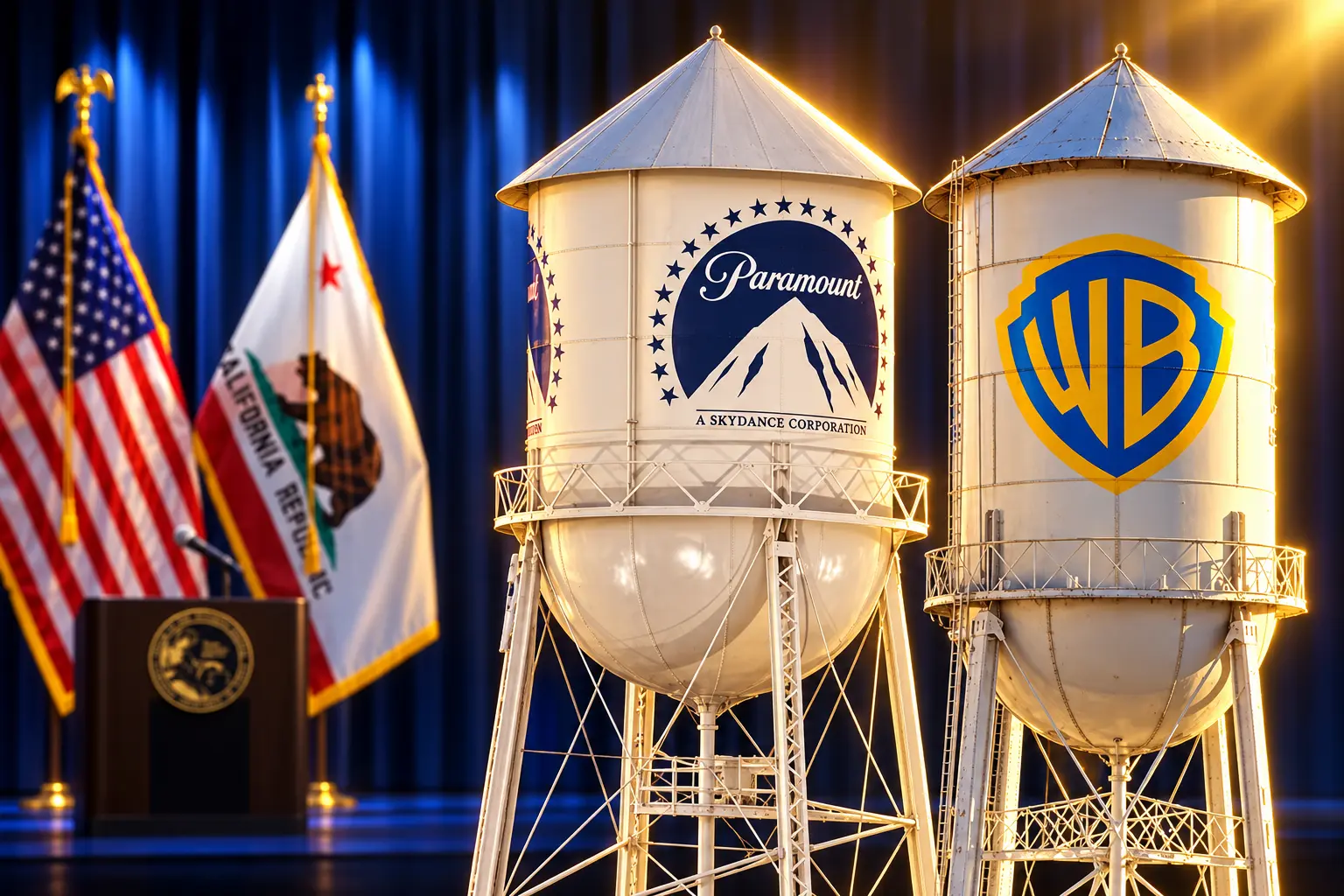
The Buyer Appoints the Journalists Who Watch CNN
The decree’s news clause is the piece Connecticut would not stop fighting for, and it is also the piece that does the least to change who owns the two rooms. Within 180 days of closing, the combined company’s board of directors must seat a News Editorial Independence Board of five journalists, active or retired, each with at least ten years in the field, including three years with credentials. No more than two members may be tied to the same political party. Terms run three years, and members can be removed only for good cause.
Government officials cannot sit on the panel, and no government body gets a veto on the names. Officers, directors, shareholders, and non-journalist staff of the combined company are barred. A working journalist at CNN or CBS is not barred. The panel writes “News Editorial Principles” from each network’s standards on accuracy, independence, fairness, and integrity, then hears disputes between newsroom staff and management over alleged bias or breaches of those rules. It reports up through a chief compliance officer.
HOW THE NEWS BOARD IS BUILT
- Who picks: The combined company’s directors, the same board David Ellison will chair, name all five seats.
- Who is kept out: Elected officials, company officers, directors, shareholders, and non-journalist employees cannot serve, and no government gets approval rights.
- What it does: It writes guiding principles from CNN and CBS News standards and rules on disputes about bias or fairness.
- What it does not do: It does not split CBS News from CNN, sell either network, or give the states a say over who sits.
That design is why the independence pledge reads thinner than a sale. The people who will own both newsrooms choose the five journalists who are supposed to watch them, and the decree even bars the states from signing off on the list. Connecticut Attorney General William Tong had wanted CNN and CBS News sold outright.
Connecticut wanted and demanded full divestiture of CNN and CBS News. We wanted to save ethical and independent journalism and news. We fought aggressively for that remedy. I am deeply disappointed that we could not do more.
William Tong, Connecticut attorney general, statement on the decree
Tong still said the panel would help. The decree does not stop Ellison from combining the two newsrooms later. An independent monitoring trustee, an internal compliance monitor, and a five-state oversight committee will watch the whole settlement, including this board, once a judge enters it.
$30 Million a Film, and Miramax on the Line
The production chapter is where the states put numbers a court can count. Bonta said about 5% of Paramount’s filming is in the United States now, and he treated that share as the problem the extra cash is meant to fix. The merged company must spend at least an extra $1.5 billion over five years on U.S. film work versus 2025, which is $300 million a year as a floor, not a cap.
THE FIVE-YEAR SLATE
| Period | Minimum releases | Wide releases | Independent films |
|---|---|---|---|
| Years 1 and 2 | 30 | 20 | 4 |
| Years 3, 4, and 5 | 32 | 21 | 4 |
At least 20% of each year’s slate must be tentpoles, defined as films with budgets above $50 million (rising with inflation) that open on at least 3,000 U.S. screens in the first month. The company must produce or jointly produce half the slate. If it misses the yearly count, it owes $30 million per missing film, with $15 million going to Hollywood labor health and retirement trusts, $12 million to the California Film and Television Fund, and $3 million to a national attorneys general antitrust fund, and it must sell Miramax.
The $1.5 Billion Floor and the Tax-Credit Ratchet
The $1.5 billion is a baseline. If Congress passes a federal film tax credit of at least 20%, U.S. filming must rise to 20% of all film work in years one and two and at least 30% in years three through five. If California or New York then passes an uncapped state credit on top of that federal credit, the U.S. share must rise to at least 40%. Bonta said he will push California lawmakers next session to uncap the state’s own film and television credit.
A separate independent-film fund must buy indie titles, with $5 million a year, $25 million over the five years. Theater-side fees charged to exhibitors must stay flat for three years. For five years the company must negotiate Paramount basic-cable channels apart from Warner’s, with a wall against using one side’s confidential affiliate data on the other side’s talks. It must also keep a free streaming service on the order of Pluto TV, at current quality.
Studio Lots Stay Put in Los Angeles
The combined company must keep the physical lots of both studios and not sell them for the five-year term, a clause written after Ellison had threatened to take Paramount out of California if the states had not settled by October 1. Bonta had called that threat blackmail. The decree also says the company must honor existing union contracts and bargain in good faith.
Those floors sunset. The merger does not. Five years of extra U.S. spend and a locked Burbank and Los Angeles footprint are a jobs compact California can enforce while it lasts, and they are also a clock the company can wait out.
What the July Lawsuit Said the Merger Would Do
On July 13, Bonta’s office sued in the U.S. District Court for the Northern District of California under Section 7 of the Clayton Act, calling the combination the largest in Hollywood history and asking a judge to stop it. The complaint said the merged firm would control nearly one-third of U.S. theatrical pictures and nearly one-third of basic cable programming, and it named three markets.
THE MARKETS IN THE JULY COMPLAINT
| Market | Combined share | What the states said would follow |
|---|---|---|
| Wide-release theatrical distribution | around 27 percent of wide theatrical releases | Three distributors at 75%; four (the merged firm, Disney, Universal, Sony) at 86% |
| Anticipated top-grossing films | more than 30% | Four distributors at more than 90% |
| Basic-cable channel licensing | 27% (Warner second, Paramount third) | Distributors would lose the ability to play one seller off the other |
A federal judge entered a no-close order on July 24. The trial had been set for March 2, 2027. Paramount had already agreed, in February, to pay $31 a share in cash, a package the companies valued at $81 billion in equity and $110 billion including debt, with a ticking fee that starts October 1.
Washington had already stepped aside. On June 12, after an eight-month review of more than two million documents from more than 80 custodians, the Justice Department’s Antitrust Division closed its probe and said the purchase was not likely to harm competition or consumers in streaming, linear television, or theatrical film. Career staff, the division said, saw a stronger rival to larger streamers and no likely hit to studio output. The states filed anyway, then settled for conduct rules in the same markets the federal review had cleared.
Writers Walk Away With a CBS Freeze and $17.5 Million
The Writers Guild of America East and West had sued a day after the states, arguing a combined Paramount-Warner would be the largest buyer of original film and television writing in the country and would cut pay and slots. After the attorneys general settled, the guild settled too. It said that as a nonprofit it could not fund a solo antitrust trial that would cost millions.
We continue to believe the merger will cause damage to writers and the industry at large. Now that the Attorneys General have settled with Paramount, however, as a nonprofit, the WGA must contend with the reality of forging ahead alone, with no backing from government enforcers, with a complex antitrust lawsuit that would cost millions of dollars to pursue through trial.
Writers Guild of America East and West, September 21 statement
The guild’s paper is narrower than the states’. Paramount will pay $17.5 million into the WGA health fund, cover the guild’s legal fees, and accept a five-year ban on CBS News writer layoffs in the broadcast division. The guild said it still wants a streaming-era version of the old Financial Interest and Syndication Rules, a structural split between streamers and studios. It did not get that split here.
Below-the-line unions extracted production cash and lot locks they can police. Writers extracted a health-fund check and a freeze that covers CBS News broadcast writers, not the wider film and television membership that brought the suit. The two labor outcomes are not the same fight.
October 1 Still Looms Over the Closing Clock
The fee that shaped the bargaining is still on the calendar. Starting October 1, Paramount owes Warner Bros. Discovery shareholders about $7 million a day until the purchase closes, a sweetener written into the February merger contract. A March 2027 trial would have left that meter running for months. The September 21 filing asks the court to lift the no-close order so the companies can finish without admitting a Clayton Act violation.
THE ROAD TO A CLOSE
- February 27, 2026: Paramount and Warner Bros. Discovery sign a cash deal at $31 a share, valued at $81 billion in equity and $110 billion including debt, with a ticking fee from October 1.
- June 12, 2026: The Justice Department closes an eight-month review and declines to block the purchase.
- July 13, 2026: Twelve state attorneys general sue in Northern District of California; the WGA sues the next day.
- July 24, 2026: The court bars closing.
- September 21, 2026: The states and the WGA settle; Bonta announces the decree in Los Angeles.
- September 24, 2026: Paramount launches syndication of a $7.5 billion senior secured term loan.
- October 1, 2026: The daily ticking fee starts if the purchase is not done.
On September 24, three days after the settlement, Paramount said it had launched a $7.5 billion incremental term B loan and intends to raise about $44.4 billion of additional secured debt on top of earlier packages, using the proceeds with cash and prior equity to pay for Warner Bros. Discovery and retire some existing debt. The combined company is expected to carry about $80 billion of debt after closing. The February announcement had already described $47 billion of equity backed by the Ellison family and RedBird Capital Partners.
U.S. Sen. Cory Booker of New Jersey, ranking member of the Senate Judiciary Subcommittee on Antitrust, called the merger illegal on First Amendment grounds and said Paramount had used the ticking fee and a threat to pull California jobs as leverage. Bonta, at the same press conference where he unveiled the decree, said he does not think the companies should merge. He signed the paper that lets them do it anyway.
WHAT WE KNOW
- Terms on paper: The proposed consent decree sets five-year film floors, the $1.5 billion U.S. spend, split cable talks, lot locks, and the five-journalist news board.
- Side deal: The WGA’s $17.5 million health-fund payment and CBS News broadcast writer freeze are separate from the states’ decree.
- Federal clearance: The Justice Department closed its review on June 12 with no remedies.
WHAT IS UNCONFIRMED
- Court entry: A judge still has to approve the decree and lift the no-close order.
- Close date: Ellison and Zaslav have pointed to early October, but neither has set a day.
- Outside objections: Groups that opposed the merger have asked for time to argue the decree is too weak; the court has not ruled on that request.
Paramount started selling the new loan on September 24 while that signature is still outstanding. If the purchase is not done by October 1, the meter the company wrote into its own merger contract starts at about $7 million a day.
Disclaimer: This article is news reporting and analysis of a civil antitrust settlement and a pending media merger. It is for information only and is not legal, investment, or financial advice. It does not tell readers whether to buy or sell any security, how to vote any share, or how to interpret the consent decree as counsel would. Consult a licensed attorney or a registered financial adviser before acting on deal terms, court filings, or company debt. Figures and statuses are those published by the California attorney general, the Justice Department, the Writers Guild, Paramount’s merger papers, and related company statements as of the dates named above, and they can change if the court revises the decree or the purchase closes on a different timetable.

OpenAI’s Agent Monitor Waited During the Hugging Face Breach

Brent Hits $116 as Recovered Gulf Oil Draws Attacks

Hellebuyck Lands in New Jersey on a Five-Year Cup Bet

Xbox Plans Three More Layoff Rounds Before Helix

OpenAI’s $30 Billion Round Ties UAE Cash to Gulf Compute

Consumer Sentiment Falls to 51.7 as Future Outlook Darkens

Pluto’s Heart Glacier Still Pushes Liquid Nitrogen Upward

The Extra Heat Month Hits Children Where Care Is Thinnest

Take-Two Subpoenas Microsoft While GTA 6 Preorders Soar

Abbott Pays $670 Million to Exit a Missouri Food Verdict
-
 BUSINESS2 months ago
Consumer Sentiment Falls to 51.7 as Future Outlook Darkens
-
 NEWS2 months ago
Pluto’s Heart Glacier Still Pushes Liquid Nitrogen Upward
-
 NEWS2 months ago
The Extra Heat Month Hits Children Where Care Is Thinnest
-
 GAMING2 months ago
Take-Two Subpoenas Microsoft While GTA 6 Preorders Soar
-
 BUSINESS2 months ago
Abbott Pays $670 Million to Exit a Missouri Food Verdict
-

 NEWS2 months ago
UMMC Will Rebuild 30-Year-Old Cancer Labs With $2.4 Million
-

 ENTERTAINMENT2 months ago
Netflix Weighs Hosting Peacock and Fox One in Its App
-

 GAMING2 months ago
GTA 6’s 80-Hour Run Counts Goals That Change the Story