

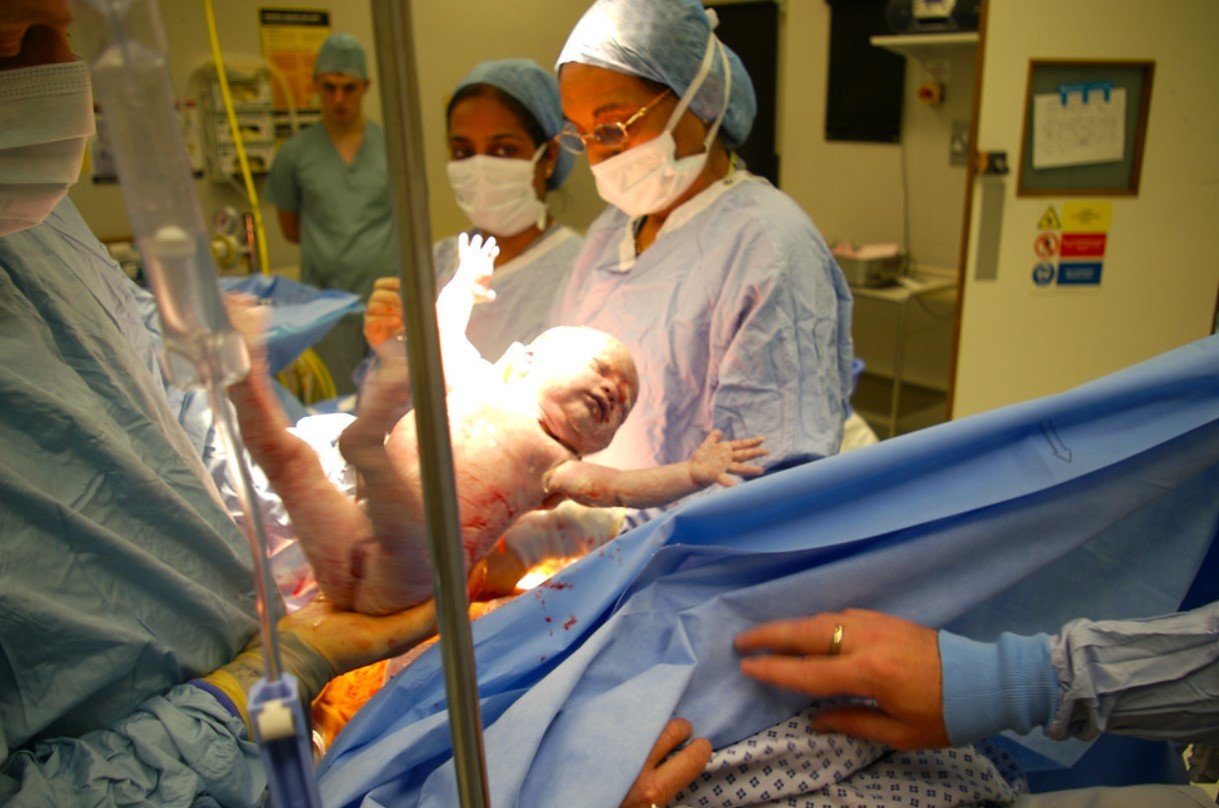
India has one of the highest rates of cesarean section deliveries in the world, but a new study suggests that following the World Health Organization’s guidelines can help improve women’s care during childbirth and lower the number of unnecessary C-sections.
The Problem of High C-Section Rates in India
Cesarean section, or C-section, is a surgical procedure to deliver a baby through an incision in the mother’s abdomen and uterus. It can be a lifesaving intervention when there are complications or risks during labor or delivery, such as fetal distress, breech position, or placenta previa.
However, C-section can also have negative consequences for the mother and the baby, such as increased bleeding, infection, pain, scarring, and longer recovery time. It can also affect the future pregnancies and births, such as increasing the chances of placenta accreta, uterine rupture, and stillbirth.
According to the latest National Family Health Survey (NFHS-5), India’s C-section rate has increased from 17.2% in 2015-16 to 21.1% in 2019-20, which is higher than the global average of 18.6%. The WHO recommends that the C-section rate should be between 10% and 15%, as there is no evidence of additional benefits beyond this range.
The reasons for the high C-section rate in India are complex and multifactorial, such as the lack of skilled birth attendants, the preference for painless delivery, the fear of litigation, the financial incentives, and the social and cultural factors.
The Solution of WHO Guidelines for Childbirth Care
The WHO has developed and published a set of guidelines to improve the quality of intrapartum care and enhance women’s childbirth experiences. The guidelines are based on the best available scientific evidence and the human rights principles, and they cover various aspects of care, such as labor monitoring, pain relief, labor induction, labor augmentation, and C-section.
One of the key recommendations of the WHO guidelines is to change the definition of active first stage of labor from the widely used 3 centimeter (cm) or 4 cm to starting from 5 cm of cervical dilation. This is because the historical ‘1 cm per hour’ rule for labor progress is unrealistic and inaccurate for most women, and it can lead to unnecessary interventions, such as C-section, when the labor is slower than expected.
Another key recommendation of the WHO guidelines is to remove the ‘alert’ and ‘action’ lines from the partograph, which is a graphical tool to record and monitor the labor progress. The partograph was originally designed to identify and prevent prolonged and obstructed labor, but it has been misused and overused to justify C-sections, especially in low-resource settings.
The WHO has also developed a ‘next generation’ partograph, known as the Labor Care Guide (LCG), which is a simplified and user-friendly tool that focuses on the woman’s well-being and preferences, rather than the numerical measurements and time limits.
The Impact of WHO Guidelines on C-Section Rates in India
A pilot study, conducted by researchers from India, Australia, and Argentina, has evaluated the implementation and effectiveness of the WHO LCG in four hospitals in India. The study, published in the journal Nature Medicine, is the world’s first randomized trial of the WHO LCG, and it involved 1,000 women who were admitted for labor and delivery.
The study found that the use of the WHO LCG reduced the C-section rate by 10.5%, from 30.9% in the control group to 20.4% in the intervention group, without compromising the maternal and neonatal outcomes. The study also found that the use of the WHO LCG improved the women’s satisfaction and empowerment, and the health workers’ confidence and competence.
The study concluded that the WHO LCG is a feasible and effective strategy to improve the quality of care and reduce the unnecessary C-sections in India, and it can be implemented in busy and resource-limited settings. The study also suggested that the WHO LCG can be scaled up and adapted to other contexts and countries, where the C-section rates are high and rising.



![gain Rise in Gold Rate in India After Falling Rs 21,200/24K; Will Gold Price Today Jump or Drop on 28 March? By Harshika Yadav Published: Saturday, March 28, 2026, 6:55 [IST] preference Add as a preferred source on Google Gold rates in India witnessed a modest recovery on March 27, 2026, after a sharp fall in the previous session, indicating a cautious stabilisation in the bullion market. The yellow metal had dropped by Rs 212 per gram (or Rs 21,200 per 100 grams) of 24 Karat (24K) earlier, but managed to regain some ground. Gold Price Updates as US-Iran Tensions Ease; Pakistan, Turkiye & Egypt Step Up Mediation Efforts The rise in yellow metal follows easing geopolitical concerns after US President Donald Trump signalled a delay in potential military action against Iran's energy infrastructure by 10 days, pushing the deadline to April 6. This development, along with ongoing diplomatic efforts, has helped support safe-haven demand. gold Rate Today Further adding to market sentiment, Pakistan's Foreign Minister Ishaq Dar confirmed that Islamabad is acting as an intermediary between the United States and Iran, relaying messages as part of efforts to de-escalate tensions. Countries like Türkiye and Egypt are also reportedly supporting the mediation process, offering some relief to global financial markets. Gold Rate in India: Check Latest 22K, 24K & 18K Gold Prices Per Gram 24 Karat Gold Rate Today in India In the 24 Karat segment, at the time of writing, the rate for 1 gram stood at Rs 14,471, rising by Rs 16 from Rs 14,455. For 8 grams, the price increased to Rs 1,15,768, up by Rs 128. The rate for 10 grams climbed to Rs 1,44,710, reflecting a gain of Rs 160, while 100 grams of 24 Karat gold were priced at Rs 14,47,100, marking an increase of Rs 1,600. 22 Karat Gold Rate Today in India The price of one gram of 22K stood at Rs 13,265, gaining Rs 15 from the previous session. For 8 grams, the rate rose to Rs 1,06,120, registering an increase of Rs 120. The cost of 10 grams advanced to Rs 1,32,650, up by Rs 150, while 100 grams were priced at Rs 13,26,500, reflecting a gain of Rs 1,500. 18 Karat Gold Rate Today in India The rate for one gram of 18K stood at Rs 10,853, up by Rs 12. For 8 grams, the price moved up to Rs 86,824, marking a gain of Rs 96. The rate for 10 grams climbed to Rs 1,08,530, increasing by Rs 120, while 100 grams were valued at Rs 10,85,300, reflecting an uptick of Rs 1,200. Latest MCX Gold Price In the domestic futures market, gold on the Multi Commodity Exchange (MCX) held firm above the Rs 1,44,500 level as per latest trading record, supported largely by the weakness in the Indian rupee, which continues to cushion local prices despite global volatility. Latest Spot Gold Rate The rebound in domestic gold rates comes alongside a recovery in international markets, where gold moved above the $4,400 per ounce mark. What Lies Ahead for Gold Prices? Check Gold Rate Prediction Jateen Trivedi, VP - Research Analyst (Commodity and Currency), LKP Securities, said, "Gold remained slightly positive, trading above $4,425 with highs near $4,475, supported by initial optimism around US-Iran talks. However, the sharp rise in crude continues to signal underlying market stress and inflation risks." From a technical perspective, he explained, "Technically, support is seen near Rs 1,42,000, while resistance is placed around Rs 1,46,500. Overall, gold is expected to remain volatile with limited upside unless clarity emerges on inflation and geopolitics."](https://keralanews247.com/wp-content/uploads/2026/03/rupee-and-dollar-scaled-120x86.png)