
AUTO
Tesla Stages a Hover as the Roadster Finally Appears
Tesla set October 1 in Waco for a remote Roadster hover on SpaceX thrusters, a show that still is not the street car reserved in 2017.

Tesla has locked October 1 for a Roadster reveal in Waco, Texas, built around a remote hover on SpaceX cold-gas thrusters. The automaker’s own post said “Go for launch.” The machine that leaves the ground is still not the street car Tesla sold to reservation holders in 2017.
Elon Musk followed with “New Tesla Roadster Unveil 10.01” and called the night “out of this world.” Production, by his own last public estimate, remains in 2027 or 2028.
A Countdown Clock and a Pad in Waco
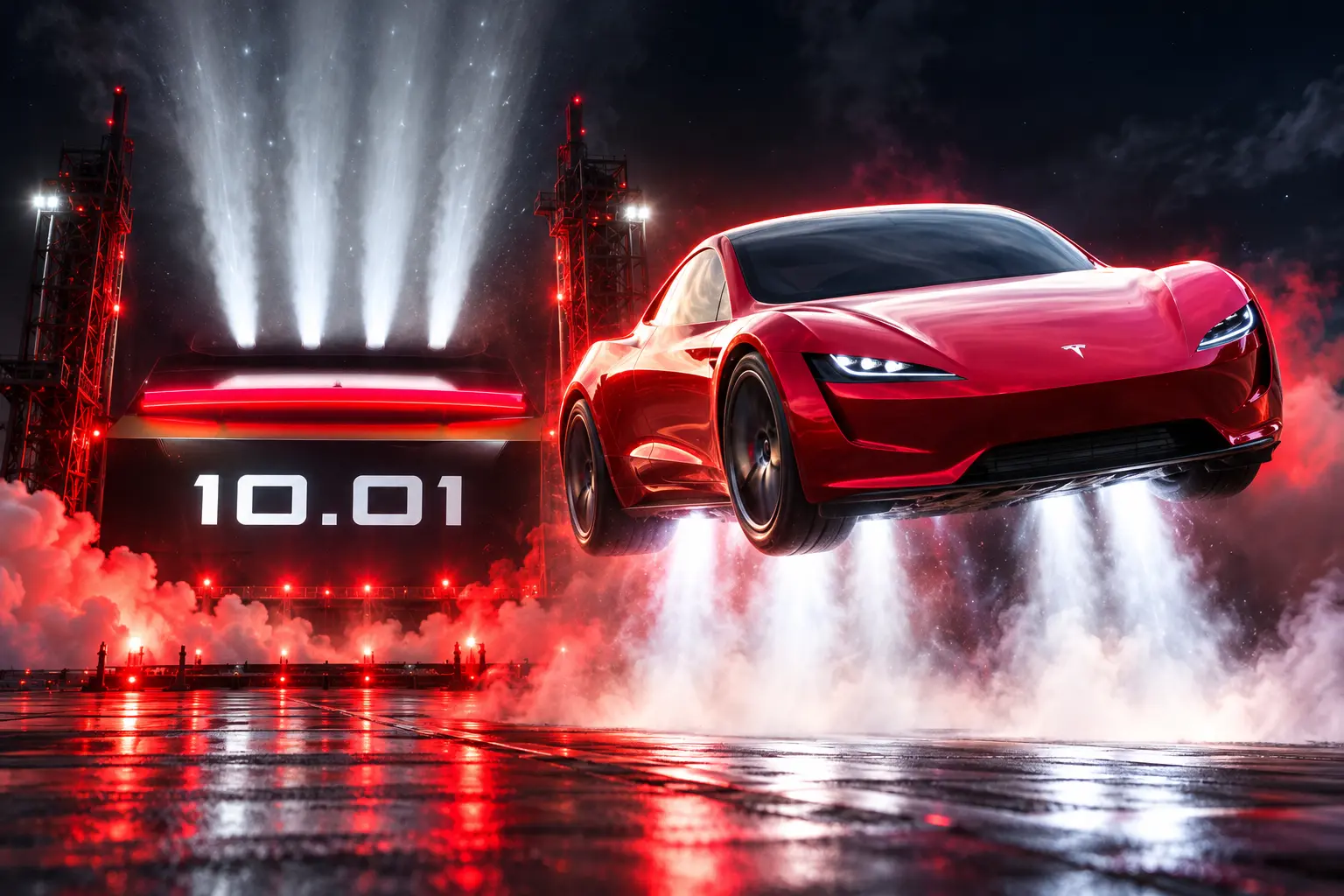
Tesla posted the teaser on September 12, a red car under vertical light that reads like a rocket pad, stamped 10.01. A live countdown clock on Tesla’s Roadster page now ticks toward the same date. Formal invitations went to reservation holders for Waco, about 90 minutes north of Tesla’s Austin headquarters, with the program set for 8:30 p.m. Eastern. RSVPs were due by September 16. Entry is limited to guests 21 and older, and the tickets are non-transferable.
Go for launch pic.twitter.com/Khu03eiZ04
— Tesla (@Tesla) September 12, 2026
Tesla has not named a hall or a stream. Waco sits close to SpaceX’s McGregor engine-test facility, a 4,000-acre site about 90 miles north of Austin where the company already hovers hardware. SpaceX’s own Crew Dragon hover test at McGregor in 2016 held a spacecraft on SuperDraco thrusters for five seconds. Putting a car event next to that pad is the point of the night, not a side detail.
People close to the program have described the hover itself as a remote run with nobody in the cabin. Spectators are to be held hundreds of yards back because the thrusters are loud enough to damage hearing. That is a rocket-test layout. It is not a sports-car launch with a driver waving from the window.
The Machine That Lifts Off Is Not a Street Car
The 2017 prototype was sold as a four-seat production car you could, in theory, register and drive. The October 1 car is a different object. Tesla has discussed a limited, non-street-legal run sold to a handful of superfans through a track program in the Ferrari customer-racing style, at a price likely in the hundreds of thousands of dollars. The rear seats on the thruster package give way to a high-pressure tank. The cabin for the hover is empty on purpose.
2017 PROMISE VERSUS THE OCTOBER 1 CAR
| Item | 2017 Tesla promise | October 1 machine |
|---|---|---|
| Role | Production street car | Remote hover demonstrator |
| Driver | Person in the cabin | None, remote control |
| Street legal | Yes, as sold | No |
| Seating | 4 | Rear seats replaced by a tank on the thruster package |
| Base price | $200,000 | Hundreds of thousands, track program |
| 0-60 mph | 1.9 seconds | 1.1 seconds, Musk’s thruster claim |
| Build start | 2020 | 2027 or 2028 |
Musk has said a thruster-equipped Roadster could hit 60 mph in 1.1 seconds under about 2.75 g. That figure is a claim for the SpaceX package, not a timed run Tesla has published from a production car. The base car was always quoted at 1.9 seconds. Both numbers can sit on a slide. Only one of them was ever a street-car promise.
SpaceX Tanks Take the Place of Rear Seats
The SpaceX package, internally called A71, uses cold-gas thrusters fed by a composite-overwrapped pressure vessel, the same family of carbon-wrapped tanks SpaceX flies on Falcon 9. Musk told reviewer Marques Brownlee the system would use “ultra high pressure air in a composite over-wrapped pressure vessel in place of the 2 rear seats.” There is no combustion. Compressed gas dumps through nozzles. Rear jets add launch shove. Side jets are meant to help with cornering and braking on a closed course.
A second system is on paper and it is not a rocket. Tesla’s adaptive downforce patent granted in August 2025, filed April 29, 2025, describes four fans (two central, two outboard) and deployable skirts that seal the underbody and suck the car to the pavement. The teaser’s four plumes can be read as either hardware. They are not the same device. Fans pull the car down. Thrusters push it up or forward. The informed fight on X is exactly that split: some watchers now argue the fan-and-skirt patent is the on-road trick, and the plumes are the show.
WHAT THE HOVER DEMO ACTUALLY REQUIRES
- Empty cabin: The car is to be driven by remote control with zero people inside.
- Stand-off crowd: Observers stay hundreds of yards back because the noise can damage hearing.
- Cold-gas pack: SpaceX-built nozzles and a composite tank take the space of the rear seats.
- No plates: The thruster car is not street legal and is aimed at a track-only client list.
The demo has already shrunk once. People familiar with the program said Tesla started closer to an aircraft stunt, including a magnetized ramp and an upside-down run, and ended with a brief hover. A former Tesla president, Jon McNeill, who ran the company from 2015 to 2018, put it in milder words: he did not know if the night would show flying, “but we may see hovering in this demo.”
What Tesla Put on the Spec Sheet in 2017
The second-generation Roadster rolled out of a Tesla Semi on November 16, 2017, in Hawthorne, California. Musk called it “the fastest production car ever made, period,” and said the point was “a hardcore smackdown on gasoline cars.” Tesla’s 2018 Roadster specification sheet still carried those numbers months later: 1.9 seconds to 60 mph, 4.2 seconds to 100 mph, a quarter mile in 8.8 seconds, a top speed over 250 mph, 10,000 Nm of wheel torque, 620 miles of range, four seats, all-wheel drive. Base price was $200,000. A standard reservation was $50,000. The Founders Series was $250,000, capped at 1,000 cars.
Tesla also talked up a 200 kWh pack, large enough, Musk said, to drive from San Francisco to Los Angeles and back without charging. Production was supposed to start in 2020. It did not. The same public page now holds a countdown instead of a build slot.
THE DATES TESLA MOVED
- November 16, 2017: Prototype unveil. Production promised for 2020.
- 2018: Musk adds a SpaceX cold-gas thruster option of about 10 small jets.
- 2020 to 2024: The start year slides through 2022, 2023, 2024 and into 2025.
- November 2025: Musk sets a demo for April 1, 2026, a date he said gave him “deniability,” and puts production 12 to 18 months later, in 2027 or 2028.
- April to June 2026: The demo slips to late April, then to August, as thruster work continues.
- September 12, 2026: Tesla posts “Go for launch” and points at October 1 in Waco.
That is at least eight missed targets on one car. From the Hawthorne night to Waco is 8 years, 10 months and 15 days, nearly nine years with no customer car.
The $250,000 Founders Series Still Has No Car
One thousand Founders Series reservations at $250,000 is $250 million paid up front. Tesla’s own terms called the money refundable until a purchase agreement is signed. Getting it back has still been a grind. Standard U.S. reservations in 2017 were $50,000. Tesla’s Australian page now asks for $7,000 on a card and $59,000 by wire within ten days, $66,000 in all. In France the same two-step is €4,000 plus €39,000, or €43,000. The forms stayed open through every delay.
Marques Brownlee reserved two cars in 2017, one paid and one as a referral reward. On his Waveform podcast in September 2025 he said he cancelled the paid slot after Tesla had been sitting with his $50,000 for eight years and had done nothing with it. He expected $45,000 back and to lose a $5,000 deposit. OpenAI chief executive Sam Altman, who reserved in 2018, hit a dead mailbox when he asked for a refund in October 2025.
I really was excited for the car! And I understand delays. But 7.5 years has felt like a long time to wait.
Sam Altman, chief executive of OpenAI, on X
Musk answered that the refund went through within 24 hours after the posts. At the November 2025 shareholder meeting he said inviting Founders Series buyers to the reveal was “the least we can do for our long-suffering Roadster reservation holders.” Those are the people Tesla is now flying into Waco. They paid first. They still have no car. The night they are invited to watch is a remote hover they will not sit in.
Why the Hover Has to Carry a Merger Story
McNeill called the Roadster “a probably not-so-hidden attempt to further knit Tesla and SpaceX’s futures together,” and said the two companies “are going to come together, probably sooner rather than later.” Shared tanks, shared test land, and a car that makes rocket noise are a single picture for investors who have been asked to treat Tesla as more than an automaker. The hover is the prop that makes that picture visible in one frame.
I don’t know if we’re going to see flying, but we may see hovering in this demo.
Jon McNeill, Tesla president 2015 to 2018
The louder problem is still the product calendar. Musk’s last numbered production window is 2027 or 2028, 12 to 18 months after a demo he originally pinned to April 1. October 1 does not, on its own, pull that window forward. Tesla can light four plumes in Waco and still owe a four-seat, 620-mile car at $200,000 to people who wired money in 2017. The countdown on the website is real. The street car is not on the pad.
If the car lifts a few feet on cold gas, with the crowd behind a safety line, Tesla will have shown that SpaceX hardware can be bolted to a Roadster body. Reservation holders will go home with that image and the same wait they brought with them.
Disclaimer: This article is news reporting and analysis of Tesla’s announced October 1 Roadster event, reservation terms, and related company statements. It is informational only and is not investment advice, a solicitation to buy or sell Tesla or SpaceX securities, or a recommendation to place, keep, or cancel a vehicle reservation. Readers who are considering a deposit, a cancellation, or a trade tied to these companies should consult a licensed financial adviser and, for contract questions, a qualified attorney. Figures, dates, and program details reflect the company pages, patents, and public remarks cited here and can change after the event.

OpenAI’s Agent Monitor Waited During the Hugging Face Breach

Brent Hits $116 as Recovered Gulf Oil Draws Attacks

Hellebuyck Lands in New Jersey on a Five-Year Cup Bet

Xbox Plans Three More Layoff Rounds Before Helix

OpenAI’s $30 Billion Round Ties UAE Cash to Gulf Compute

Consumer Sentiment Falls to 51.7 as Future Outlook Darkens

Pluto’s Heart Glacier Still Pushes Liquid Nitrogen Upward

The Extra Heat Month Hits Children Where Care Is Thinnest

Take-Two Subpoenas Microsoft While GTA 6 Preorders Soar

Abbott Pays $670 Million to Exit a Missouri Food Verdict
-
 BUSINESS2 months ago
Consumer Sentiment Falls to 51.7 as Future Outlook Darkens
-
 NEWS2 months ago
Pluto’s Heart Glacier Still Pushes Liquid Nitrogen Upward
-
 NEWS2 months ago
The Extra Heat Month Hits Children Where Care Is Thinnest
-
 GAMING2 months ago
Take-Two Subpoenas Microsoft While GTA 6 Preorders Soar
-
 BUSINESS2 months ago
Abbott Pays $670 Million to Exit a Missouri Food Verdict
-
 NEWS2 months ago
UMMC Will Rebuild 30-Year-Old Cancer Labs With $2.4 Million
-

 ENTERTAINMENT2 months ago
Netflix Weighs Hosting Peacock and Fox One in Its App
-

 GAMING2 months ago
GTA 6’s 80-Hour Run Counts Goals That Change the Story