
AUTO
California Locks Waymo Off Freeways After a Recalled Defect
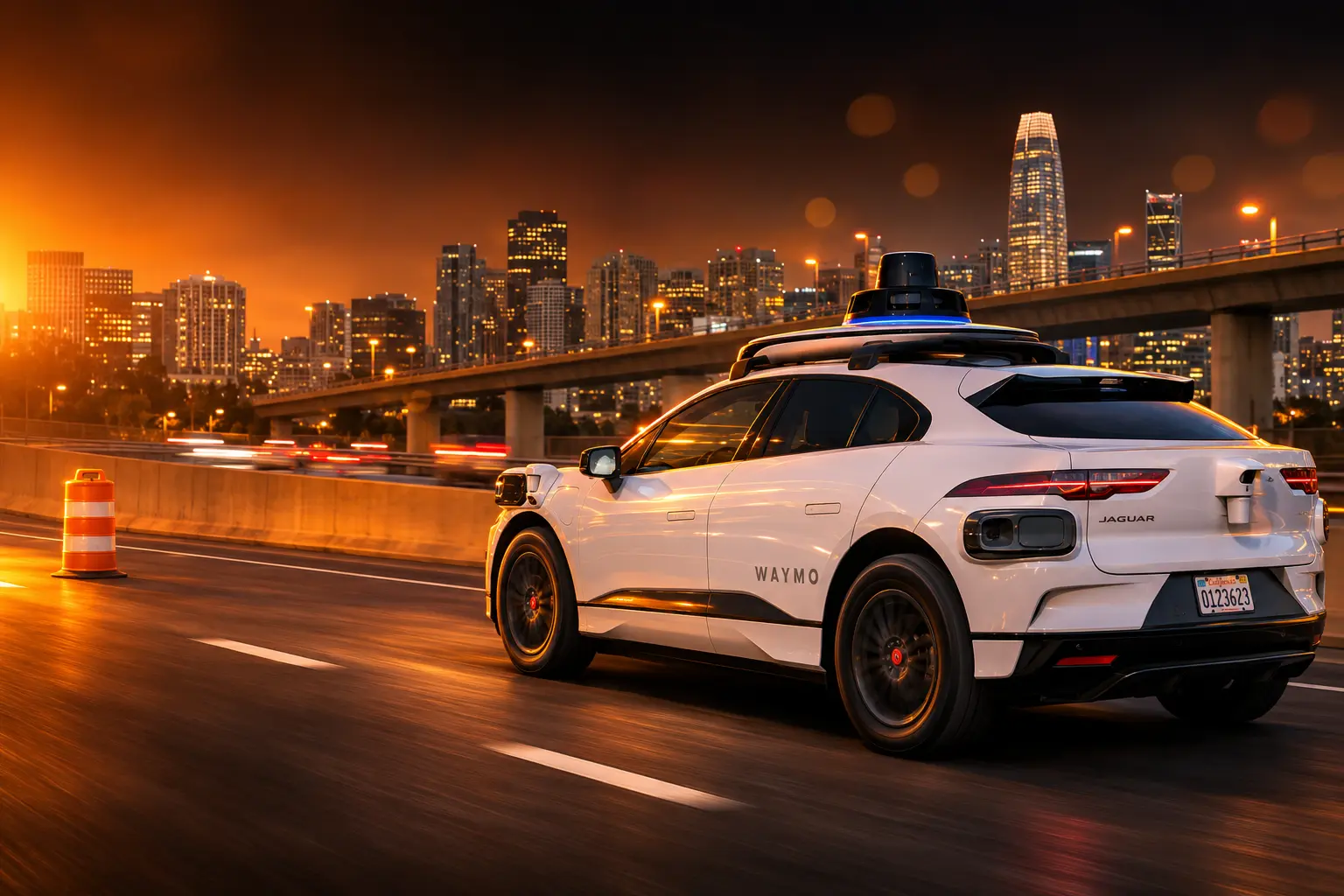
California’s DMV locked Waymo off freeways on November 11 after robotaxis repeated a construction-zone defect the company had already recalled and tried to patch.

The California DMV barred Waymo robotaxis from every state freeway on November 11, calling driverless highway operations an imminent hazard to public safety.
The trigger was a live U.S. 101 construction closure and a Highway Patrol traffic break on Highway 280, the same class of miss Waymo recalled in June and tried to patch before restoring freeway rides in July.
Three Robotaxis Drove Into a Closed Stretch of 101
Three driverless Waymos entered an active construction closure on U.S. 101 near Burlingame in the days before the order. A separate car on Highway 280 in San Francisco tried to go around California Highway Patrol units running a traffic break.
Video from that 280 incident shows CHP cars with emergency lights on, escorting a construction vehicle. An officer cut the Waymo off. The robotaxi stayed close and tried to pass again. Jonathan Groveman, a California DMV spokesperson, said both events fed the order, and that they came after prior limits and fixes that followed similar incidents on May 18, 2026.
The Department determined that Waymo’s driverless freeway operations pose an imminent hazard to public safety due to recurring incursions by its vehicles into active construction zones where construction workers, vehicles and equipment are present, despite a prior restriction and corrective actions implemented following similar incidents that occurred on May 18, 2026.
Jonathan Groveman, spokesperson, California DMV
Dana Gallagher, a Waymo spokesperson, said the 101 construction-zone encounters involved no injuries and no collisions. The company is pausing freeway riding in every other market as well, she said, while street hailing continues.
WHAT WE KNOW
- The order: The DMV modified Waymo’s permits on November 11 and disclosed the lock on Tuesday, November 17.
- The 101 event: Three robotaxis entered a closed, active work zone near Burlingame.
- The 280 event: One robotaxi tried to pass a CHP traffic break with lights flashing.
- The reach: California forbids driverless freeway operation and testing; Waymo has also paused freeway service in other states.
WHAT IS UNCONFIRMED
- Exact November dates: Officials have not posted a public incident log with calendar days for the 101 and 280 events.
- A return date: The DMV has not set a clock for when freeway riding may restart.
- The software stack: Waymo has not said whether the November cars were running the July construction-zone update in full.
The crash-rate argument that usually protects Waymo does not cover this. Sam Abu Al Saad, a transportation analyst at Telemetry, said the cars are not reading construction zones and emergency vehicles the way they need to. Ranking robotaxis against drunk or distracted humans misses that point. The DMV is policing a repeated closed-zone path, not issuing a general safety score.
NHTSA Already Had This Construction Defect on File
On May 18, seven Waymo robotaxis in the San Francisco Bay Area drove into freeway lanes under active construction. Waymo’s own filing says the software was “prioritizing the avoidance of other freeway hazards and/or failing to recognize the construction zone,” and that the cars went between cones that marked a closed adjacent lane. The company pulled every robotaxi off highways the next day, May 19.
That Bay Area day was not the first. Waymo’s Field Safety Committee had already reviewed Phoenix events on April 11 and April 19, when cars “did not recognize and drove past ramp closure signs into pre-planned freeway construction zones.” Six Phoenix cases plus the seven Bay Area cases made 13 known closed-zone entries before the summer recall.
Elliot Slade, a rider in one May incident, said the scene was already marked. “There were construction signs,” he said. “There were lights going on. Police in the distance and it sped up. That’s when I looked at my fiancée, we’re done. This is it. We’re dead. We’re going to die right here in the Waymo.”
Waymo’s safety board voted on June 8 to treat the behavior as a recall. The company filed Part 573 report 26E035 with the National Highway Traffic Safety Administration on June 17, covering 3,871 fifth-generation driving systems built to run driverless on freeways. Production of those systems ran from March 17, 2022, through May 19, 2026. NHTSA’s acknowledgment letter says driving through a closed construction zone raises the risk of a crash.
CONSTRUCTION ENTRIES IN 2026
| When | Where | What the cars did | Vehicles |
|---|---|---|---|
| April 11 and April 19, 2026 | Phoenix | Drove past ramp-closure signs into planned freeway work zones | 6 |
| May 18, 2026 | San Francisco Bay Area | Drove between cones into live construction lanes | 7 |
| Days before November 11, 2026 | U.S. 101 near Burlingame | Entered a closed, active construction zone | 3 |
| Days before November 11, 2026 | Highway 280, San Francisco | Tried to pass a CHP traffic break | 1 |
The April and May counts are the 13 cases in the federal recall. The November 101 and 280 events sit after that filing, and after the software Waymo said would fix this class of miss.
Under certain circumstances, the AV may enter and drive at speed in freeway construction zones due to inappropriately prioritizing the avoidance of other freeway hazards and/or failing to recognize the construction zone.
Waymo LLC, Part 573 Safety Recall Report 26E035, National Highway Traffic Safety Administration
As of that June filing, Waymo said its cars had driven more than 170 million miles without a driver and claimed a 13-times cut in serious-injury-or-worse crashes against human drivers. Federal crash files still show the rate per million miles falling. In 2025, the raw count of Los Angeles crashes involving Waymo cars tripled as more vehicles went out. Those two facts can sit together. A falling rate does not score a car that threads cones at highway speed.
After a 71-Day Pause, Freeway Rides Restarted in Phoenix
Waymo put freeway rides back on the road on July 29, starting in Phoenix, its first driverless market. Los Angeles and the Bay Area were next, with Miami also on the restart. The company said it was “resuming freeway operations across its entire service area, including areas with construction, after implementing software updates designed to improve performance around freeway construction zones.” The updates, it said, added better scene recognition and routing.
The pause from May 19 to July 29 ran 71 days. Riders had already learned what freeway access was worth. Public freeway trips began in November 2025 in Phoenix, Los Angeles and the Bay Area, a step Waymo used to sell shorter airport runs and peninsula commutes. When the cars left the freeway in May, people asked where the fast option had gone. In July the company invited riders to join an interest list in the app for highway trips.
The July message was that construction was now in the model, not an edge case. The November 11 order is the state’s reply. A voluntary pause can be lifted by the same safety board that called it. An imminent-hazard limit on a California deployment permit cannot.
Surface Streets Still Carry Over Half a Million Weekly Trips
The California order hits driverless freeway operation and testing. It does not take Waymo off city streets. Gallagher said street service still handles over half a million trips each week, and that the company is working with the DMV and other state officials to restore freeway running. Waymo also said it will keep freeway testing with trained specialists while the driverless ban holds.
Chris Bonelli, another Waymo spokesperson, said more than 1,300 vehicles are running in the San Francisco Bay Area. The Los Angeles fleet is more than 1,000 robotaxis on its own. Commercial riding now covers 15 U.S. cities in eight states, with mapped growth still listed toward Sacramento and Cloverdale. San Diego riding was already street-only, so the freeway lock does not change that market’s product.
WHAT STILL RUNS
- Street hailing: Over half a million trips a week continue on surface streets.
- California fleets: More than 1,300 cars in the Bay Area and more than 1,000 in Los Angeles stay in service off the freeway.
- The platforms: The state lists Jaguar, Zeekr and Hyundai robotaxis for driverless work at all hours, in rain and fog, on approved maps.
- Specialist testing: Waymo says trained crews can still take freeways while rider service cannot.
Alphabet still holds the largest robotaxi network. Amazon’s Zoox and Tesla are putting their own driverless products on streets. A freeway ban does not end that race. It does take the high-speed part of Waymo’s California product offline until Sacramento says the construction and emergency-vehicle gaps are closed.
Riders Lose the Fast Road to the Airport
Freeway access is how a robotaxi competes with a human driver on a long trip. In the Bay Area the service area runs from San Francisco south into Silicon Valley. Trips across the Peninsula that used to take 45 minutes, or more than an hour, on surface streets got shorter once the cars could take 101 and 280. Airport runs sit in that same bundle. Those are the rides that drop first.
The people the DMV named in the hazard finding are not the riders. They are crews inside closures, with trucks and gear on live lanes, and officers trying to hold a traffic break. A robotaxi that treats cones as optional, or treats a lit CHP line as a gap, puts those workers in the path. That is a different harm from a fender-bender logged in a crash-rate table.
WHO LOSES THE FREEWAY
- Airport and Peninsula riders: The fast 101 and 280 paths are off the menu until the DMV signs off.
- Phoenix and Miami riders: Waymo’s own national pause pulls highway trips in markets California does not regulate.
- Work-zone crews: The state’s finding is that repeated entries put workers, vehicles and equipment at risk.
- CHP traffic breaks: The 280 clip is the emergency-vehicle test the July software was supposed to pass.
Human drivers fail those tests every day, and the DMV still prints licenses for them. That complaint is fair as far as it goes, and it is the wrong comparison for a recalled software path that returned. A person can be ticketed on the shoulder. A driverless fleet that repeats the same cone-gap needs a permit change, which is what November 11 is.
What Waymo Must Prove to Get Freeways Back
The DMV says the lock stays until Waymo shows “effective corrective actions.” Before freeway riding resumes, the company must give enough evidence that the cars can detect and respond to construction zones, emergency vehicles, and other roadway situations inside the roads they are allowed to drive. The department reviews that packet. Waymo does not get to declare the fix complete on its own, as it did in July.
California already wrote sharper tools for this fight. On April 28, the DMV adopted rules that let officers cite companies for moving violations committed by their cars, require a reply to first responders within 30 seconds, and let local emergency officials push a geofence that robotaxis must leave within two minutes. The November order sits on top of that stack. It is not a surprise raid. It is the construction-zone chapter of a rulebook the state spent the spring tightening.
THE 2026 FREEWAY TIMELINE
- November 2025: Opens public freeway rides in Phoenix, Los Angeles and the Bay Area.
- April 11 and April 19, 2026: Six Phoenix robotaxis pass ramp-closure signs into planned work zones.
- May 18, 2026: Seven Bay Area robotaxis drive between cones into live construction lanes.
- May 19, 2026: Halts freeway driving in every market.
- June 17, 2026: Files NHTSA recall 26E035 on 3,871 freeway-capable driving systems.
- July 29, 2026: Restarts freeway rides in Phoenix, then Los Angeles, the Bay Area and Miami.
- November 11, 2026: California DMV bars driverless freeway operation and testing as an imminent hazard.
- November 17, 2026: The order is made public; Waymo extends the freeway pause to other states.
The May pause lasted 71 days and ended when Waymo said the software was ready. The November lock has no such off switch inside the company. Gallagher’s line is that Waymo is working “diligently and responsibly” to resume. Street hailing goes on. Specialist testing goes on. Rider trips on 101 and 280 do not, until the DMV says the cones and the patrol lights are in the model for good.

Baker Mayfield’s Foot Strain Tests Tampa’s Run-First Formula

Measles Turns Endemic After the US Loses Elimination Status

California Locks Waymo Off Freeways After a Recalled Defect

Aidan Hutchinson’s Season Ends on a Celebration Jump in Munich

Super El Niño Hits Food Systems Already Under Strain

Consumer Sentiment Falls to 51.7 as Future Outlook Darkens

Pluto’s Heart Glacier Still Pushes Liquid Nitrogen Upward

Take-Two Subpoenas Microsoft While GTA 6 Preorders Soar

The Extra Heat Month Hits Children Where Care Is Thinnest

Netflix Weighs Hosting Peacock and Fox One in Its App
-
 BUSINESS3 months ago
Consumer Sentiment Falls to 51.7 as Future Outlook Darkens
-
 GAMING3 months ago
Take-Two Subpoenas Microsoft While GTA 6 Preorders Soar
-
 NEWS3 months ago
Pluto’s Heart Glacier Still Pushes Liquid Nitrogen Upward
-
 NEWS3 months ago
The Extra Heat Month Hits Children Where Care Is Thinnest
-
 ENTERTAINMENT3 months ago
Netflix Weighs Hosting Peacock and Fox One in Its App
-

 NEWS3 months ago
FDA Clears Rasonque and Widens Who Can Take It
-
 NEWS3 months ago
UMMC Will Rebuild 30-Year-Old Cancer Labs With $2.4 Million
-

 BUSINESS3 months ago
Abbott Pays $670 Million to Exit a Missouri Food Verdict