
NEWS
Spain Train Crash Kills 68 After a Restart Order
Spain’s second Renfe-Iryo high-speed crash of 2026 killed at least 68 after a control centre sent a train into a stopped rival.

A Renfe high-speed train struck a stopped Iryo service near Urda on 28 October, killing at least 68 people. Castilla-La Mancha president Emiliano García-Page said 24 of the dead were on the state AVE and 44 were on the private train. It was the second deadly crash this year on the Madrid-Seville line, and it involved the same two operators.
Transport minister Óscar Puente said a 1992 train-protection system dropped out, the trains stopped as designed, and a controller then told the AVE to run at normal speed toward a red signal. Prime Minister Pedro Sánchez called two high-speed disasters in one year unacceptable for Spain.
Two High-Speed Trains Collided at 8:53
The impact came at kilometre 118, between Los Yébenes and Urda in Toledo province, on the line that takes trains from Madrid to Seville and the rest of Andalusia. Adif, the state company that owns the track, placed the wreck on that marker, and Iryo used the same point in its statement.
La incidencia ha ocurrido entre Mora y Orgaz y Urda, en el PK 118, entre un tren de Renfe y otro de la compañía Iryo, que cubrían el trayecto Madrid-Sevilla.
— INFOAdif (@InfoAdif) October 28, 2026
Iryo service 6076 had left Madrid Puerta de Atocha at 07:54 with 147 passengers, three crew, a barista and a driver. Renfe’s AVE 2080, a Siemens Series 103 set, left at 08:00 with 397 passengers, timed into Sevilla Santa Justa at 10:39. Neither train arrived.
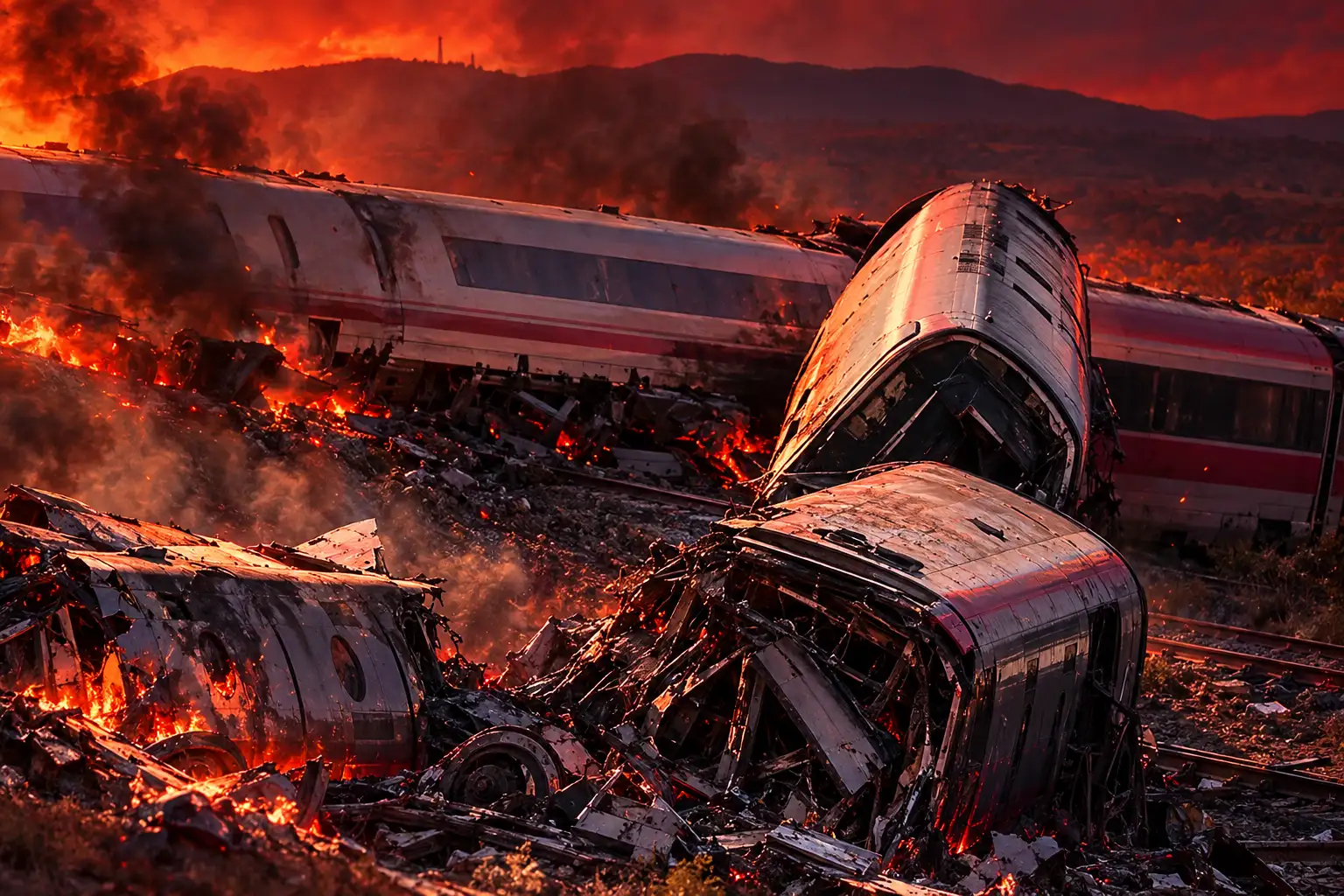
Puente said the AVE hit the Iryo from behind. Several coaches left the rails, two Iryo cars went down an embankment, and four cars of the AVE came off the track. García-Page, speaking at the command post, said firefighters with cranes had still not reached the bottom of the wreckage on Wednesday afternoon and that more bodies could be found there.
THE URDA TOLL AS GIVEN WEDNESDAY
- The dead: At least 68 people, with 24 on the Renfe AVE and 44 on the Iryo train, according to García-Page.
- Who was aboard: 397 passengers on AVE 2080 and 147 passengers on Iryo 6076, plus Iryo’s three crew, a barista and a driver.
- The place and time: Kilometre 118 between Los Yébenes and Urda, at 08:53, on the Madrid-Seville high-speed line.
- The corridor this year: 114 people have now died in two crashes on this line in 2026, after 46 were killed at Adamuz on 18 January.
A passenger in a rear coach described a strong impact about 40 minutes after leaving Madrid. Local mayor Manuel Galán said the scene around the village held many casualties. India’s embassy in Madrid opened an emergency line for families seeking news of passengers, without naming any Indian dead.
The Control Centre Authorised Normal Speed
Puente spoke from Adif’s 24-hour control centre at Atocha, where he said he had watched a replay of the traffic and listened to the desk talking to the trains. He called a rear-end crash on the Spanish network “truly implausible,” then laid out a short chain of times.
THE 23 MINUTES BEFORE THE IMPACT
- 28 October, about 08:30: The LZB protection kit at Urda suffers a computer-communications failure, leaving a 63-kilometre stretch without that system, and six trains on the section stop automatically.
- 28 October, 08:36: The Atocha control centre tells the AVE 2080 driver to disconnect and reconnect LZB and to resume under lateral-signal block at normal speed, even though a red entry signal at Urda is still against movement.
- 28 October, 08:36 to 08:53: The AVE runs about 25 kilometres in 17 minutes. Puente said the speed at impact is not yet known and could have been as high as 200 km/h on that stretch.
- 28 October, 08:53: The AVE strikes the rear of the Iryo train, which is still standing at Urda.
When LZB drops out, Adif’s own rules call for “marcha a la vista,” line-of-sight running at a pace that lets a driver stop short of anything ahead, a cap colleagues put at 40 km/h. Puente said the desk instead authorised normal speed, which he called an inexplicable and wrong decision, and he said the train drivers were not at fault.
Recordings of the Atocha desk, later circulated from the inquiry file, capture the order to the AVE in these words: “Desconecte y vuelva a conectar el LZB y reanude marcha al amparo del BSL con marcha normal.” That is an instruction to cycle the protection equipment and then run on as if the line were clear.
Why the Iryo Train Did Not Move
Puente said the Iryo service also received an order to move after the AVE had already been sent on, and that it was not yet clear why that train stayed put. The gap matters because the AVE was driving into an occupied block with a red signal still lit at the station entry.
There was a red signal prohibiting movement, yet the train was authorized to proceed. These are the facts. It’s not a system fault.
Óscar Puente, Minister of Transport, at Adif’s Atocha control centre
In a separate exchange, the Iryo driver tells Atocha she has lost transmission, has been running under a 40 km/h target, and is standing at Urda’s entry signal: “Estoy detenida en la señal de entrada de Urda.” The desk tells her, too, to cycle LZB and resume at normal speed. She does not get moving before the blow comes.
Renfe said its train went on as instructed and then hit an Iryo service that had remained stationary “for reasons we don’t know,” and that the exact sequence would be for investigators. The company activated a helpline for victims on 900 10 10 20 and opened its crash-victim assistance plan. Iryo set its own line on 900 001 403, cancelled every south-corridor departure from Atocha, and said there was no date for restoring those trains.
Puente said the person who issued the restart order has been identified and is in the hands of the inquiry, and that he had not spoken to that controller himself. The automatic stop after the LZB dropout is the part of the morning that worked. The restart at line speed is the part that did not.
Adamuz Killed 46 People in January
On 18 January, at 19:43, an Iryo train from Málaga toward Madrid derailed on a straight stretch at Adamuz in Córdoba province. Three rear coaches crossed onto the opposite track. About 20 seconds later a Renfe Alvia heading for Huelva hit those coaches. Forty-six people died, including the Renfe driver, and 292 people were injured. A 40-centimetre break in a rail has been the working cause, with investigators later pointing to a poor weld, missed track-circuit warnings and inspection gaps. The technical file on Adamuz is still open.
Sánchez said the two crashes did not appear to share a cause. They share a corridor, a pair of operators and a public that has now watched this line kill 114 people in ten months. After Adamuz the line closed for repairs and testing and reopened on 17 February. After Urda it is closed again.
TWO CRASHES ON THE MADRID-SEVILLE LINE IN 2026
| Crash | Adamuz, 18 January | Urda, 28 October |
|---|---|---|
| Deaths | 46 | at least 68 |
| Operators | Iryo 6189 and Renfe Alvia 2384 | Iryo 6076 and Renfe AVE 2080 |
| How it began | A 40-centimetre rail break, then a collision on the opposite track | An LZB outage, then a restart order into a stopped train |
| Where | Adamuz, Córdoba, same high-speed line | Kilometre 118, Toledo, same high-speed line |
Sánchez, at the Urda site, said it was unacceptable for a country like Spain to suffer two high-speed accidents in the same year. He said any failure in the safety system or any negligence would be met with the utmost severity. He also said Spain was in mourning, all of Spain.
The 1992 Safety System Was Due for Replacement
LZB, Linienzugbeeinflussung, is a German cab-signalling and automatic-protection system that Spain fitted when this line opened in 1992 as the country’s first high-speed route. It watches trains through a cable in the track, can order an emergency brake, and is the kit that stopped the six trains when the computers at Urda failed. Puente said LZB still works, that dropouts are uncommon but possible, and that the system is being replaced because it is old and is no longer manufactured. He said the rest of Spain’s high-speed network already uses the newer European kit, and that this corridor is the one still waiting.
That wait has a paper trail. Adif put the swap from LZB to ERTMS out to tender in February 2020, had to cancel that contest after a bureaucratic error, lost about a year, and awarded the job in September 2021 to Thales España GRP for 94 million euros on a 52-month term. The new system was still not in passenger service on 28 October. Puente put the wider renewal of the corridor, including the La Sagra-Toledo branch, at more than 700 million euros, a separate and larger budget than the Thales signalling contract.
THE DELAYED SWAP ON SPAIN’S OLDEST FAST LINE
- The kit in use: LZB from 1992, the original protection on the Madrid-Seville line, giving continuous speed supervision through track cables.
- The replacement: ERTMS Level 2, Europe’s common train-control standard, which supervises speed from the cab over radio and can apply the brakes.
- The contract: Awarded in September 2021 for 94 million euros after a cancelled 2020 tender, with a 52-month build that has not yet gone live.
- The year on this line: The government said the Madrid-Seville route had logged 162 incidents from 1 January through 28 October, without saying how many were LZB faults.
Drivers on the corridor had been reporting repeated LZB dropouts and lost transmission in the weeks before the crash, according to people in the operating unions. Those warnings do not, on their own, explain a restart order issued against a red signal. They do explain why an unfinished swap on a 34-year-old system is now sitting inside a criminal and technical file.
Private Operators Now Carry a Third of High-Speed Trips
Iryo, backed by Italy’s state railway through the ILSA consortium, began running Spanish high-speed services in 2022 and sits on the same Adif tracks as Renfe and the French-backed low-cost operator Ouigo. By 2024 the new entrants held 34% of the commercial market, with Iryo at 21% and Ouigo at 13%. About 40 million high-speed commercial trips were made that year, 77% more than in 2019, on a network of more than 3,700 kilometres, the largest high-speed system in Europe.
Competition cut fares and filled trains. It also put three liveries into a control system built for a single state operator, and it put more paths onto a 1992 line whose protection upgrade was already late. Adif still holds the signalling, the control desk and the movement authorities. When that desk talks, both the state AVE and the private Iryo are supposed to hear the same occupied track.
Iryo’s fleet on this corridor is the Hitachi-built Frecciarossa type; Renfe’s train on Wednesday was the Series 103 Velaro. Both are designed to run under LZB and under ERTMS. On Wednesday morning they were running under a failed LZB and a human instruction that treated an occupied block as if it were empty.
The Line Stays Closed While Crews Cut the Wreckage
Sánchez declared three days of official mourning. The duty court in Orgaz has the criminal file, with extra judges sent in from Toledo and Alcázar de San Juan, and Spain’s new multimodal accident body, which replaced the old rail commission this year, has the technical one. Guardia Civil officers have been taking statements and mapping the site with drones. A military emergency unit was sent to Toledo.
Commercial high-speed trains between Madrid, Ciudad Real and Andalusia were cancelled through 29 October. Renfe put some public-service Avant trains onto the conventional line via Ciudad Real, with longer journeys and a change of train, and told people who did not have to travel to stay off the route. Attention points were opened at Madrid-Atocha, Seville Santa Justa and Córdoba.
WHAT WE KNOW
- The collision: Renfe AVE 2080 rear-ended Iryo 6076 at kilometre 118 at 08:53 on 28 October.
- The toll: García-Page has given at least 68 dead, 24 on the AVE and 44 on the Iryo, and said carriages still had to be lifted.
- The order: After an LZB dropout at about 08:30, Atocha authorised the AVE at 08:36 to resume at normal speed with a red signal still in force.
WHAT IS UNCONFIRMED
- Impact speed: Puente said it is not established and could have been as high as 200 km/h.
- The Iryo standstill: Why that train did not move after its own restart order is still open.
- A final death toll: García-Page warned the figure of 68 may rise once the lowest wreckage is opened.
García-Page said the worst coaches had still not been fully lifted by Wednesday afternoon. The Orgaz court has a case, the accident body has a technical file, and the controller who issued the restart order has been identified. The death toll of 68 is the figure the regional government has given, and he warned it may not be the last.

Baker Mayfield’s Foot Strain Tests Tampa’s Run-First Formula

Measles Turns Endemic After the US Loses Elimination Status

California Locks Waymo Off Freeways After a Recalled Defect

Aidan Hutchinson’s Season Ends on a Celebration Jump in Munich

Super El Niño Hits Food Systems Already Under Strain

Consumer Sentiment Falls to 51.7 as Future Outlook Darkens

Pluto’s Heart Glacier Still Pushes Liquid Nitrogen Upward

Take-Two Subpoenas Microsoft While GTA 6 Preorders Soar

The Extra Heat Month Hits Children Where Care Is Thinnest

Netflix Weighs Hosting Peacock and Fox One in Its App
-
 BUSINESS3 months ago
Consumer Sentiment Falls to 51.7 as Future Outlook Darkens
-
 GAMING3 months ago
Take-Two Subpoenas Microsoft While GTA 6 Preorders Soar
-
 NEWS3 months ago
Pluto’s Heart Glacier Still Pushes Liquid Nitrogen Upward
-
 NEWS3 months ago
The Extra Heat Month Hits Children Where Care Is Thinnest
-
 ENTERTAINMENT3 months ago
Netflix Weighs Hosting Peacock and Fox One in Its App
-

 NEWS3 months ago
FDA Clears Rasonque and Widens Who Can Take It
-
 NEWS3 months ago
UMMC Will Rebuild 30-Year-Old Cancer Labs With $2.4 Million
-

 GAMING3 months ago
GTA 6’s 80-Hour Run Counts Goals That Change the Story