
NEWS
The Extra Heat Month Hits Children Where Care Is Thinnest
A VUB study finds 560 million children already live through 30 extra humid-heat days, with the load falling on tropical clinics, schools and caregivers.

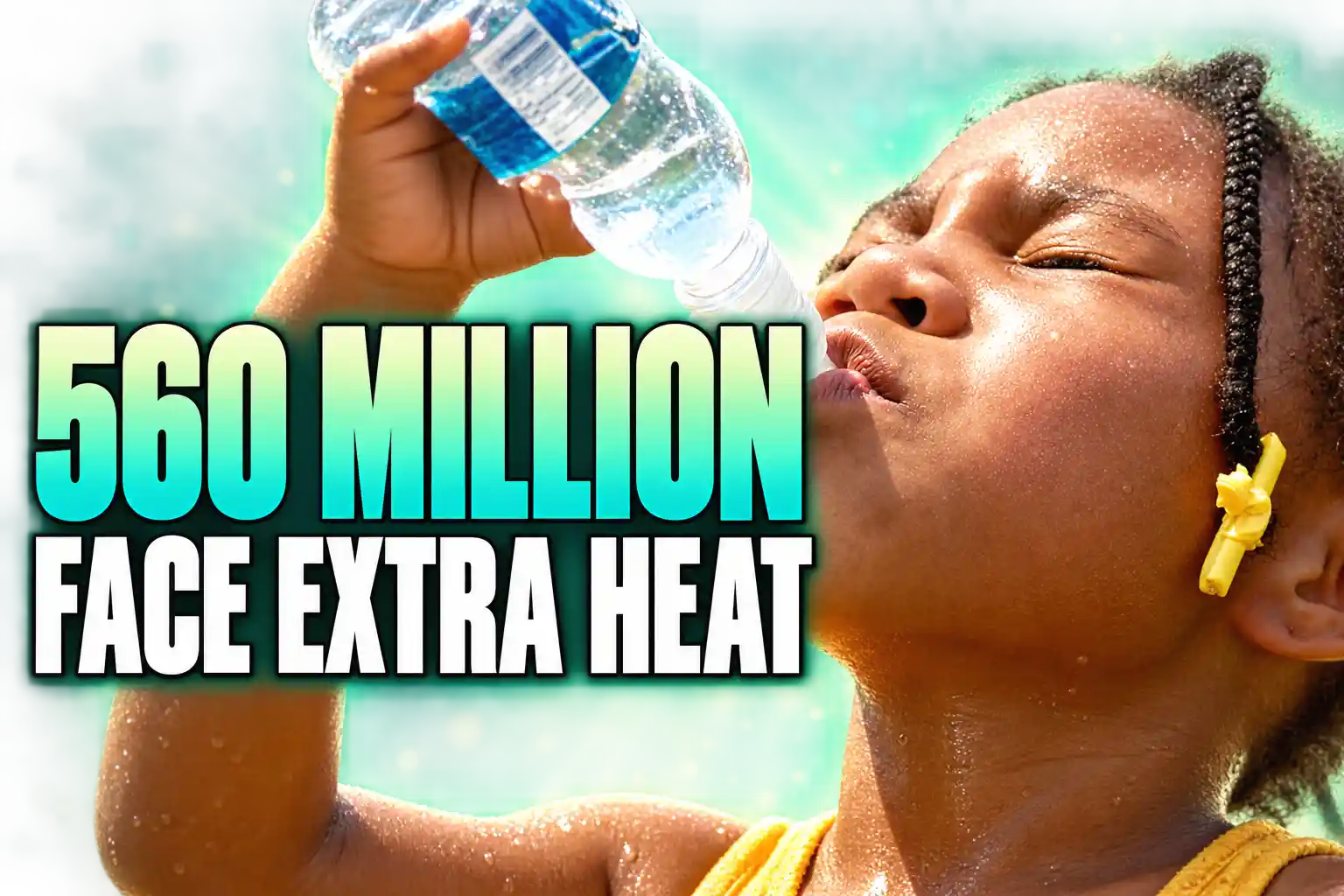
560 million children aged 0 to 9 already live through at least 30 extra heat-stress days a year because of human-caused climate change. That is 43 percent of that age group, according to a Vrije Universiteit Brussel team writing in Science Advances on 26 August 2026. The extra month is not spread evenly. It lands where populations are youngest, housing is hottest, and pediatric care is already thin: South Asia, Southeast Asia and West Africa.
The paper is the first age-specific humid heat analysis to pin those extra days on human-caused warming, using grid-scale attribution plus population data. Lead author Rosa Pietroiusti, a doctoral researcher at VUB, and senior author Wim Thiery, a VUB climate professor, find that children in this band already outpace every older group on climate-added heat, including people aged 60 to 69.
The Extra Month Lands in the Young Tropics
The headline figure counts children living through 30 or more extra heat-stress days a year that would not exist in a preindustrial climate. On a looser cut of 20 extra days, the same study finds 583 million children aged 0 to 9 (range 497 to 592 million) compared with 190 million people aged 60 to 69 (range 166 to 196 million). That is 2.8 to 3 times more children than older adults at present-day warming, in both reanalysis and climate-model runs.
An average child already lives through 9 to 10 more attributable heat-stress days than a person aged 60 to 69. The authors call that gap conservative, because children spend more time outdoors than the shaded, moderate-wind metric assumes.
Climate change has also almost tripled the number of children living through at least five months, or 150 days, of total heat stress, from 120 million (9 percent) in a modelled world without warming to 350 million (27 percent) today. About 120 million adults aged 60 to 69, or 18 percent of that group, now face the same five-month load.
| Group | 30+ extra heat-stress days | 20+ extra heat-stress days | 150+ total heat-stress days |
|---|---|---|---|
| Children aged 0 to 9 | 560 million (43%) | 583 million (497 to 592 million) | 350 million (27%), up from 120 million without warming |
| Adults aged 60 to 69 | 190 million (30%) | 190 million (166 to 196 million) | 120 million (18%) |
Those counts come from the VUB press materials and from the paper’s own 20-day results. The 30-day cut is the figure the authors put in front of policymakers. The 20-day cut shows the same imbalance at a lower bar.
Why South Asia’s Children Face More Extra Heat Days
The imbalance is a map of where childhood is concentrated. Humid heat has risen fastest in the tropics and in poorer countries, and those countries have younger age pyramids, so more of the world’s 0 to 9 year olds live under the new heat. South Asia, Southeast Asia and West Africa hold the highest numbers of children now exposed to dangerous heat stress, the team said.
Côte d’Ivoire is the paper’s worked example. People there now live through about 112 heat-stress days a year (range 68 to 121 across reanalyses), against about 51 days (range 15 to 65) under preindustrial conditions, which implies about 53 extra days a year (range 47 to 70) attributed to human-caused climate change. Twenty-seven percent of Côte d’Ivoire’s population is aged 0 to 9. In Germany that share is 9 percent.
UNICEF’s South Asia office has already reported that three out of four children in the region are exposed to extremely high temperatures, against one in three children globally, and that 28 percent of children in South Asia face 4.5 or more heatwaves a year, against 24 percent worldwide. A separate UNICEF global file, the 1.5 billion children exposed to heatwaves count in the Children’s Climate Risk Report 2026, puts 1.2 billion children under extreme heat conditions. That report uses a broader age band than the VUB paper, but it points at the same belt.
The paper also notes that South Asia and western Africa have large shares of people in outdoor farm work, so heat is not only a bedroom and classroom problem. Sub-Saharan Africa still has the world’s highest share of people living below the extreme poverty line and a high existing burden of disease, which leaves less slack when an extra month of humid heat arrives.
A Heat-Stress Day Starts at WBGT 28
The team did not count hot afternoons by air temperature alone. They used a modified wet bulb globe temperature, the so-called indoor formulation, which assumes moderate winds and shade and folds humidity into the score. A heat-stress day in this study is a day when that score crosses 28 degrees Celsius. Japanese coverage of the paper, matching the authors’ earlier conference figures, treated WBGT 28 as the cut and reported that children already live through about 28 extra such days a year compared with a world without warming.
That number is a workplace and sports threshold as much as a climate one. The U.S. National Weather Service’s wet bulb globe temperature outdoor guidance describes WBGT as a mix of temperature, humidity, wind and solar radiation, and notes that the American College of Sports Medicine uses it to set practice limits in school athletics. Occupational tables treat 28 C as the line where moderate work for acclimatized adults already needs rest and water breaks; unacclimatized people are told to avoid activity in that band.
HOW THE STUDY BUILDS A HEAT-STRESS DAY
- The metric: A shaded, moderate-wind WBGT, chosen because humid heat blocks sweat from cooling the body.
- The cut: Days crossing WBGT 28 C count as heat-stress days.
- The counterfactual: The same grids are run with preindustrial climate so extra days can be attributed to human-caused warming.
- The people: Gridded age data from the ISIMIP project, HYDE 3.3 and UN population files are laid on those grids.
Because the metric assumes shade, outdoor play, walking to school and farm work sit on the hot side of the estimate. Full sun can push a heat index much higher than a shaded reading, which is why the authors say the child-versus-older gap is likely too small, not too large.
Overstretched Clinics Face a Pediatric Heat Load
Children are not only more numerous in the heat belt. Their bodies take up the heat faster. Young children have a higher surface area relative to body mass, they sweat less efficiently, and they depend on adults to get them into shade, water and cooler rooms. Overheating can bring dehydration and heatstroke, and the authors also flag risks to learning and cognitive development.
UNICEF’s child-environment brief puts the physiology in plainer terms: children produce higher heat production per kilogram of weight than adults because they move less economically, and a higher surface-area-to-mass ratio can pull in more heat from the surroundings. Infants cannot say they are too hot. Breastfeeding shortens on the hottest days in some studies, and heat during pregnancy is tied to preterm birth and low birth weight.
Climate change is already causing hundreds of millions of children to suffer from dangerous heat worldwide, posing severe risks to their health. Children in developing countries face disproportionate exposure to climate extremes now and into the future, despite contributing the least to historical greenhouse gas emissions. At the same time, poverty, inadequate housing, limited access to cooling, and overstretched healthcare systems leave many children with few ways to protect themselves from the heat.
Rosa Pietroiusti, lead author and doctoral researcher at Vrije Universiteit Brussel
That is the stakeholder the global headline skips. The extra month is lived by parents who cannot buy air conditioning, by teachers in metal-roof classrooms, and by clinics that already run thin on oral rehydration, staff and power. Heat action plans and stronger public health systems are the adaptation half of what Thiery asked for, alongside cuts in oil, coal and gas and a larger flow of climate finance to developing countries.
WHO advice for infants is small and specific because the risk is small-scale: never leave a child in a parked car, never drape a dry cloth over a pram (it traps heat), use a wet thin cloth and shade, and treat shade as more than 10 C of relief. Those steps assume a caregiver is present and water is close. In the regions with the most extra days, that assumption often fails.
Heat Deaths Still Cluster in Older, Cooler Countries
Exposure is not the same as death. WHO’s heat-and-health fact sheet, updated 31 July 2026, still records the mortality record in older adults: heat-related deaths among people over 65 rose by about 85 percent between 2000-2004 and 2017-2021. Studies for 2000-2019 find about 489,000 heat-related deaths a year, with 45 percent in Asia and 36 percent in Europe. Europe’s summer of 2022 alone is credited with 61,672 excess heat deaths.
WHAT THE DEATH TALLIES SHOW
- Older adults: Heat-related mortality at ages 65 and over is the series WHO still flags as rising fastest.
- Europe 2022: More than 61,000 excess heat deaths in one summer, in a region with an older age structure and strong death registration.
- Asia’s share: About 45 percent of modelled global heat deaths in 2000-2019, even before this new child-exposure map.
- The gap: Death records track who dies in places that count the dead; the VUB paper tracks who lives through extra humid-heat days.
A Lancet Planetary Health modelling study published on 17 August 2026, ten days before the VUB paper, found that older adults breach experimentally derived heat-tolerance limits more often and over a wider area than younger adults, even at 1.5 C of warming. That paper is about when the body can no longer dump heat. The VUB paper is about how many extra days of humid heat climate change has already added, and who lives in the grid cells where those days fall.
Both can be true. Older adults in mid-latitude cities die in recorded heatwaves. Young children in the humid tropics live through a longer season of heat that rarely appears in European excess-death tables. The clinics and schools that see those children every afternoon are the ones that have to plan for a 30-day addition that is already here.
A 1.5-Degree Path Still Leaves 620 Million Exposed
The authors ran the same age maps at 1.5 C and 2 C of global warming, levels they say current policies are extremely likely to overshoot. At 1.5 C, 620 million children aged 0 to 9 (49 percent) would live through at least one extra month of heat stress, and 390 million (31 percent) through at least five months of total heat stress. At 2 C those figures rise to 650 million (59 percent) and 420 million (37 percent).
The child-versus-older gap does not close as the world ages, the team found. Children remain the most exposed age group under both warming levels. Thiery said policymakers need to cut fossil fuel emissions and limit warming in line with the Paris Agreement, and that heat action plans and better public health systems will still be required to protect younger generations in a warming world.
Pietroiusti also pointed to young people already pressing governments, from school strikes to court cases. The science in this paper is narrower than that politics. It says the extra month is already allocated, by latitude and by birth rate, to children who did not burn the fuel.
For a newsroom in South Asia, the operational question is not whether 560 million is a large number. It is whether classrooms, anganwadis and pediatric wards are staffed and cooled for a humid-heat season that is already a month longer than the climate those buildings were planned for, and whether that month grows again if 1.5 C is missed.
Frequently Asked Questions
Why Do Young Children Overheat Faster Than Adults?
Infants and toddlers have sweat glands that are not fully developed, so they take longer to start cooling themselves, and a larger share of their body weight is water, which they lose faster through dehydration. UNICEF also notes that core temperature in a child can rise higher and faster than in the adult standing next to them, so a parent who feels merely hot may already have a child in heat stress. Babies cannot report thirst or dizziness, which is why heat illness in this age group is easy to miss until it is advanced.
What Is Wet Bulb Globe Temperature Used For?
WBGT was built for military training and later adopted for farm work, factory floors and school sports because it tracks how well a body can shed heat, not how hot the air feels on a dry-bulb thermometer. The shaded indoor formula used in the VUB paper weights the wet-bulb (humidity) reading more heavily than air temperature. Sports doctors use WBGT to cancel or shorten practice; occupational tables use it to force rest cycles. Crossing 28 C on that scale is already a work-rest warning for healthy adults doing moderate labor, which is why the authors treated it as a dangerous day for a small child.
How Did Researchers Separate Climate-Driven Heat From Ordinary Hot Weather?
They compared today’s climate and climate-model runs against a counterfactual preindustrial climate on the same geographic grid, a method drawn from earlier work by Thiery and colleagues and updated with ISIMIP3 bias-adjusted climate and population files. Reanalysis products, which blend observations and models, were used alongside the models; both streams produced the same 2.8-to-3-times gap between children and 60-to-69-year-olds. Uncertainties are larger in early decades and in data-sparse tropical regions, which the authors flag in the paper.
How Many Children Already Live With Extreme Heat Worldwide?
UNICEF’s Children’s Climate Risk Report 2026, a separate project from the VUB study, estimates that nearly two in three children worldwide, about 1.5 billion, are exposed to heatwaves that are becoming more frequent, longer or more severe, and that 1.2 billion live with extreme heat conditions. An earlier UNICEF heat-wave file put about 559 million children under high heatwave frequency. Those figures cover a wider age range than the 0-to-9 band in Science Advances, so they should not be added to the 560 million extra-month count; they show the background of heat that the new attribution study then slices by age and by human-caused warming.

IT Stocks Climb as Sensex Falls After RBI Hike

Anthropic Prices Claude Haiku 5.5 as a Subagent Worker

Nifty Falls While India Pays $121 a Barrel

OpenAI’s 722 Math Papers Leave the Checking to Humans

Flipkart Recruits Sellers and Riders for Big Billion Days

Consumer Sentiment Falls to 51.7 as Future Outlook Darkens

Pluto’s Heart Glacier Still Pushes Liquid Nitrogen Upward

The Extra Heat Month Hits Children Where Care Is Thinnest

UMMC Will Rebuild 30-Year-Old Cancer Labs With $2.4 Million

Netflix Weighs Hosting Peacock and Fox One in Its App
-
 BUSINESS2 months ago
Consumer Sentiment Falls to 51.7 as Future Outlook Darkens
-
 NEWS2 months ago
Pluto’s Heart Glacier Still Pushes Liquid Nitrogen Upward
-
 NEWS2 months ago
UMMC Will Rebuild 30-Year-Old Cancer Labs With $2.4 Million
-

 BUSINESS1 month ago
Abbott Pays $670 Million to Exit a Missouri Food Verdict
-
 ENTERTAINMENT1 month ago
Netflix Weighs Hosting Peacock and Fox One in Its App
-

 NEWS1 month ago
Water-Shedding Coatings Charge the Drops That Pierce Them
-

 GAMING1 month ago
Take-Two Subpoenas Microsoft While GTA 6 Preorders Soar
-

 NEWS1 month ago
FDA Clears Rasonque and Widens Who Can Take It