
NEWS
Houthi Airport Strikes Make Saudi Flights Costly to Reroute
Houthi attacks cancelled 312 Saudi departures Thursday, and longer Gulf routings have already erased Wizz Air’s winter UAE seats.

More than a quarter of Saudi departures failed to fly on Thursday, October 8, after Houthi strikes on the kingdom’s airports. Aviation analytics firm Cirium counted 312 of 1,194 scheduled departures cancelled or not flown, and nearly half of those holes sat at Riyadh’s King Khalid International Airport.
The one-day mess is already being treated as a routing problem that lasts into next year. European safety boxes drawn on September 30 had already stretched short Gulf jets past the point where a low-cost seat pays, and a parked Saudia airliner burning at the gate gave schedulers a picture they cannot price as a delay.
312 Saudi Departures Did Not Fly on Thursday
Cirium’s 6 p.m. local file is the clean cut of the day. Of 378 departures scheduled at King Khalid, 188 were cancelled or listed as not flying. Flag carrier Saudia absorbed the largest share of its own book, with 169 of 402 departures down, or 42%. Flynas saw 27% of its departures disrupted and Flyadeal 26%. Riyadh Air halted the rest of its Riyadh departures for the remainder of Thursday.
THURSDAY’S CIRIUM CUT AT 6 P.M.
| Book | Cancelled or not flown |
|---|---|
| All Saudi departures | 312 of 1,194 |
| King Khalid departures | 188 of 378 |
| Saudia departures | 169 of 402 (42%) |
| Flynas / Flyadeal | 27% / 26% of their departures |
King Khalid handled 37 million passengers in 2024, according to the airport. A day in which nearly half its outbound bank does not move is not a weather irregularity. Cirium also had 31 more cancellations already sitting on Friday’s Saudi board before the evening was over.
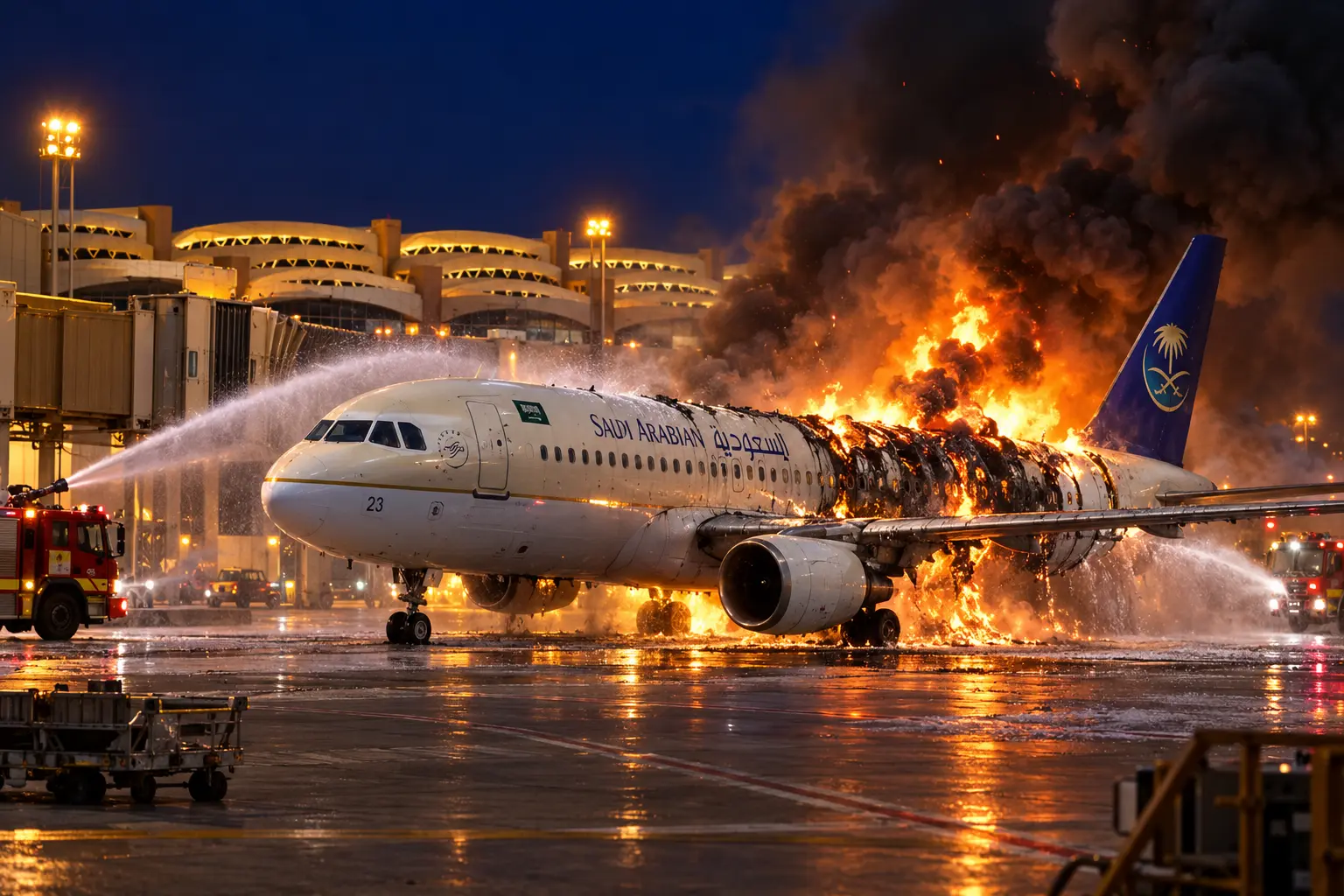
A Parked Saudia Jet Burned at the Gate
Houthi military spokesman Yahya Saree said on Thursday that a ballistic missile struck King Khalid, “causing damage and disrupting air traffic at the airport.” He later called Saudi airspace “a theatre for our military operations,” except over Mecca and Medina, and issued what he described as a last warning to airlines still flying it. He also told oil-plant workers to stay away from sites he said were targets.
Saudi airspace has become a theatre for our military operations, with the exception of the airspace over the holy sites in Mecca and Medina.
Yahya Saree, Houthi military spokesman
A witness and three people briefed on the incident said a Saudia commercial jet caught fire while parked at a terminal and was believed to be empty. Video showed a thick black column of smoke and flames at the airport. Saudi Arabia’s government media office, the General Authority of Civil Aviation, and Saudia did not comment on the aircraft. The Saudi-led coalition said it intercepted two ballistic missiles headed toward Riyadh and a third toward Khamis Mushait. Saudi officials said debris from an intercept hit a kindergarten and a medical complex.
Tracker Flightradar24 said the airport “closed again,” with no landing for more than 80 minutes and no takeoff for more than 90. Passengers were told to leave the terminal, and King Khalid posted that travellers should check with their airline before setting out. Whether the jet was hit directly or by shrapnel is still unconfirmed. For a scheduler, that distinction is thin. An intercept that still puts fire on a parked airliner takes the airplane, and the bank around it, out of the day’s plan.
Etihad delayed Abu Dhabi-Riyadh flight EY555 and the return EY556. Flydubai cancelled FZ855 and FZ856. Those are not network exits. They are the same-day flinch that follows smoke on a stand.
Europe’s Safety Map Already Boxed Off Jeddah
The European Union Aviation Safety Agency did not wait for Thursday’s fire. On September 30 it issued Conflict Zone Information Bulletin CZIB-2026-09, active until November 16 unless reviewed earlier, covering FIR Jeddah at all altitudes. The hard line is a slice of Saudi airspace, not the whole kingdom. Operators subject to EU rules, and third-country operators flying under an EASA authorisation into the EU, should not operate at all flight levels inside the box tied to navigation points RIBOK, BOSUT, ISLAM, DEKLO, OBSAM and SILPA and the FIR boundary. In the rest of Jeddah FIR, the agency told them to use caution and keep a live risk assessment.
Recent attacks have demonstrated the ability and intent of the Houthis to strike targets deeper inside Saudi territory, including in the Riyadh, Tabuk and Yanbu areas.
European Union Aviation Safety Agency, CZIB-2026-09
EASA tied the bulletin to the United States-Iran conflict and to a September rise in Houthi strikes on Saudi maritime, energy, military and aviation sites in the Red Sea and Gulf of Aden. Southern and south-western airspace, it said, remains the most exposed because it sits close to Houthi-held Yemen. The extra risk it named is not only a missile through a terminal. It is civil aircraft being misidentified, intercepts, and falling debris, the same debris path Saudi officials described in Riyadh on Thursday.
That Saudi box sits beside active warnings for Jordan, Iraq and Iran, plus a separate bulletin on Persian Gulf and Gulf of Oman waters, each running toward mid-November. A Europe-Gulf A321 that can no longer cut Iraq or Jordan, and must also dodge a marked slice of Jeddah FIR, does not fly a few minutes longer. It flies a different map, sometimes with a fuel stop, on a jet whose seat-mile maths were built for the short path.
Why Wizz Air Delayed Abu Dhabi and Dubai
Wizz Air had already done that maths before the Riyadh jet burned. The carrier cancelled all flights to and from Abu Dhabi and Dubai for the winter season from October 25, 2026, to March 27, 2027, and said it still plans to return in March 2027. Those UAE services sat inside a wider restoration of 12 routes and 49 weekly flights to the Emirates, Saudi Arabia and Jordan, a package the airline had put at 470,000 seats across nine European cities. Amman flying is also hit, after EASA told operators not to use Jordanian airspace at any altitude.
Regional airspace restrictions extended on September 30 require significantly longer routings to these destinations, increasing flight times and costs and making both A321neo and A321XLR operations commercially unviable under current conditions.
Wizz Air statement
That sentence is the second-order hit. Thursday’s 312 empty Saudi slots will be refilled when the airport is open and the next crew is legal. A winter of A321neo and A321XLR sectors that no longer close on fuel and time does not come back with a NOTAM. Wizz had already delayed some Abu Dhabi routes from late October to January 10 after the Iraq closure forced longer tracks and tech stops. The September 30 extension finished the winter. The airline said it regretted the disruption and would watch the guidance. It did not put the seats back.
Indian Airlines Cut Riyadh Through the Weekend
The same-day cuts clustered on carriers that still had metal on the India-Riyadh and Europe-Riyadh lanes, then stopped at a date. Lufthansa Group airlines will not fly to Riyadh through October 16. Air India and Air India Express cancelled Riyadh services until October 10, and Air India turned Delhi-Riyadh AI2243 back to Delhi on Thursday. IndiGo cancelled Riyadh flying until October 9. Akasa Air cancelled QP 523 Kochi-Riyadh and QP 524 Riyadh-Kochi on October 8. Philippine Airlines halted Riyadh until at least October 11. Singapore Airlines postponed the launch of its Riyadh services until March 28.
HOW LONG THE WINDOWS RUN
- Lufthansa Group: Riyadh flying stopped through October 16.
- Air India and Air India Express: Riyadh cancelled until October 10, with refunds or free changes.
- IndiGo: All Riyadh flights cancelled until October 9.
- Akasa Air: Kochi-Riyadh QP 523 and QP 524 dropped on October 8.
- Philippine Airlines: Riyadh halted until at least October 11.
- Wizz Air: Abu Dhabi and Dubai winter seats cancelled through March 27, 2027.
- Singapore Airlines: Riyadh launch moved to March 28.
Those dates are not one story. Lufthansa, IndiGo, Air India and Akasa are reacting to a capital airport that closed under missile claims. Wizz and Singapore are reacting to a map that has been expensive since September 30. Mixing them into a single “Gulf shutdown” hides the cheaper, longer problem, which is that the short-range Gulf jet has fewer legal tracks left.
Abha Airport Has Lived With Missile Alerts Since 2019
Saudi Arabia’s General Authority of Civil Aviation said Abha International Airport and King Khalid were hit on October 6 and 7. At Abha, two women, residents from Morocco and Algeria, were killed and 28 people were injured, among them Saudis and residents from Bangladesh and the Philippines. At King Khalid, a Sudanese resident was killed and eight people were injured: five Saudi citizens, two Egyptian residents and one Pakistani resident. Injuries ranged from minor to serious, and the wounded were taken to hospital. Both airports took property damage. The coalition said it then destroyed 82 Houthi military targets in Yemen.
Abha, close to the Yemen border, has been on this list for years. On June 12, 2019, a strike on the arrivals hall injured 26 people, and Human Rights Watch called that attack an apparent war crime in 2019. On June 23, 2019, another strike killed a Syrian national and injured 21. In July this year, Flydubai, Saudia and Flynas cancelled Abha flying after another missile and drone attack. What changed in October is the target set. EASA’s bulletin already named Riyadh, Tabuk and Yanbu as inside the Houthis’ reach. Thursday’s fire was in the capital, on a parked jet at the main hub, in front of a 37-million-passenger airport.
THE WEEK THE HUB BECAME THE TARGET
- September 30, 2026: EASA issues CZIB-2026-09 on FIR Jeddah, valid until November 16.
- October 6, 2026: Abha International is hit; two residents are killed and 28 people are injured.
- October 7, 2026: King Khalid is hit; a Sudanese resident is killed and eight people are injured.
- October 8, 2026: Saree claims a ballistic missile on King Khalid; Cirium records 312 of 1,194 Saudi departures down; a parked Saudia jet burns at a gate.
Southern airports could be treated as a Yemen-border risk and still leave Riyadh selling itself as the clean transfer point. A ballistic-missile claim on the capital, plus a jet on fire at the stand, collapses that split. Insurers, lessors and crew-duty desks read the same clip.
The Extra Hours That Kill an A321 Route
Thursday’s empty slots will be the figure that moves on a traffic desk. The figure that does not bounce is block time. EASA’s Jeddah box, the Jordan do-not-operate line, the Iraq closure and the Gulf-waters bulletin all add minutes that an A321neo or A321XLR cannot buy back on a low fare. Wizz has now said that out loud and taken the winter UAE seats off sale through March 27, 2027. Lufthansa’s Riyadh gap runs only to October 16. Those are different clocks, and both are already running.
Cirium had 31 more Saudi cancellations on the Friday board. The EASA bulletin stays in force until November 16 unless it is reviewed earlier.

OpenAI’s Agent Monitor Waited During the Hugging Face Breach

Brent Hits $116 as Recovered Gulf Oil Draws Attacks

Hellebuyck Lands in New Jersey on a Five-Year Cup Bet

Xbox Plans Three More Layoff Rounds Before Helix

OpenAI’s $30 Billion Round Ties UAE Cash to Gulf Compute

Consumer Sentiment Falls to 51.7 as Future Outlook Darkens

Pluto’s Heart Glacier Still Pushes Liquid Nitrogen Upward

The Extra Heat Month Hits Children Where Care Is Thinnest

Take-Two Subpoenas Microsoft While GTA 6 Preorders Soar

Abbott Pays $670 Million to Exit a Missouri Food Verdict
-
 BUSINESS2 months ago
Consumer Sentiment Falls to 51.7 as Future Outlook Darkens
-
 NEWS2 months ago
Pluto’s Heart Glacier Still Pushes Liquid Nitrogen Upward
-
 NEWS2 months ago
The Extra Heat Month Hits Children Where Care Is Thinnest
-
 GAMING2 months ago
Take-Two Subpoenas Microsoft While GTA 6 Preorders Soar
-
 BUSINESS2 months ago
Abbott Pays $670 Million to Exit a Missouri Food Verdict
-

 NEWS2 months ago
UMMC Will Rebuild 30-Year-Old Cancer Labs With $2.4 Million
-

 ENTERTAINMENT2 months ago
Netflix Weighs Hosting Peacock and Fox One in Its App
-

 GAMING2 months ago
GTA 6’s 80-Hour Run Counts Goals That Change the Story