
NEWS
France Blames Iran After Unpatched Freezers Cooked Store Stock
France blamed an IRGC cyber unit for cooking supermarket stock, but the November wave still found end-of-life freezer controllers left on the public internet.

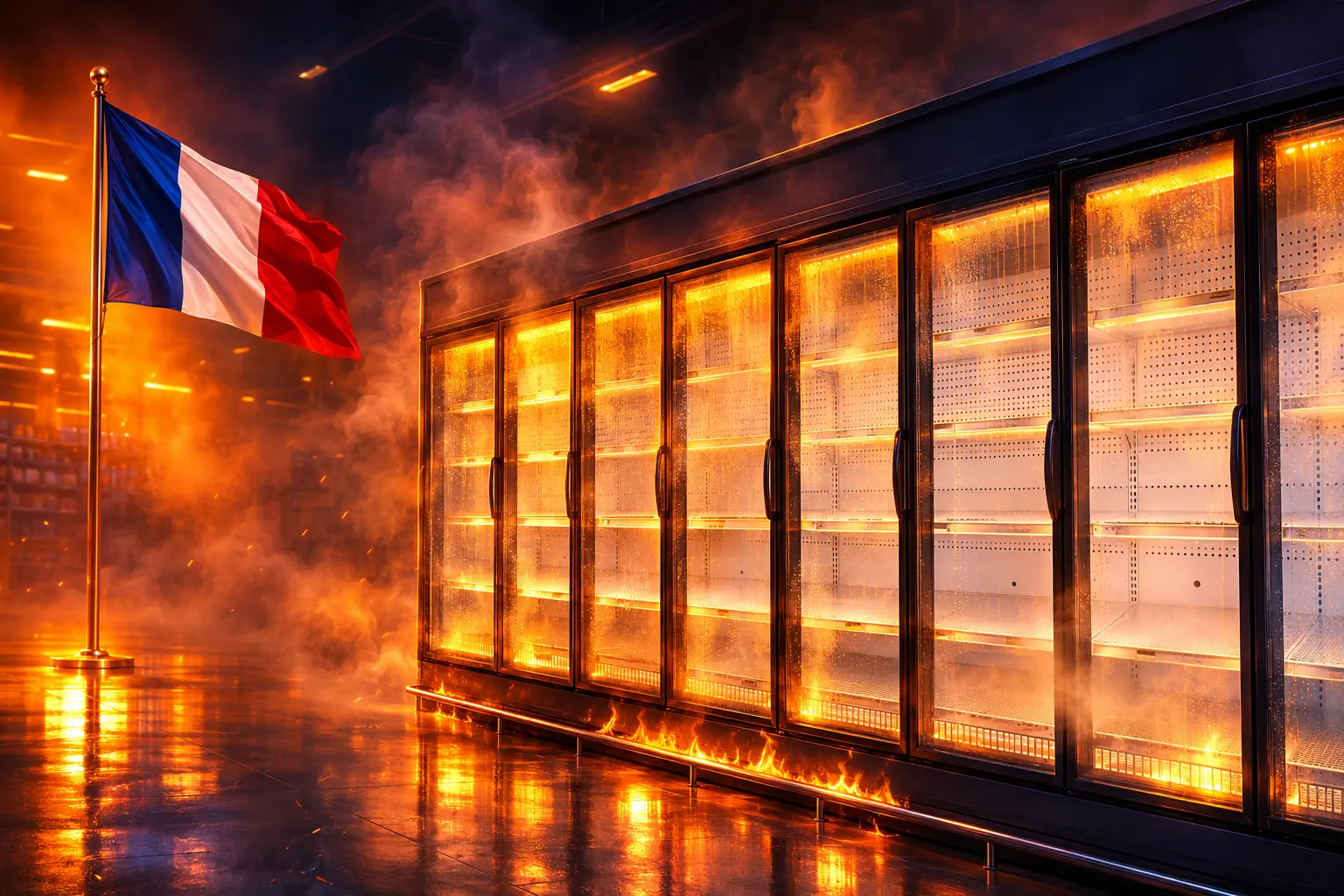
France summoned Iran’s ambassador on November 10 after blaming an IRGC cyber unit for a campaign that pushed supermarket freezers into endless defrost. The October wave hit more than 700 French retail sites, spoiled food worth tens of millions of euros, and started fires.
Twenty-one days later the same remote-defrost trick turned up in SuperValu, Delhaize, ICA and other chains, on controllers that researchers had already shown how to abuse and that France’s cyber agency had already told operators to take off the public internet.
Paris Named Shahid Kaveh for the October Wave
Foreign Minister Jean-Noël Barrot said on November 9, during a G7 meeting in Paris, that Iran’s Islamic Revolutionary Guard Corps carried out the October 11 and 12 break-ins. The French foreign ministry attributed the October sabotage to Iran in a written declaration the same day, naming Shahid Kaveh, an offensive cyber unit tied to the IRGC’s electronic warfare and cyber organisation.
Paris prosecutor Laure Beccuau said specialist investigators had matched a working method used by that unit, including Farsi-language traces and internet addresses tied to devices in Iran. Her office opened a case against the unit’s head and two deputies and asked for international arrest warrants.
Barrot called the campaign an attack of a scale and aggression France had not seen at home, and said Paris would seek European Union sanctions. Speaking on France Info on November 10, he said the government could also take steps it would not discuss in public. The foreign ministry said the Iranian ambassador was received that morning by its secretary-general.
No group had publicly claimed the freezer jobs. The ministry also noted that the EU already sanctioned the Iranian firm Emmenet Pasargad in March 2026 over other cyber activity. Naming a unit does not, by itself, take a controller off a shop floor.
The Same Defrost Trick Then Crossed Six More Countries
Overnight into Monday, November 2, refrigeration panels in Belgium, Luxembourg, Sweden, Ireland, Estonia and the Netherlands jumped their setpoints. In several shops the high reading was again 50°C (122°F), the same figure French chains reported in October, when Les Mousquetaires said Intermarché equipment sat that hot for six hours.
The method was the built-in defrost cycle, held on far past a normal overnight scrape of ice. Staff opening cases in the morning hit a wall of warm air. ICA Kvantum in Sjöbo, Sweden, put it in one Facebook line: “What shouldn’t have happened has happened!”
Carrefour Belgium called the incident a cyberattack on its refrigeration plant and said 15 of more than 700 Belgian stores were touched. Delhaize described an IT incident across about 40 shops in Belgium and Luxembourg; some of those units were logged at 15°C, a different reading from the 50°C shops. Colruyt said five Spar franchises were hit, and one owner south of Antwerp found cases at 18°C. IKEA said its Mons store in Belgium was affected and stayed open.
Stephan Moelans, chief executive of Sabcobel, the contractor that runs freezer plant for Delhaize, said his crews spent the night unplugging affected systems. Belgian operators had started patching after the French wave, and Moelans said the November damage would have been worse if they had not. That is the gap the October warning was supposed to close, and it only closed where someone actually pulled a plug or replaced a box.
Why Older Danfoss Controllers Cannot Take a Patch
France’s computer emergency team CERT-FR, part of the national agency ANSSI, said on October 12 it knew of numerous compromises of remote refrigeration controllers. The alert, updated the next day, named Danfoss AK-SM and AK-SC series units plus Copeland xweb and Dixell xweb panels. Putting a management interface on the public internet, it said, runs against basic practice.
Danfoss told French media that most of the gear in the October jobs was legacy kit that no longer receives software or security updates. It named the AK-SM 800, taken off support in May 2021, and the AK-SC 355, phased out in 2016. Some current AK-SM 800A units were also in the mix, it said, because they were running old firmware. Copeland said the weakness sat in a discontinued, end-of-life generation of controllers and that it was working with hit customers.
THE BOXES NAMED IN THE FRENCH ALERT
- Danfoss AK-SC 355: Phased out in 2016, with no software or security updates left to install.
- Danfoss AK-SM 800: Declared end of life in May 2021, and Danfoss has told shops to migrate off it.
- Danfoss AK-SM 800A: Still sold; the firm’s fix for the 2025 login flaws is firmware R4.3.1 or later.
- Copeland and Dixell XWEB: Added to the French alert on October 13; Copeland issued firmware 1.13 for the XWEB Pro line after a separate research dump.
CERT-FR told operators that a factory reset will not protect end-of-life units. Wipe the box, leave it on a public address, and it will be broken into again. The alert also told shops to check their insurance wording before they cut the data link that refrigeration contractors use to watch alarms, because that uplink is often the reason the panel is reachable at all.
MàJ ⚠️ Incident de sécurité ciblant les contrôleurs à distance des installations de réfrigération Danfoss série AK-SM, AK-SC ainsi que Copeland xweb et Dixell xweb.
Retrouvez le bulletin d’alerte régulièrement mis à jour sur :
➡️ https://t.co/CHUqbSiZAt https://t.co/eyaujVVS7V pic.twitter.com/JmtsTBwudW— ANSSI (@ANSSI_FR) October 13, 2026
ANSSI’s own post on October 13 pointed operators at that live bulletin after Copeland and Dixell were added to the target list. The November victims were not a new class of machine. They were the machines that bulletin already described.
Claroty’s August Demo Already Cooked a Test Fridge
Claroty’s Team82 published the Copeland work on August 9, after a coordinated hand-off to the vendor. The paper lists 23 flaws in Copeland XWEB Pro supervisory controllers, 21 of them rated high. One login bug, filed as CVE-2026-25085, tricked Lua middleware into treating an empty result as a valid session. Another built a daily administrator password from the date, the device’s hardware address and a key sitting in the firmware.
Once inside, the researchers found 19 ways to run operating-system commands as root. In a bench setup they talked to a field controller over Modbus, set the display to any value between -50°C and 110°C, and turned the cooling off while the screen still showed a believable probe reading. CERT-FR has not tied those file numbers to the supermarket jobs, and neither has Danfoss. The demo still shows what a reachable supervisor can do to food without malware that anyone has to plant.
A compromised supervisory controller grants an attacker the ability to physically manipulate refrigeration systems and silently spoil the contents.
Claroty Team82, XWEB Pro research note, August 9, 2026
The same research group had already flagged three bugs in the Danfoss AK-SM 800A, including CVE-2025-41450, a hidden “code-of-the-day” login. Danfoss shipped firmware R4.3.1. Mirko Travaglin, who runs monitoring and connectivity in Danfoss Climate Solutions, said customers on the 800A should move to that build or later. That advice does not help a shop whose panel is an 800 or a 355 with no build left to install.
How Many SuperValu and Delhaize Stores Lost Stock
Musgrave said a cyber incident hit refrigeration in 13 of 223 SuperValu stores in Ireland, limited to a specific model, and that chilled and frozen lines were pulled. “Our monitoring systems alerted us to the issue and we took immediate action,” the wholesaler said. ICA said 23 Swedish stores using an outside supplier, sitting outside ICA’s own store network, lost cooling; eight of those shops had to throw refrigerated and frozen product away. Coop reported trouble at six stores in central Sweden, and some of its cases sat on a 4G link that left them more exposed.
In Estonia, Selver said one outlet was hit. Jann Mutso, chief executive of refrigeration firm Kitman Coldtech, said attackers reached an older Danfoss controller, set a freezer to 50°C, and were stopped in about 10 minutes, with no goods lost. Dutch public broadcasting counted 17 companies, including butchers and small neighbourhood shops. Axfood said a home-delivery warehouse in Västra Frölunda was affected through an outside refrigeration supplier, which stalled online grocery drops around Gothenburg.
NOVEMBER 2 STORE TALLY
| Chain | Country | Confirmed sites | What staff found |
|---|---|---|---|
| Delhaize | Belgium and Luxembourg | about 40 | IT incident; some units at 15°C |
| Carrefour | Belgium | 15 of more than 700 | Called a cyberattack on refrigeration plant |
| Spar (Colruyt) | Belgium | 5 | One shop logged 18°C |
| SuperValu (Musgrave) | Ireland | 13 of 223 | Specific model; chilled and frozen lines pulled |
| ICA | Sweden | 23 | 8 shops discarded stock; outside the central network |
| Coop | Sweden | 6 | Central Sweden; some cases on 4G |
| Selver | Estonia | 1 | Caught in about 10 minutes; no goods lost |
| Dutch firms | Netherlands | 17 companies | Butchers and small shops among them |
| IKEA | Belgium | 1 (Mons) | Store stayed open |
The November list is smaller than France’s October wave, when Carrefour said 80 of 6,000 French stores were hit and Coopérative U president Dominique Schelcher put his network’s count at 80 of nearly 2,000. EU agriculture commissioner Christophe Hansen said food security now needs attention at every level, “because the weaponisation of food has become a reality.” The shops that lost the least time, like Selver, still had a contractor watching the setpoint.
Danfoss Exposure Dropped 76 Percent After Two Waves
Internet census firm Censys counted Danfoss StoreView management panels, the web front end on many of those controllers, as they vanished from public view after each wave. Global StoreView exposure fell from 3,004 hosts on October 9 to 708 on November 5, a 76% drop. Copeland and Dixell XWEB hosts fell from 3,708 to 2,420, a 35% drop. Taken together the two families went from 6,695 to 3,124, down 53%.
France did most of the Danfoss work by taking panels offline. Censys found 1,825 French StoreView hosts on October 11 and, in its early November pass, 220 StoreView hosts still online in France, with 41% of those appearing to run patched firmware. Unplugging the interface, not a firmware file, is what actually cut the French count.
STOREVIEW HOSTS STILL REACHABLE
| Country | Hosts counted | Share that looked patched |
|---|---|---|
| France | 220 | 41% |
| Belgium | 138 | 68% |
| Netherlands | 51 | 37% |
| Sweden | 50 | 58% |
Belgium’s patched share was higher than France’s, and Delhaize still lost cases. That split fits end-of-life 800 and 355 boxes that cannot take R4.3.1. The Copeland and Dixell drop was shallower, which leaves a larger public-internet population for whoever still has the defrost playbook.
Blood Banks and Base Stores Faced the Same Risk
The US Cybersecurity and Infrastructure Security Agency, the FBI, and the departments of Health and Human Services, Agriculture and Transportation issued a joint fact sheet on November 5. It said attackers are going after electronic temperature controllers and commercial refrigeration controllers in grocery and cold storage, and that they may force units into continuous defrost through authentication bypass, code injection or weak configuration. Effects listed include fire, lost stock, a shorter life for the plant, and a “denial-of-view” where operators no longer see the real temperature.
Every organization that depends on refrigeration and monitoring systems should assume it could be a target. We urge you to review the joint fact sheet and take action now to close known security gaps.
Chris Butera, CISA acting executive assistant director for cybersecurity, November 5, 2026 press release
FBI Cyber Branch operations director Brett Leatherman said the same systems protect food and medicine, and that the bureau is seeing them targeted across critical sectors worldwide. An FBI briefing on the fact sheet said attackers went after refrigeration at three French national blood-service sites earlier in November. Alarms reached the right people, staff responded, and no blood was lost.
THE COLD-CHAIN TIMELINE
- August 9, 2026: Claroty Team82 publishes the Copeland XWEB Pro findings and describes a live spoilage demo.
- August 26, 2026: Fort Huachuca’s commissary account says its freezer “went into defrost mode where it heated up all the food.”
- Late August 2026: At least six US base stores log similar failures; Cyber Command later treats them as a suspected hack and Army criminal investigators speak with French counterparts.
- October 11 and 12, 2026: Attackers force defrost across more than 700 French retail sites.
- October 12, 2026: CERT-FR issues its first Danfoss alert, then adds Copeland and Dixell the next day.
- November 2, 2026: The second grocery wave hits six other countries.
- November 5, 2026: CISA and the FBI publish the joint cold-chain fact sheet.
- November 9 and 10, 2026: France names Shahid Kaveh and summons Iran’s ambassador.
US officials have not confirmed that the August commissary failures were a break-in. Fort Irwin, Travis Air Force Base, F.E. Warren Air Force Base, Naval Station Newport and Columbus Air Force Base were among the stores that reported spoiled meat, dairy and frozen food. The sequence still sits on the same class of remote defrost plant that CISA told operators to take off the public internet.
On November 10 the Iranian ambassador was received at the French foreign ministry. Censys still counted 2,420 Copeland and Dixell XWEB hosts on the public internet as of November 5.

Baker Mayfield’s Foot Strain Tests Tampa’s Run-First Formula

Measles Turns Endemic After the US Loses Elimination Status

California Locks Waymo Off Freeways After a Recalled Defect

Aidan Hutchinson’s Season Ends on a Celebration Jump in Munich

Super El Niño Hits Food Systems Already Under Strain

Consumer Sentiment Falls to 51.7 as Future Outlook Darkens

Pluto’s Heart Glacier Still Pushes Liquid Nitrogen Upward

Take-Two Subpoenas Microsoft While GTA 6 Preorders Soar

The Extra Heat Month Hits Children Where Care Is Thinnest

Netflix Weighs Hosting Peacock and Fox One in Its App
-
 BUSINESS3 months ago
Consumer Sentiment Falls to 51.7 as Future Outlook Darkens
-
 GAMING3 months ago
Take-Two Subpoenas Microsoft While GTA 6 Preorders Soar
-
 NEWS3 months ago
Pluto’s Heart Glacier Still Pushes Liquid Nitrogen Upward
-
 NEWS3 months ago
The Extra Heat Month Hits Children Where Care Is Thinnest
-
 ENTERTAINMENT3 months ago
Netflix Weighs Hosting Peacock and Fox One in Its App
-
 NEWS3 months ago
FDA Clears Rasonque and Widens Who Can Take It
-

 NEWS3 months ago
UMMC Will Rebuild 30-Year-Old Cancer Labs With $2.4 Million
-

 GAMING3 months ago
GTA 6’s 80-Hour Run Counts Goals That Change the Story