
NEWS
Congo’s Bundibugyo Ebola Outbreak Passes 11,000 With No Vaccine
Congo’s Bundibugyo Ebola outbreak has reached 11,114 cases and 5,433 deaths, and the licensed Zaire shot still cannot be used as a public health tool.

Congo has confirmed 11,114 Bundibugyo Ebola cases and 5,433 deaths, with no licensed vaccine for the strain driving the country’s largest outbreak.
The Democratic Republic of the Congo declared the epidemic on 15 May. It now spans eight of the country’s 26 provinces, and 48.9% of confirmed patients have died.
Congo’s Confirmed Tally Stands at 11,114
The European Centre for Disease Prevention and Control, citing Congolese government data up to 10 November, put the national total on 11 November at 11,114 confirmed cases and 5,433 deaths. Another 3,031 people had recovered. Some 981 patients sat in isolation wards. Teams were still following 85.5% of known contacts.
That update added 72 confirmed infections and 46 deaths on the previous day’s figures. Ituri logged 44 of the new cases, North Kivu 24, Haut-Uélé three and North Ubangi one. Ituri still holds 69.5% of Congo’s confirmed caseload.
CONFIRMED CASES BY PROVINCE
| Province | Confirmed cases | Deaths | Health zones hit |
|---|---|---|---|
| Ituri | 7,728 | 3,655 | 28 of 36 |
| North Kivu | 2,761 | 1,523 | 17 of 34 |
| Haut-Uélé | 499 | 216 | 7 of 13 |
| Tshopo | 98 | 32 | 7 of 23 |
| Bas-Uélé | 13 | 4 | 4 of 11 |
| North Ubangi | 10 | 1 | 2 of 11 |
| South Kivu | 3 | 1 | 1 of 34 |
| South Ubangi | 2 | 1 | 1 of 16 |
Those eight rows sum to the national total. Cases have been found in 67 of Congo’s 178 health zones. Beni, Bunia and Mandima led the most recent 21-day wave in the World Health Organization’s 6 November Disease Outbreak News, which had already counted 67 health zones in eight provinces with spread still active in 51 of them.
North Kivu’s death rate, 1,523 of 2,761 confirmed infections, is 55.2%, the highest among the large provinces. In the WHO window after 21 October, 335 of 512 deaths happened in the community rather than in a treatment centre. Late October field metrics were worse still: about 59% of confirmed deaths occurred outside an Ebola unit, contact lists averaged 10.6 names against a target of 20, and some isolation wards were running at 140% of beds.
About 5,000 confirmed cases landed in the first 100 days after 15 May. The next 80 days more than doubled that. This is Congo’s 17th Ebola outbreak and the first in which Bundibugyo virus, not the Zaire species, has run across the east.
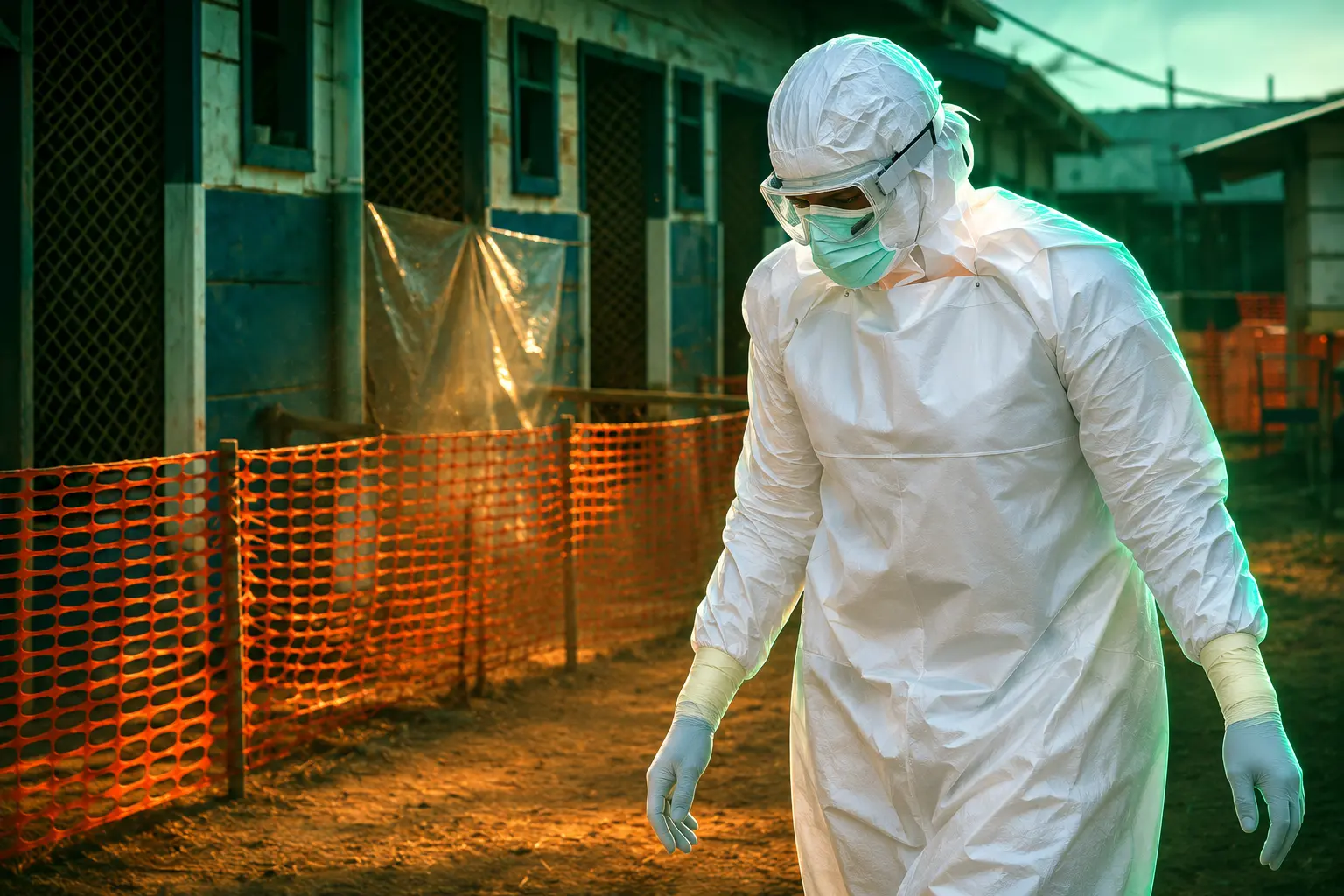
The Licensed Ebola Shot Does Not Cover This Virus
BUNDIBUGYO VIRUS DISEASE:
- The virus: Bundibugyo virus is one of four orthoebolaviruses that make people sick, distinct from Zaire, Sudan and Taï Forest viruses.
- The gap: Ervebo, the only licensed and WHO-prequalified Ebola shot, is approved for Zaire virus disease, not for Bundibugyo.
- The illness: Fever, fatigue, muscle pain, headache and sore throat come first, then gut symptoms, organ failure and, in some patients, bleeding. People are not infectious before symptoms. The incubation window is two to 21 days.
WHO’s own vaccine questions page is blunt: there is no licensed vaccine for Bundibugyo virus disease. The same hole exists for treatment. Ebanga and Inmazeb, the licensed antibody drugs from the Zaire years, do not cover this species. Zabdeno and Mvabea, the two-dose Zaire regimen, do not either.
Fruit bats are the suspected reservoir. Infection then moves person to person through blood, other body fluids, contaminated bedding and unsafe burials, and it accelerates in clinics when infection control is thin. Older Bundibugyo outbreaks were smaller. Uganda in 2007 killed about 30% of patients. Congo’s 2012 outbreak killed about 50%. The current crude death rate, 48.9%, sits on that second figure.
Richard Hatchett, chief executive of the Coalition for Epidemic Preparedness Innovations, said the cost of having no licensed vaccine against Bundibugyo virus is already visible in deaths and in unprotected health staff.
There is still no licensed vaccine against Bundibugyo virus, and the cost of that absence is being counted in the DRC every day, in lives lost and in health workers who go to work without protection. Tumaini aims to change that.
Dr Richard Hatchett, CEO, Coalition for Epidemic Preparedness Innovations
CEPI had already put more than $60 million behind four candidate shots, from IAVI, Moderna, Oxford with the Serum Institute of India, and Public Health Vaccines. The U.S. Department of State added $50 million on 12 June. That money is now feeding a trial. It is not a stockpile that ring-vaccination teams can draw on tonight in Beni.
WHO’s Strategic Advisory Group of Experts on Immunization told countries to keep Ervebo inside a research protocol for this outbreak. Lab work on human sera and animal models hints at some cross-protection. The agency says that hint is not enough to measure protection in people, and not enough to treat Ervebo as a Bundibugyo public-health tool.
Health Teams Lost More Than 1,000 Contacts After One Raid
The virus is moving through the same hills and towns that fought the 2018-2020 Zaire outbreak, and the security map is uglier than a missing vial. WHO Director-General Tedros Adhanom Ghebreyesus told a briefing that insecurity is now one of the greatest obstacles to the response, cutting access and slowing the time it takes to reach sick families.
Wessam Mankoula of the Africa Centres for Disease Control and Prevention, speaking on 12 November, laid out a short ledger of violence that has grown deadlier since late September.
ATTACKS LOGGED BY AFRICA CDC
- Armed raids: Four armed attacks on the response.
- Assaults: Sixteen assaults on responders.
- Clinics: Eleven health facilities burned or otherwise hit.
- Cantine-Aloya: An Allied Democratic Forces raid in North Kivu killed 66 people, including three health workers, and wrecked three clinics.
- The list that vanished: More than 1,000 contacts dropped out of follow-up, and three confirmed patients remain unaccounted for.
WHO officials said the search for those missing patients and contacts was still on after the raid, and that attacks continued as recently as the night of 11 November. When a clinic burns, the chain of names that ring vaccination needs burns with it. North Kivu has been producing about half of new infections in some recent weeks. A hole in that province is a hole in the national curve.
Community hostility is doing similar damage without rifles. In late October, youths in Bafwasende, Tshopo province, killed an experienced nurse on community outreach and badly wounded a teacher working with him. Local officials said the pair were accused of spreading Ebola through the water. Julien Harneis, the senior United Nations Ebola coordinator, called the nurse’s death a loss to the response and a greater loss to patients. Remaining staff in Bafwasende sheltered inside the general hospital under police guard, afraid to go home. Dr Stanislas Masulimare, a disease-surveillance expert speaking in Kisangani on 11 November, said some communities in that health zone still reject investigation teams, which blocks case-finding and contact tracing.
Health workers are dying of the virus as well as of the violence. Dr Marie-France Shogogo died in a treatment centre and was buried on 31 October at Nyamurongo Cemetery in Bunia under safe-burial rules. The index patient of the whole outbreak, Congo’s health ministry said, was also a nurse, who died in a Bunia facility after fever, bleeding, vomiting and weakness. WHO judged that hidden spread had likely started weeks before the 15 May declaration.
Community engagement and disease surveillance remain critical to bringing the #Ebola outbreak under control in the DRC.
Working alongside partners, including @UNICEF, @WHO continues to support government-led efforts to strengthen the response and interrupt transmission. pic.twitter.com/XzguwjuCNf
— WHO African Region (@WHOAFRO) November 11, 2026
Managers at the Kibali gold mine sent some staff and contractors home after two Ebola deaths in a nearby community, a reminder that the outbreak is already moving people who are not on any contact list.
What the Tumaini Trial Can Prove by Early 2027
On 23 October, the first participant was vaccinated in Bunia in Tumaini, a Phase 2/3 ring-vaccination trial whose Swahili name means hope. Congo’s Institut National de Recherche Biomédicale is leading it with the University of Antwerp, alongside WHO, Epicentre, Médecins Sans Frontières, the Institute of Tropical Medicine of Antwerp, Africa CDC, the health ministry and the Institut National de Santé Publique.
The first product in the rings is Ervebo, put there to test whether the Zaire shot does anything against Bundibugyo in people. Four rings were already up by early November, built around contacts of the sick and the dead, with more being prepared. WHO then recommended adding two new Ebola vaccine candidates once national approvals land: ChAdOx1 from Oxford and the Serum Institute of India, and Moderna’s mRNA-1469. Advisers said both protected animals, raised antibodies within 14 days, and looked acceptable in early human safety work. They will be the first Bundibugyo-specific shots tested during an outbreak of this virus. Vaccine-trial results are expected in early 2027.
HOW THE OUTBREAK AND THE TRIAL LINED UP
- 15 May 2026: Congo declares an Ebola outbreak in Ituri after laboratory confirmation of Bundibugyo virus at INRB.
- 17 May 2026: WHO declares a Public Health Emergency of International Concern for the epidemic in Congo and Uganda.
- 18 May 2026: Africa CDC declares a Public Health Emergency of Continental Security.
- July 2026: The PARTNERS treatment trial opens in Bunia, testing MBP134, remdesivir, or both against standard care.
- 23 October 2026: Tumaini vaccinates its first participant in Bunia, starting with Ervebo in a ring design.
- 4 November 2026: WHO advisers recommend adding the Oxford-Serum ChAdOx1 shot and Moderna’s mRNA-1469 after national approvals.
- 5 November 2026: The United Kingdom evacuates a confirmed infected health worker from Congo to a London isolation unit.
Treatment research is running on a shorter clock than the vaccine arms. WHO says first PARTNERS findings are due in the coming months. Maftivimab is lined up to join that study. A separate post-exposure trial is giving obeldevisir to contacts who are not yet sick. None of those products is approved for Bundibugyo disease. Until a result reads out, supportive care and isolation remain the medicine.
Vaccines alone will not end this outbreak, but they could become a powerful new tool for bringing it under control.
Dr Tedros Adhanom Ghebreyesus, WHO Director-General, 4 November 2026 statement
WHERE EXPERTS DISAGREE
- Médecins Sans Frontières: Waiting for a Bundibugyo-specific shot leaves people exposed, so broader use of the Ervebo vaccine should start now, on the chance of cross-protection.
- WHO SAGE: Ervebo should stay inside a research protocol because human evidence of Bundibugyo protection is still too thin to set policy.
⏰ Every moment waiting for a vaccine specific to Bundibugyo virus leaves people exposed to the Ebola outbreak in DRC.
Broader use of the ERVEBO® vaccine could help protect people today.https://t.co/RT4rEH7Ks1
— MSF International (@MSF) November 12, 2026
MSF has also said too little of the money and staff piled into the response is reaching the villages that actually have cases. That complaint sits beside the vaccine fight: a trial in Bunia does not replace contact tracers who cannot walk a road, or a clinic that has been burned.
Kenya Discharged Its Last Patient on 11 November
Cases have been recorded in five countries since 15 May: Congo, France, Kenya, Nigeria and Uganda. France and Uganda had their outbreaks under control from August. Kenya and Nigeria were still closing contact lists in November.
Kenya confirmed nine infections and two deaths, all in one cluster around an imported first patient, a Kenyan citizen who had been living in Congo and travelled home through Uganda on 3 October. Eight later cases were four family members and four health workers. The last Kenyan case was recorded on 20 October. On 11 November the last patient left treatment and the last contacts finished 21 days of watch. Kenya had screened 760,415 travellers at designated entry points by 5 November. WHO said the 42-day countdown to an official end starts only after that last discharge, so Kenya is not yet in the clear on paper.
Uganda counted 20 confirmed cases and two deaths. Its last confirmed case came on 21 June. The last patient left Mulago National Referral Isolation Centre on 16 July. After 42 days with no new confirmed case, Uganda declared the outbreak over on 27 August. Screening at the Congo border has stayed in place.
Nigeria reported one laboratory-confirmed imported case in Abuja on 20 October. The patient had flown from Uganda, developed symptoms on 7 October, sought care on 11 October, and tested positive nine days later. On 26 October Switzerland evacuated that patient and her husband to Geneva. Of 62 Nigerian contacts, 52 had finished 21 days of follow-up as of 11 November.
WHO still advises against travel or trade bans. Several countries have added entry screening anyway. Congo restricted some movement from affected provinces and shut commercial flights at Bunia airport as part of its own health-security rules. The larger export risk is not a passenger on a long-haul jet. It is the next uncounted funeral in Ituri.
These Provinces Stopped a Smaller Outbreak With Ervebo
From 1 August 2018 to 25 June 2020, North Kivu, Ituri and South Kivu fought Zaire ebolavirus with a tool this outbreak does not have. That tenth Congolese outbreak ended at 3,470 cases, including 3,317 confirmed and 153 probable, and 2,287 deaths. Responders vaccinated 265,183 people with Ervebo in 1,853 rings. It was the first time an Ebola vaccine was used at that scale, and it was the same geography: Beni, Butembo, Mandima, the Ituri towns now filling isolation beds again.
Armed groups and mistrust slowed that response too. The outbreak still lasted almost two years. It did not reach 11,114 confirmed cases in 180 days. The difference is not that eastern Congo became peaceful. The difference is that ring vaccination had a licensed product matched to the virus in the blood samples.
The 2014-2016 West Africa epidemic remains the largest Ebola outbreak on record and killed more than 11,000 people. Congo has now taken second place on both cases and deaths, and it has done so with a species that still has no approved shot and no approved drug. On 17 May WHO called the Bundibugyo wave a Public Health Emergency of International Concern. That status had not been lifted by 11 November.
In the latest ECDC interval Congo added 72 confirmed cases and 46 deaths, 44 of the new infections in Ituri. Those infections arrived while the first Bundibugyo-specific shots were still waiting on national approvals to enter a trial that will not report until early 2027.
Disclaimer: This article is news reporting on an ongoing outbreak and related vaccine and treatment studies. It is for information only and is not medical advice, a diagnosis, or a guide to vaccination, travel, or clinical care. Readers who may have been exposed, who have symptoms, or who are making health decisions should speak with a qualified physician or their national public-health authority. Case counts, death totals, trial status and travel rules are those published by the agencies named above as of the dates given in the story and will change as new situation reports appear.

Baker Mayfield’s Foot Strain Tests Tampa’s Run-First Formula

Measles Turns Endemic After the US Loses Elimination Status

California Locks Waymo Off Freeways After a Recalled Defect

Aidan Hutchinson’s Season Ends on a Celebration Jump in Munich

Super El Niño Hits Food Systems Already Under Strain

Consumer Sentiment Falls to 51.7 as Future Outlook Darkens

Pluto’s Heart Glacier Still Pushes Liquid Nitrogen Upward

Take-Two Subpoenas Microsoft While GTA 6 Preorders Soar

The Extra Heat Month Hits Children Where Care Is Thinnest

Netflix Weighs Hosting Peacock and Fox One in Its App
-
 BUSINESS3 months ago
Consumer Sentiment Falls to 51.7 as Future Outlook Darkens
-
 GAMING3 months ago
Take-Two Subpoenas Microsoft While GTA 6 Preorders Soar
-
 NEWS3 months ago
Pluto’s Heart Glacier Still Pushes Liquid Nitrogen Upward
-
 NEWS3 months ago
The Extra Heat Month Hits Children Where Care Is Thinnest
-
 ENTERTAINMENT3 months ago
Netflix Weighs Hosting Peacock and Fox One in Its App
-
 NEWS3 months ago
FDA Clears Rasonque and Widens Who Can Take It
-

 NEWS3 months ago
UMMC Will Rebuild 30-Year-Old Cancer Labs With $2.4 Million
-

 GAMING3 months ago
GTA 6’s 80-Hour Run Counts Goals That Change the Story