
NEWS
Meta Settlement Holds $5.3 Billion Until Rivals Match
Meta’s $18 billion youth addiction settlement pays about $12.7 billion for sure; $5.3 billion and a one-hour cap wait on YouTube and TikTok.

Meta will pay about $18 billion over 10 years to settle youth addiction claims against Instagram and Facebook, with $5.3 billion waiting on TikTok and YouTube. Judge Yvonne Gonzalez Rogers entered the consent judgment on August 26, 2026, eight days after trial opened in Oakland.
The company denies the states’ claims. The order still locks in default time caps, night blocks, and age checks for users under 18, then leaves a third of the cash and the tighter rules hanging on whether two rivals copy them.
Meta Keeps $5.3 Billion Until Rivals Pay
Meta’s newsroom put the package at about $18 billion, paid in yearly installments over a decade, and said participating states get about 70 percent, or about $12.7 billion over 10 years, no matter what competitors do. The other 30 percent, about $5.3 billion, is released only after YouTube and TikTok put in a one-hour daily limit, night mode, and age-assurance measures, and after each of them pays a matching sum, with half of the held-back money tied to each company.
That structure does two jobs at once. States get a guaranteed check. Meta also gives those same states a reason to squeeze the two apps that still collect the rest of teen attention if Instagram and Facebook go dark at midnight.
Meta said it would book about $10 billion as a legal expense in the third quarter of 2026, a charge it said was not in the expense range from its July earnings call. The cash still goes out over 10 years, and the last 30 percent may never move if YouTube and TikTok refuse.
C.J. Mahoney, Meta’s chief legal officer, tied the whole bargain to that industry copy.
Our new Time Limit commitments, Night Mode features and usage limits during school hours set the right path forward for our whole industry, but this framework will only work if all our peers join us.
C.J. Mahoney, Chief Legal Officer, Meta
What Changes on Instagram and Facebook for Teens
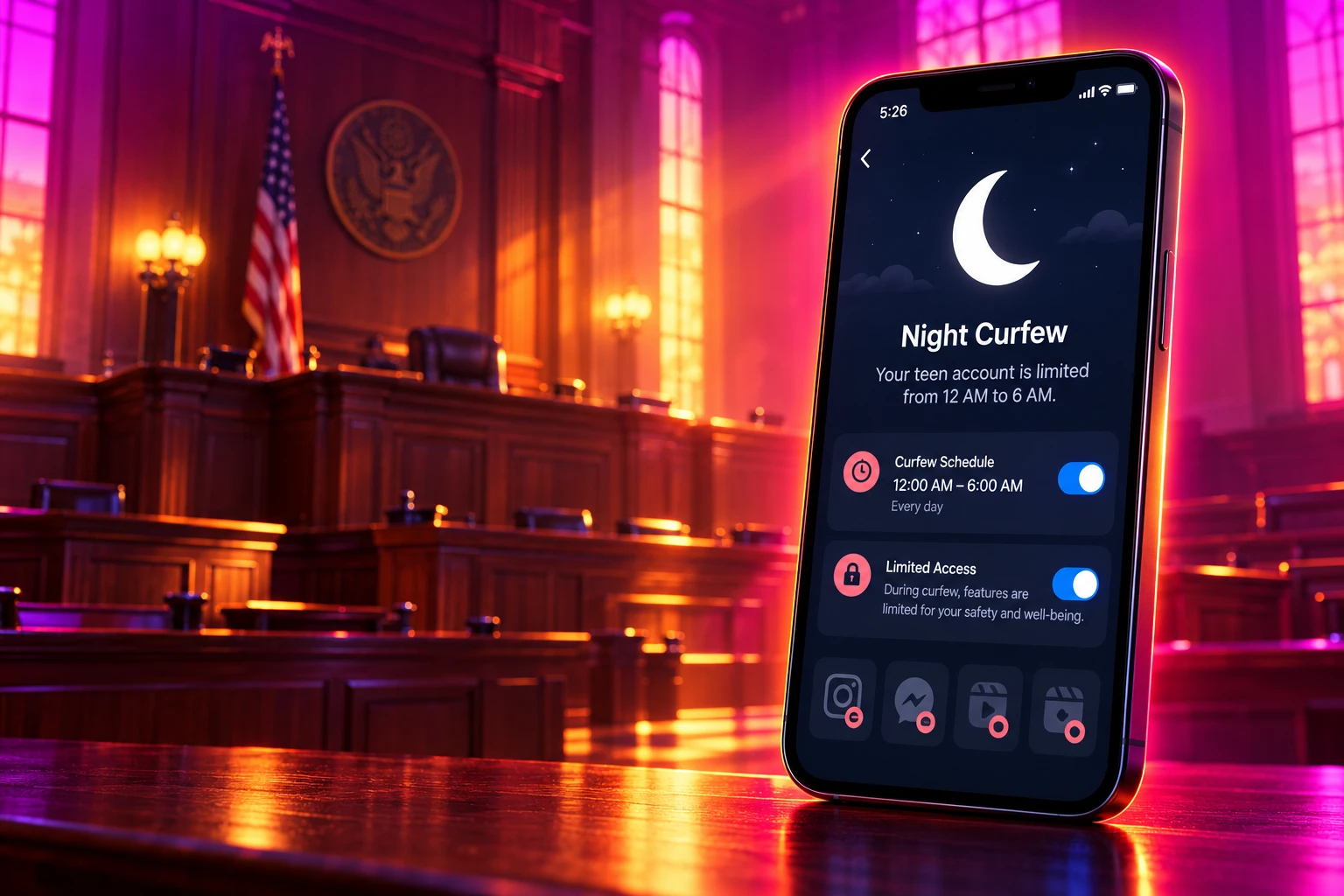
The product rules are the part teens will feel. Under the judgment, defaults for users under 18 apply in participating U.S. states and territories. A parent can lift the time cap and the night block. The teen cannot.
Meta starts looser than the terms it wants from YouTube and TikTok. The sliding scale is written into the deal.
HOW THE CAP TIGHTENS IF RIVALS SIGN ON
| Rule | Meta default now | If YouTube and TikTok match |
|---|---|---|
| Daily time cap | Two hours combined on Facebook and Instagram | One hour per app |
| Night block | Midnight to 6 a.m. | 10 p.m. to 7 a.m. |
| How long those two rules last | Five years | Ten years |
Tennessee Attorney General Jonathan Skrmetti described the tighter one-hour, 10-year version as turning on if Snapchat, TikTok, and YouTube adopt comparable terms, a wider trigger than Meta’s cash clause, which names only YouTube and TikTok. Most other terms in the judgment are required to remain in place for 10 years either way.
Direct Messages Escape the Daily Cap
The two-hour ceiling is cumulative across Facebook and Instagram, including time Meta detects on more than one account. It does not cover everything a teen does inside those apps. Meta said direct messaging is excluded from Night Mode, the time limit, and School Mode so teens can still reach friends and family after the feed locks.
That hole is large. A teen who hits the cap can keep talking. A teen who is blocked from Reels at 12:01 a.m. can still sit in chats. The cap binds the infinite scroll Meta was sued over, and it leaves the private thread running.
TEEN DEFAULTS BEYOND THE CLOCK
- Scroll pauses: Prompts appear after every 15 minutes of continuous screen time, and again when daily use hits 60 minutes and 90 minutes.
- School mute: Push notifications are off by default from 8 a.m. to 3 p.m., except for direct messages and safety or security alerts.
- Hidden likes: Teens will not see like and reaction counts on their own posts or on other people’s posts by default.
- Filter ban: Extreme makeup filters are blocked for teens, on top of Meta’s existing block on cosmetic-surgery filters.
- Feed choice: Teens can pick a non-personalized feed as the default, and parents can require that setting.
- Autoplay: Teens can turn autoplay off so the next clip does not start without a tap or swipe, and parents can require that too.
- Age checks: Meta pledged stronger tools to find under-13 accounts and to place 13-to-17 accounts in teen experiences even when someone enters an adult birthday.
- Parent alerts: Supervision tools will notify parents when a teen links a secondary account and when the teen tries to change protective settings.
California Attorney General Rob Bonta’s office also said Meta must answer 90 percent of teens’ reports of potentially harmful content within six hours, and it cited default notification blocks from 10 p.m. to 7 a.m. on top of the school-day mute. Bonta said the company has to make the changes within months.
California Stands to Collect $1.5 Billion to $2.1 Billion
Meta counted 52 attorneys general across states, territories, and the District of Columbia. Florida and New Mexico are not on that published list. How each state spends its share is a local choice. Bonta said California’s money is earmarked in the deal for preventing or repairing mental-health and other harms to young people tied to social media use, with the Legislature and governor making the final call.
WHAT SOME STATES SAY THEY WILL RECEIVE
| Jurisdiction | Stated amount | Noted use |
|---|---|---|
| California | $1.5 billion to $2.1 billion for California | Youth mental-health and social-media harm work, subject to state budget process |
| Tennessee | $751,922,691.13 | Net recovery to the Tennessee Children’s Digital Protection Fund |
| Massachusetts | At least $366 million, up to $516 million | State share of the multistate deal |
| District of Columbia | $90,395,940 to $129,356,762 | Floor and ceiling published by the D.C. attorney general |
| Delaware | $73.6 million guaranteed, plus $30 million if rivals pay | Starts with $11 million in 2026 |
Delaware Attorney General Kathy Jennings said the first-year check also folds in $4.2 million tied to the older Cambridge Analytica matter, a privacy claim resolved in the same package. Several attorneys general compared the deal, on size, with the state tobacco settlements of the 1990s.
The Oakland Trial Stopped on Day Eight
The federal case sat inside multidistrict litigation over adolescent social-media harm, People of the State of California et al. v. Meta Platforms, Inc., before Judge Gonzalez Rogers in the Northern District of California. States alleged Meta used Facebook and Instagram to “entice, engage, and ultimately ensnare” young users, misled families about risk, and violated the Children’s Online Privacy Protection Act by collecting data from children under 13. Meta denies liability.
THE PATH TO THE CONSENT JUDGMENT
- 2021: Nearly every state attorney general joins a nationwide investigation of how social apps were designed and sold to children.
- October 24, 2023: California and fellow states file the federal complaint that becomes the Oakland trial track.
- August 18, 2026: Trial opens in Oakland on consumer-protection and COPPA claims.
- August 26, 2026: The parties file a consent judgment filed in Oakland, and Judge Gonzalez Rogers enters it as a final judgment the same day.
- August 27, 2026: Meta updates its newsroom post at 10:30 a.m. PT to record the judge’s approval.
Tennessee had been in a parallel trial in Davidson County before Chancellor Russell T. Perkins. That case ended when Tennessee joined the national deal. Judge Gonzalez Rogers called the settlement “a good step forward” and told the lawyers she was “quite happy to not have to finish up this trial.” The parties waived appeal of the final judgment.
Skrmetti Told the Rest of Big Tech to Catch Up
Meta did not wait for a quiet implementation. The same day as the judgment, it published an open letter to urge TikTok and YouTube to join, arguing that teens move from one app to another when a single platform is restricted. In the days after August 26, neither YouTube nor TikTok posted matching one-hour caps, night blocks, or a parallel payment.
That silence is the live risk inside the order. A two-hour lock on Instagram and Facebook, with chats still open, does not bind the short-video apps that already hold a large share of teen time. If those apps stay uncapped, leftover minutes flow there. If they match, Meta’s own cap drops to one hour per app, night mode stretches from 10 p.m. to 7 a.m., and those two rules last 10 years instead of five.
The settlement addresses Meta’s role in an industry-wide problem, and now the rest of Big Tech needs to catch up to Meta and implement similar protections.
Jonathan Skrmetti, Attorney General of Tennessee
Skrmetti added, “We’re going to make sure they do.” He also said litigation cannot replace a federal duty of care, and he thanked Senators Marsha Blackburn and Richard Blumenthal for pushing the Kids Online Safety Act. Meta, for its part, said app stores should verify age and get parental approval before a teen downloads an app, a shift that would push the ID check upstream from Instagram to Apple and Google.
Age checks are already the part of the deal that draws the sharpest privacy objection. Requiring stronger identification of under-18 users can mean more ID scans and more data held on minors, which is a separate fight from whether a two-hour timer belongs on Reels.
WHAT WE KNOW
- The judgment: Judge Gonzalez Rogers entered the consent judgment on August 26, 2026, and the parties waived appeal.
- The floor payment: Meta committed about $12.7 billion to participating states over 10 years even if no rival signs on.
- The Meta-only cap: The default two-hour combined limit and the midnight-to-6 a.m. block apply to Instagram and Facebook, not to YouTube or TikTok.
WHAT IS UNCONFIRMED
- Rival payments: There is no public commitment from YouTube or TikTok to pay a matching amount or to install a one-hour teen cap.
- Snap’s role: Meta’s cash trigger names YouTube and TikTok; Tennessee’s description of the tighter one-hour, 10-year product rules also names Snapchat.
- The last $5.3 billion: Whether that tranche ever leaves Meta depends on those future deals, which the August 26 judgment does not order.
Bonta put the states’ case in simpler terms than the contingent math.
Today, we have secured a settlement with Meta that will make social media less dangerous for our kids and make a world of a difference for children and their families.
Rob Bonta, Attorney General of California
Family Lawsuits Were Left Off the Release
The consent judgment binds the settling states and Meta. It does not create a private right of action, and it says only the parties and the court can enforce a breach. Claims by private individuals, and pending cases by school districts and other local governments, are carved out of the release.
That split is why the August 26 deal can close the attorneys general track and still leave thousands of family and school cases in the same MDL. Parents who sued over a child’s injury are not paid out of the $12.7 billion. School systems that sued over counseling costs stay on their own dockets.
An independent auditor will test Meta’s compliance each year for five years and report to the states. Meta also agreed to an injunction against further false or misleading statements about its safety features. The money and the product orders are the parts that made the trial stop. The leftover dockets are the parts that did not.
Frequently Asked Questions
Does the Two-Hour Cap Count Extra Instagram Accounts?
Yes. Meta said the two-hour default is cumulative across Facebook and Instagram, and that time spent scrolling on both apps counts toward the total, including if the company detects that someone has multiple accounts. A second Instagram login does not reset the clock.
What Can a Teen Still Open After Midnight?
Night Mode, Meta said, stops teens from posting or viewing Feed, Stories, Explore, or Reels between midnight and 6 a.m. Direct messaging stays available during that window, and it also stays available after the daily time limit is used up and during school-hour notification muting.
Can a Parent or Teen Sue Meta Under This Judgment?
No. The consent judgment states that it does not create a private right of action and does not give a non-party any right to enforce it. Families and school districts keep whatever separate lawsuits they already filed; they do not gain a new claim from this order.
What Is the Independent Research Foundation in the Deal?
The agreement will set up an independent social media research foundation, and Meta said it will share consented user data with that foundation to study teen well-being online. That research track sits beside the yearly compliance auditor and is a separate promise from the cash paid to states.
In the days after the August 26 judgment, the $5.3 billion tranche was still sitting behind a door YouTube and TikTok had not opened. The two-hour clock, and the chat window that outruns it, is what under-18 users on Instagram and Facebook will meet first.
Disclaimer: This article is news reporting and analysis of a completed court settlement and related company statements. It is informational only and is not legal, investment, or parenting advice. It does not tell readers whether to sue, hold or sell Meta securities, or change a child’s app settings. Anyone facing a related claim, a custody or school matter, or a portfolio decision should consult a qualified attorney, licensed financial adviser, or pediatric clinician before acting. Figures, parties, and product rules reflect the cited filings and statements as of the dates given and may change if the judgment is modified or if other companies later settle.

IT Stocks Climb as Sensex Falls After RBI Hike

Anthropic Prices Claude Haiku 5.5 as a Subagent Worker

Nifty Falls While India Pays $121 a Barrel

OpenAI’s 722 Math Papers Leave the Checking to Humans

Flipkart Recruits Sellers and Riders for Big Billion Days

Consumer Sentiment Falls to 51.7 as Future Outlook Darkens

Pluto’s Heart Glacier Still Pushes Liquid Nitrogen Upward

The Extra Heat Month Hits Children Where Care Is Thinnest

Take-Two Subpoenas Microsoft While GTA 6 Preorders Soar

Abbott Pays $670 Million to Exit a Missouri Food Verdict
-
 BUSINESS2 months ago
Consumer Sentiment Falls to 51.7 as Future Outlook Darkens
-
 NEWS2 months ago
Pluto’s Heart Glacier Still Pushes Liquid Nitrogen Upward
-
 NEWS2 months ago
The Extra Heat Month Hits Children Where Care Is Thinnest
-
 GAMING2 months ago
Take-Two Subpoenas Microsoft While GTA 6 Preorders Soar
-
 BUSINESS2 months ago
Abbott Pays $670 Million to Exit a Missouri Food Verdict
-

 NEWS2 months ago
UMMC Will Rebuild 30-Year-Old Cancer Labs With $2.4 Million
-

 ENTERTAINMENT2 months ago
Netflix Weighs Hosting Peacock and Fox One in Its App
-

 GAMING2 months ago
GTA 6’s 80-Hour Run Counts Goals That Change the Story