
BUSINESS
The ATF Hike Splits Airlines Before Dussehra Travel
ATF rose 5.46% to ₹121.28 a litre, but IndiGo’s cash and Delhi-Mumbai VAT cuts mean Dussehra fare pain will hit thin, high-tax routes first.

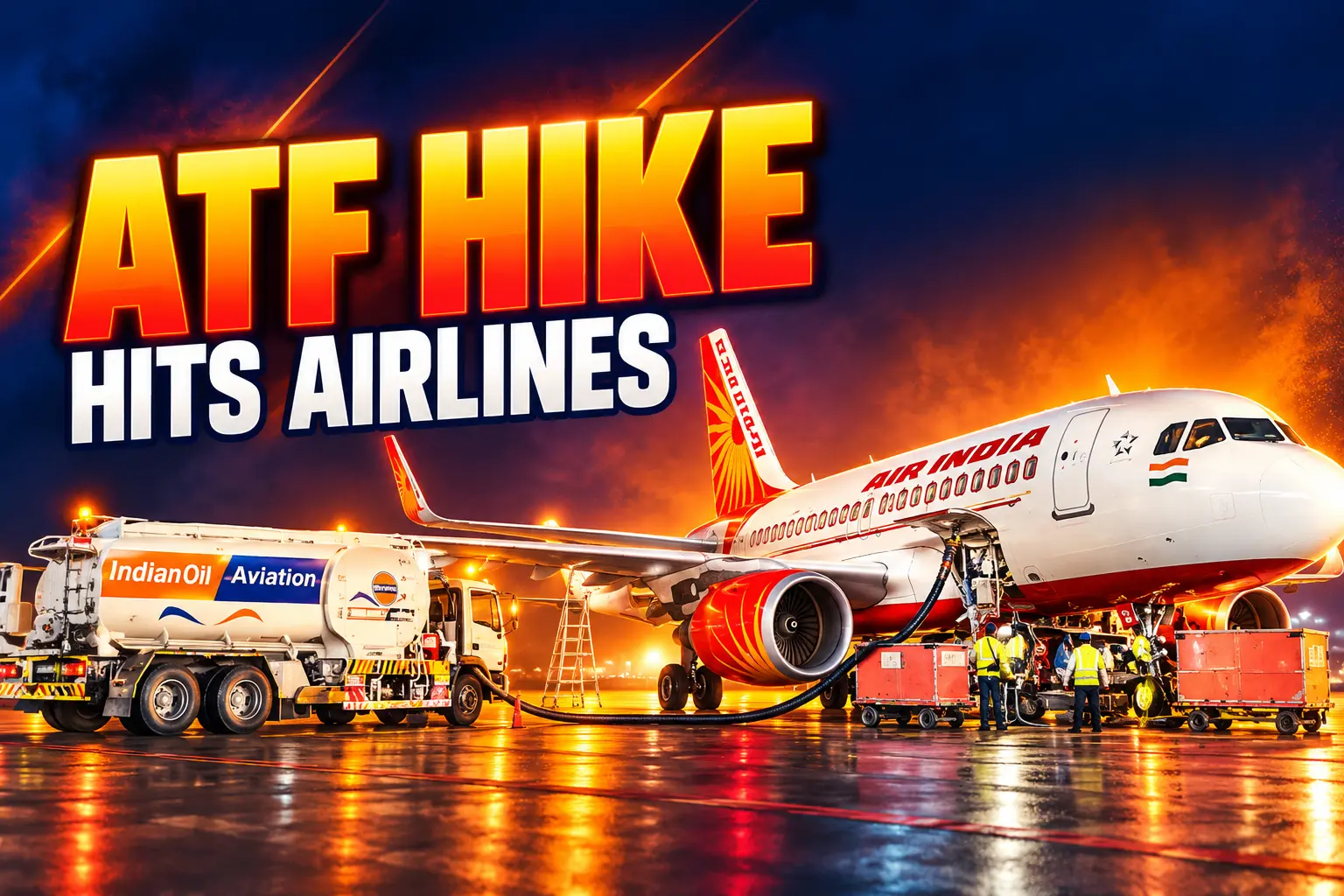
State-owned oil firms raised aviation turbine fuel for domestic airlines by 5.46% to ₹121.28 a litre on 1 September, the second monthly increase. The ₹6.28 jump follows a ₹5 rise on 1 August and lands 48 days before Dussehra and 67 days before Diwali.
Ticket prices will not move as one block. IndiGo can still choose where to pass the bill on, because it holds a large cash pile and most of its fuel is uplifted in Delhi and Maharashtra, where VAT is 7% until mid-November. Passengers on high-tax festive routes, and carriers without that cash, have less room.
ATF Now Costs ₹121.28 a Litre After Two Hikes
Indian Oil Corporation sources put the new domestic airline rate at ₹121.28 a litre, up from ₹115. That is a 5.46% increase on the August price and the second consecutive monthly revision higher. On 1 August the same rate had moved from ₹110 to ₹115. In July it had been cut by ₹5, so the two-month climb from that low is ₹11.28, or 10.3%.
Oil marketing companies reset ATF on the first of each month against international benchmarks and the rupee. City prices still differ because state VAT sits on top of the base, which is why the monthly ATF prices in four metros have never been a single national number. On 1 March, before the West Asia shock fully hit the published table, Delhi stood at ₹96,638.14 a kilolitre, Mumbai at ₹90,451.87, Kolkata at ₹99,587.14 and Chennai at ₹1,00,280.49.
THE SEPTEMBER FUEL PRINT
- New rate: ₹121.28 a litre for domestic airlines from 1 September.
- Monthly move: ₹6.28 a litre, or 5.46%, on the ₹115 August price.
- Two-month climb: ₹11.28 a litre, or 10.3%, from the ₹110 July rate.
- Cost weight: Fuel is 35-40% of airline operating costs in a normal month and can reach 60% when prices spike, per the civil aviation ministry.
InterGlobe Aviation shares were at ₹5,077.50 on the NSE on Tuesday, down 2.99%. SpiceJet was at ₹10.14, down 1.74%. Trading on Wednesday extended that slide as crude kept rising.
IndiGo’s Fuel Bill Jumped 85.7% Last Quarter
India’s largest carrier has already shown what a fuel spike does to a full quarter. For the three months to 30 June, InterGlobe Aviation posted a net loss of ₹2,380 million against a profit of ₹21,763 million a year earlier, even after revenue from operations rose 19.9% to ₹245,841 million. Fuel costs of ₹108,329 million were 85.7% higher than the ₹58,326 million billed in the same quarter last year, and fuel came to 44.1% of operating revenue.
INDIGO Q1 FY27 VERSUS A YEAR EARLIER
| Metric | Jun 2026 | Jun 2025 | Change |
|---|---|---|---|
| Revenue from operations | ₹245,841 mn | ₹204,963 mn | +19.9% |
| Aircraft fuel | ₹108,329 mn | ₹58,326 mn | +85.7% |
| Fuel CASK | ₹2.49 | +80.4% | |
| Yield per km | ₹6.04 | ₹4.98 | +21.3% |
| Load factor | 83.3% | 84.6% | -1.3 pts |
| Passengers | 31.3 million | 31.0 million | +0.7% |
| Net profit / (loss) | (₹2,380 mn) | ₹21,763 mn |
Yield rose 21.3% to ₹6.04 a kilometre while the load factor slipped 1.3 points to 83.3%. The airline filled almost the same number of seats, 31.3 million against 31.0 million, by charging more per kilometre. That is pass-through in the fare, not in the load factor, and it is the lever IndiGo still holds on busy trunk routes into the festive weeks.
The first quarter was shaped by a volatile operating environment, with elevated fuel costs and network-related constraints in the middle east impacting profitability. At the same time, demand remained healthy and our revenue performance improved year-on-year, supported by improved yields and continued customer preference for IndiGo as we proudly served more than 31 million passengers.
Rahul Bhatia, Managing Director, InterGlobe Aviation, Q1 FY27 results
Bhatia also said fuel costs and rupee depreciation produced a loss of around 2 billion rupees for the quarter. The rupee was more than 11% weaker year on year, which lifts dollar leases and maintenance as well as fuel. Against that, IndiGo still held ₹390,387 million of free cash and ₹528,846 million in total cash at 30 June, against a fleet of 432 aircraft and a peak of 2,298 flights a day. A carrier with that cash can fail to pass a ₹6.28 litre hike through on Delhi-Mumbai and still fly. A thinner balance sheet cannot.
Capacity in the July-September quarter was guided as broadly flat against a year earlier. Management said utilisation should rise after that seasonally weaker stretch, which is exactly the window that contains Dussehra and Diwali.
The Fuel Freeze That Found No Buyers
In June the Union Cabinet approved a one-time ₹10,000 crore Price Stabilisation Fund for oil marketing companies, sold as a way to lock ATF for scheduled Indian carriers for up to three years. Participating airlines would have paid a fixed free-on-board benchmark of ₹86.32 a litre for domestic operations, plus taxes and airport charges, for an effective selling price around ₹115 in Delhi and ₹114.5 in Mumbai, and about ₹139 in Chennai. Carriers that stayed out would pay the market, which in May had been near ₹142 a litre after international ATF jumped from ₹60.50 in March.
IndiGo had not opted into the price freeze when it reported those June results. From 9 June it booked fuel at prevailing market prices while it waited for detailed guidelines on the fund. The published domestic rate then moved again on 1 July, 1 August and 1 September, which is how a market-linked price behaves, not a three-year cap.
Civil Aviation Minister Ram Mohan Naidu had said the fund would cut uncertainty in fuel costs and, in time, airfares. The same briefing noted that ATF can be 40% of operating costs in a normal month and 60% in a spike, and that landing and parking charges for domestic carriers had been cut 25%. None of that froze the September print at ₹115. Airlines that stayed on the market kept the upside if jet fuel fell, and they now take the downside as Brent firms again.
Why Jet Fuel Costs More in Chennai Than Mumbai
The ₹6.28 litre hike is only the base move. What a flight actually burns depends on where the tanker fills, because ATF is still outside GST and each state sets its own VAT. Naidu thanked Delhi and Maharashtra for cutting that tax to 7%, from the airports that supply 75-80 per cent of India’s ATF uplift.
Maharashtra cut VAT from 18% to 7% from 15 May through 14 November, for domestic operations only. Delhi followed on 17 May, cutting 25% to 7% for an initial six months. Legal analysis by Maheshwari & Co. put Delhi’s revenue given up at about ₹985 crore, against ATF VAT of about ₹1,368 crore a year, nearly 19% of Delhi’s VAT take. Maharashtra’s cost was put at ₹550-600 crore a year.
VAT ON ATF BY HUB
| State / airport class | VAT on ATF | Window |
|---|---|---|
| Maharashtra (domestic) | 7% (from 18%) | 15 May to 14 November |
| Delhi | 7% (from 25%) | Six months from 17 May |
| Tamil Nadu | 29% | No cut announced |
| West Bengal | 25% | No cut announced |
| Karnataka | 18% | Unchanged |
| Telangana | 16% | Unchanged |
| Andhra Pradesh | 1% | Unchanged |
| UDAN airports | 1% | Scheme rate |
A litre uplifted in Mumbai or Delhi in September therefore carries a 7% state tax. A litre uplifted in Chennai still carries 29%, and Kolkata 25%. That gap was already visible on 1 March, when Chennai’s published rate was about ₹9,829 a kilolitre above Mumbai’s. The June scheme design baked the same distortion in: the locked selling price was ₹114.5 in Mumbai and ₹139 in Chennai.
For a passenger, the effect is route-shaped. Delhi-Mumbai has the most seats, the most competition, and fuel taxed at 7% at both ends until mid-November. A Durga Puja ticket into Kolkata, or a Chennai sector for Dasara, burns fuel taxed at 25% or 29% with fewer carriers able to absorb it. UDAN towns sit at 1%, which is why a regional hop can look cheap on fuel even when a metro hop does not.
Delhi’s 7% ATF Tax Window Closes After Diwali
The festive calendar and the tax calendar now sit on top of each other. Dussehra falling on 20 October is a Tuesday, with Sharad Navratri from 11 October. Diwali, the Lakshmi Puja, is Sunday 8 November. Maharashtra’s 7% VAT ends on 14 November, six days after Diwali. Delhi’s six-month cut, dated from 17 May, runs to about 17 November. If those rates snap back to 18% and 25%, the two hubs that supply most of the country’s jet fuel get more expensive just as the last festive traffic is still in the air.
THE FUEL AND FESTIVE CLOCK
- 1 April 2026: Centre caps the domestic ATF increase at 25% and extends emergency credit support after West Asia prices spike.
- 15 May 2026: Maharashtra cuts ATF VAT from 18% to 7% until 14 November.
- 17 May 2026: Delhi cuts ATF VAT from 25% to 7% for six months.
- Late May 2026: Air India trims domestic frequencies by up to 22%; IndiGo cuts domestic capacity 5-7% and international capacity 17%, per Maheshwari & Co.
- 3 June 2026: Cabinet clears the ₹10,000 crore ATF stabilisation fund.
- 9 June 2026: Published domestic ATF moves to ₹115 a litre; IndiGo stays on market prices.
- 1 July 2026: ATF cut by ₹5, to ₹110.
- 1 August 2026: ATF raised by ₹5, back to ₹115.
- 1 September 2026: ATF raised 5.46% to ₹121.28.
- 20 October 2026: Dussehra.
- 8 November 2026: Diwali.
- 14 November 2026: Maharashtra’s 7% VAT window ends.
In April, the Federation of Indian Airlines, which speaks for Air India, IndiGo and SpiceJet, told the government the industry was “under extreme stress and on the verge of closing down or stopping operations” and asked for a uniform fuel-pricing mechanism. Scheduled domestic weekly flights were projected to fall from 22,220 to 20,670 in June, a 7% cut, as fuel made some frequencies unviable. Those seats have not all come back just because a festive calendar is approaching.
Brent’s $4 Jump Lands Ahead of October’s ATF Reset
The September ATF print was set on Tuesday. Crude did not stop there. Brent futures settled at $94.65 a barrel that session, up $4.16 or 4.6%, the largest daily gain since 24 July. West Texas Intermediate closed at $90.22, up $4.46. Overnight, US Central Command said American forces had struck Islamic Revolutionary Guard Corps targets after attempted attacks on shipping in the Strait of Hormuz and on US personnel. Iran answered against bases in the region, and the Guard said the strikes would tighten traffic through a waterway that handled about a fifth of global oil use before the conflict.
ING analysts wrote that developments in recent days brought risks to regional oil supplies back into focus, and that crossings remain at risk even though some oil has still moved through Hormuz. US Treasury Secretary Scott Bessent said about 17 million barrels left the strait on Monday, arguing that Iran does not control the waterway. Traders are still pricing the chance that it might.
Oil companies will reset ATF again on 1 October, 19 days before Dussehra. A second month of $90-plus Brent would feed that circular. The GST exclusion does the rest: there is no input credit on jet fuel, and no single national rate, so every rupee on the base is multiplied by whichever VAT the airport happens to levy.
WHO PAYS THIS HIKE
- Trunk-route flyers: Delhi-Mumbai and other high-frequency pairs still have spare seats and 7% VAT at both hubs until mid-November, so a full pass-through is harder to make stick.
- Puja and Dasara city pairs: Kolkata at 25% VAT and Chennai at 29% already burn dearer fuel into a season when demand is less elastic.
- Last-minute bookers: Yield, not load factor, was IndiGo’s Q1 release valve; late festive inventory is where that lever gets pulled again.
- Cash-thin carriers: Without IndiGo’s ₹390,387 million of free cash, absorbing ₹6.28 a litre on a full October network is a margin cut, not a marketing choice.
- Anyone flying after 14 November: If Maharashtra and Delhi let 7% expire, the two airports that uplift most of India’s ATF reprice even if crude is flat.
The next published ATF number is due on 1 October. Until then the ₹121.28 litre rate is the one in the tanks, the 7% VAT in Delhi and Mumbai is still on the clock, and the seats that were pulled in May are the ones that will not be there to dilute a festive fare.

IT Stocks Climb as Sensex Falls After RBI Hike

Anthropic Prices Claude Haiku 5.5 as a Subagent Worker

Nifty Falls While India Pays $121 a Barrel

OpenAI’s 722 Math Papers Leave the Checking to Humans

Flipkart Recruits Sellers and Riders for Big Billion Days

Consumer Sentiment Falls to 51.7 as Future Outlook Darkens

Pluto’s Heart Glacier Still Pushes Liquid Nitrogen Upward

The Extra Heat Month Hits Children Where Care Is Thinnest

UMMC Will Rebuild 30-Year-Old Cancer Labs With $2.4 Million

Take-Two Subpoenas Microsoft While GTA 6 Preorders Soar
-
 BUSINESS2 months ago
Consumer Sentiment Falls to 51.7 as Future Outlook Darkens
-
 NEWS2 months ago
Pluto’s Heart Glacier Still Pushes Liquid Nitrogen Upward
-
 NEWS2 months ago
The Extra Heat Month Hits Children Where Care Is Thinnest
-
 GAMING2 months ago
Take-Two Subpoenas Microsoft While GTA 6 Preorders Soar
-
 NEWS2 months ago
UMMC Will Rebuild 30-Year-Old Cancer Labs With $2.4 Million
-
 BUSINESS2 months ago
Abbott Pays $670 Million to Exit a Missouri Food Verdict
-

 ENTERTAINMENT2 months ago
Netflix Weighs Hosting Peacock and Fox One in Its App
-

 NEWS2 months ago
Water-Shedding Coatings Charge the Drops That Pierce Them