
NEWS
Google Bets Orbital AI on 1,800 Starship Flights
Google’s first TPUs reached orbit on October 1, but its own paper still prices orbital AI on about 1,800 Starship flights by the mid-2030s.

Google put four of its Tensor Processing Units into low Earth orbit on October 1, 2026, on a SpaceX Falcon 9 rideshare from Vandenberg Space Force Base. Travis Beals, the Google director who runs Project Suncatcher, confirmed contact with the satellite the same day and said it was operating as expected.
The flight is a hardware test, not a data center. The same research group’s reviewed paper in Joule still prices large orbital compute on launch falling to about $200 per kilogram, a path that would take Starship on the order of 1,800 flights over the next decade.
Four TPUs Leave California on a Falcon 9
Liftoff was at 11:32 a.m. PT from Space Launch Complex 4E. SpaceX listed 130 payloads on Transporter-18, a dedicated smallsat rideshare, and the first-stage booster made its 25th flight before landing at Landing Zone 4.
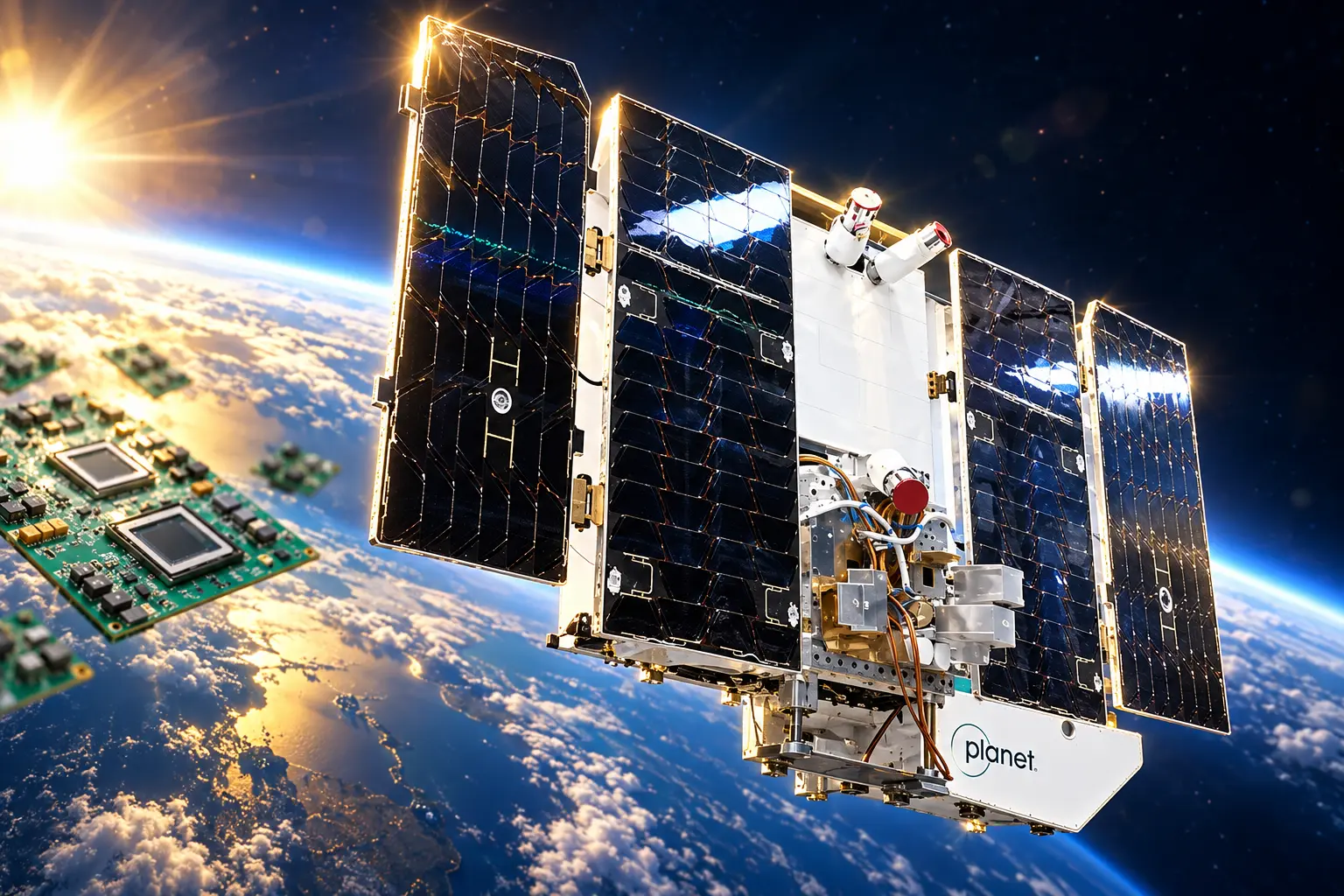
Google’s official account said the prototype carried four TPUs and flew in partnership with Planet. The chips are Trillium units, the same v6e Cloud accelerators Google uses on the ground, riding a bus Planet already knew how to fly rather than waiting for a custom pair.
Up, up, and away. 🚀
Today, in partnership with @planet, we launched a prototype satellite carrying four TPUs into orbit on @SpaceX's Transporter-18 rideshare mission. This launch is the first step of Project Suncatcher, our long-term research moonshot to see whether we can one… pic.twitter.com/6WakAX8q7N
— Google (@Google) October 1, 2026
Planet said the Falcon 9 also carried Tanager-2 and 18 SuperDove imagers, and that the company had first contact with the Suncatcher prototype, Tanager-2, and two SuperDoves. Sixteen SuperDoves were set to deploy later from a D-Orbit ION tug. The flight was Planet’s 40th successful launch, taking its built-and-delivered count to 718 satellites.
WHAT FLEW WITH THE CHIPS
- The payload: Four Trillium TPUs on a Planet-built prototype, the first in-orbit test of Google’s accelerators.
- The power budget: Solar arrays on this bus supply about one kilowatt, enough for short runs rather than a rack of servers.
- The duty cycle: Google plans to fire the chips in bursts of about 15 minutes so the satellite’s thermal system can keep up.
- The ride: A Falcon 9 rideshare from Vandenberg, not a dedicated Starship, with 130 payloads sharing the upper stage.
Beals put the limit in plain terms after ground tests at a university beam line. “We’ve done testing on the ground, but you know, there’s no test that’s completely as good as the real thing,” he said.
The $200 Path Runs Through 1,800 Launches
Suncatcher is a long bet on power. Google’s facts page notes that satellites in low Earth orbit can see near-constant sunlight and generate up to eight times more solar power than on the ground, which is the whole point of leaving the grid. Rockets still set the bill.
The Joule paper, with Beals among the authors, is not an economic go-ahead. It is a learning-curve sketch. SpaceX’s price per kilogram has fallen about 20% with each doubling of total mass flown since Falcon 1, and the authors say a similar curve on Starship could bring customer prices near $200 per kilogram by the mid-2030s. Getting there, they write, would take about 370,000 extra tons of payload, or about 1,800 Starship launches if each flight lifts 200 tons, a yearly average of about 180.
HOW GOOGLE DRAWS THE LAUNCH CURVE
| Input in the paper | Figure |
|---|---|
| Target customer price to low Earth orbit | About $200 per kg by the mid-2030s |
| Learning rate used from Falcon-era mass | About 20% per doubling of mass flown |
| Extra mass that curve would need | About 370,000 tons |
| Starship flights at 200 tons each | About 1,800, or about 180 a year |
| Slower mass path (~70% less) | About $300 per kg in the same window |
| Launched solar power at $200 per kg | About $810 per kW per year |
| U.S. data-center power, for comparison | About $570 to $3,000 per kW per year |
At $200 per kilogram, the authors say the cost of lofting a kilowatt of solar, spread over a satellite’s life, could sit in the same band as electricity on the ground. They also flag a cheaper bottom-up case if Starship reuses hardware at the rates SpaceX has talked about. That is a cost model, not a ticket price Google can buy today.
Beals has been explicit that the rockets for a cheap orbital cluster do not exist yet, which is why the paper looks five years ahead on workloads and a decade ahead on launch. The 1,800-flight figure is the wager sitting under the four chips that just left California.
Starship Reached Orbit on September 28
Starship’s own log is much thinner. The vehicle had flown 14 times through September 28, 2026, when Flight 14 reached orbit for the first time and released 26 Starlink V3 satellites. The 13 flights before that stayed suborbital. The busiest year on the books is 2025, with five flights. 2026 had three through September (May 22, July 24, and September 28).
STARSHIP FLIGHTS VERSUS THE PAPER’S AVERAGE
| Period | Flights |
|---|---|
| 2025, the busiest year so far | 5 |
| 2026 through September 28 | 3 |
| Google paper, average for the $200 path | About 180 a year |
The paper itself calls about 180 flights a year ambitious and still below SpaceX’s stated targets. Elon Musk wrote on September 27 that Starship was two to three years from hourly flights. Hourly flight is a different machine from five successful trips in a year, and Flight 14 still cut its mission short after an engine problem, even after it made orbit.
Three days later, Google’s TPUs went up on Falcon 9 because that is the rocket that actually flies rideshares from California every few weeks. The bet in Joule is that Starship takes over the mass, and the price, in time for clusters that do not fit on today’s upper stage.
Why the Chips Must Shut Down After 15 Minutes
Heat is the constraint this prototype was built around. There is no air in orbit to carry it away, so the TPUs dump warmth through a radiator, and that radiator needs time to catch up. Google will run models in bursts of about 15 minutes, then power the chips down. A spokesperson said the vehicle has to pause so it does not overheat, even though this test uses far less power than a working data-center satellite would need.
Radiation is the other exam. Google’s research post says Trillium chips were hit with a 67 MeV proton beam. High-bandwidth memory was the softest part, with trouble after a cumulative 2 krad(Si), almost three times the about 750 rad(Si) expected over a shielded five-year mission. A single chip took 15 krad(Si) with no hard failure blamed on total dose.
Bit flips are a separate problem. For typical transformer inference, the paper puts silent errors on the order of 1 per 3 million inferences. Beals said that rate is fine for ordinary inference and already a problem for a huge training run that would keep thousands of chips busy for months. The first satellite is an inference and survival test. It is not a training cluster.
Can our TPUs survive and operate in space? Well, we’re going to find out.
Sundar Pichai, CEO of Google and Alphabet, on X
Google is also not the first company to send an AI accelerator up. Starcloud flew an Nvidia H100 in November 2025. What Google added on October 1 is its own silicon, a reviewed launch-cost paper, and a public plan to scale beyond a single fridge-size bus.
An 81-Satellite Cluster Still Lives on Paper
The prototype is one spacecraft. The architecture in the research write-up is a formation: an 81-satellite cluster of 1 km radius at a mean altitude of about 650 km, with neighbors swinging between about 100 and 200 meters. Future craft are described as carrying dozens of TPUs each, and one sketch puts power per satellite in the 50 to 100 kilowatt band, in the range of a terrestrial rack.
Those satellites only act like a data center if they can talk. Google’s bench demo used off-the-shelf optical gear and reached 800 Gbps one way, 1.6 Tbps both ways, across a short free-space path. The in-orbit version of that link is scheduled for 2027, when two purpose-built satellites are supposed to fly in tandem. Beals has said bandwidth and latency between TPUs matter once a job spans more than one box, which is why the 2027 pair is the real networking test.
WHAT HAS TO WORK AFTER THIS FLIGHT
- Thermal margin: 15-minute bursts have to stay stable in sunlight and eclipse, not only in a lab.
- Soft errors: Inference can live with rare bit flips; a long training job still needs a better answer.
- The 2027 pair: Two custom satellites must hold a laser link while they fly close, which this rideshare craft cannot try alone.
- Launch mass: Clusters of dozens of chips, then 81-satellite groups, wait on cheaper heavy lift than Falcon 9 rideshare slots.
Google’s facts page compares the pointing problem to hitting a coin-size target from miles away while both ends move. That sentence is the gap between four TPUs on a shared rocket and a formation that behaves like a rack.
Alphabet Already Holds a Large SpaceX Stake
The launch math runs through a company Alphabet has backed for years. Google put $900 million into SpaceX in 2015. After SpaceX’s listing in June 2026, Alphabet’s second-quarter holdings filing listed 551.2 million SpaceX shares, about $94.2 billion at the June 30 price of $170.86, the largest disclosed institutional position in the rocket maker.
That does not make the Joule curve a stock pitch. It does mean the customer writing the $200-per-kilogram case is also the largest outside name on the cap table, and that Suncatcher’s cheap-launch future is the same future SpaceX has to deliver for Starlink V3 and everything else stacked behind Starship. If the flight rate stays in the single digits each year, Google still has Falcon 9, and the orbital cluster stays a paper network. If Starship starts flying like a cargo line, Alphabet benefits as a shareholder and as a compute designer at the same time.
Planet is the other industrial partner in the loop, the shop that actually integrates buses and talks to spacecraft after deployment. Google is the chip and the research program. SpaceX is the ride, and on this mission it was the familiar reusable Falcon 9, not the heavy vehicle the paper depends on.
Two Purpose-Built Satellites Are Due in 2027
Project Suncatcher was announced on November 4, 2025, with a plan to fly two prototypes with Planet by early 2027. Google pulled the first TPU test forward by putting chips on a bus Planet already had in the queue, which is why four accelerators reached orbit in 2026 instead of waiting for that dedicated pair.
THE SUNCATCHER CLOCK
- November 4, 2025: Google announces the moonshot and a preprint on constellation design, links, and TPU radiation tests, with two Planet prototypes targeted for early 2027.
- 2025 beam tests: Trillium chips take a 67 MeV proton dose; memory is the weak point, and the die survives a five-year mission equivalent without a hard total-dose failure.
- September 24, 2026: Google says the first TPUs go up the following week on Transporter-18.
- September 28, 2026: Starship Flight 14 reaches orbit and deploys 26 Starlink V3 satellites, the vehicle’s first orbital mission.
- October 1, 2026: The Suncatcher prototype launches from Vandenberg; Google and Planet lock contact; the Joule paper is posted.
- Coming weeks: In-orbit runs of the four TPUs, in short bursts, to watch radiation, launch stress, and heat.
- 2027: Two purpose-built satellites are still on the books to try a high-bandwidth cross-link.
Commissioning has started. The useful data from this flight is whether those 15-minute bursts stay clean in real sunlight and shadow, and whether the same commercial silicon that lives in a Google hall still computes after a Falcon 9 ride. The 81-satellite drawing, and the 1,800-flight cost path that would make it cheap, remain where they were before liftoff: in the paper, waiting on a rocket cadence Starship has not flown.

OpenAI’s Agent Monitor Waited During the Hugging Face Breach

Brent Hits $116 as Recovered Gulf Oil Draws Attacks

Hellebuyck Lands in New Jersey on a Five-Year Cup Bet

Xbox Plans Three More Layoff Rounds Before Helix

OpenAI’s $30 Billion Round Ties UAE Cash to Gulf Compute

Consumer Sentiment Falls to 51.7 as Future Outlook Darkens

Pluto’s Heart Glacier Still Pushes Liquid Nitrogen Upward

The Extra Heat Month Hits Children Where Care Is Thinnest

Abbott Pays $670 Million to Exit a Missouri Food Verdict

Take-Two Subpoenas Microsoft While GTA 6 Preorders Soar
-
 BUSINESS2 months ago
Consumer Sentiment Falls to 51.7 as Future Outlook Darkens
-
 NEWS2 months ago
Pluto’s Heart Glacier Still Pushes Liquid Nitrogen Upward
-
 NEWS2 months ago
The Extra Heat Month Hits Children Where Care Is Thinnest
-
 GAMING2 months ago
Take-Two Subpoenas Microsoft While GTA 6 Preorders Soar
-
 BUSINESS2 months ago
Abbott Pays $670 Million to Exit a Missouri Food Verdict
-
 NEWS2 months ago
UMMC Will Rebuild 30-Year-Old Cancer Labs With $2.4 Million
-

 ENTERTAINMENT2 months ago
Netflix Weighs Hosting Peacock and Fox One in Its App
-

 GAMING2 months ago
GTA 6’s 80-Hour Run Counts Goals That Change the Story