
BUSINESS
Nifty Falls While India Pays $121 a Barrel
The Nifty 50 opened 0.34% lower on October 8 as India paid $121 a barrel for crude, the rupee shrugged off a rate hike, and Paytm priced a UPI fee delay.

The Nifty 50 opened at 22,527.65 on Thursday, October 8, down 0.34%, as Brent crude held above $102 a barrel. The Sensex printed 72,428.92. The Indian crude basket, the price refiners actually pay, stood at $121.05 a barrel on October 7.
A day after the Reserve Bank of India lifted the repo rate, the rupee still needed support, and shares of Paytm parent One 97 Communications hit a 10% lower circuit on talk that a new UPI merchant fee due on October 15 may slip to January 1, 2027.
A Weak Open, Then a Deeper Slide
Wednesday’s close was 22,603.05 on the Nifty and 72,638.70 on the Sensex, after the policy decision. Thursday’s first print was already lower. By 11:00 IST the Nifty was at 22,445.15, down 0.70%, or 157.90 points, and the Sensex was at 72,232.67, down 0.56%, or 406.03 points.
Brent crude traded at $102.31 a barrel, up 2.13%. West Texas Intermediate was at $89.81, up 1.74%. Gold held at $4,161.30, up 0.48%. Information-technology names found buyers, with Tata Consultancy Services, Infosys, HCLTech and Tech Mahindra among the Sensex gainers, while ITC was down 3% by late morning and InterGlobe Aviation sat with the laggards.
THURSDAY OPENING SNAPSHOT
| Contract | Level | Move |
|---|---|---|
| Nifty 50 | 22,527.65 | -0.34% |
| Sensex | 72,428.92 | open print |
| Brent crude | $102.31 | +2.13% |
| WTI crude | $89.81 | +1.74% |
| Gold | $4,161.30 | +0.48% |
| USD/INR (Wednesday close) | 96.75 | then 96.65 Thursday morning |
The open was the slow leak. The session then had to digest a rate rise, a $102 futures barrel, and a stock-specific hole in the payments group that the index print does not show.
The Rate Hike Did Not Hold the Rupee
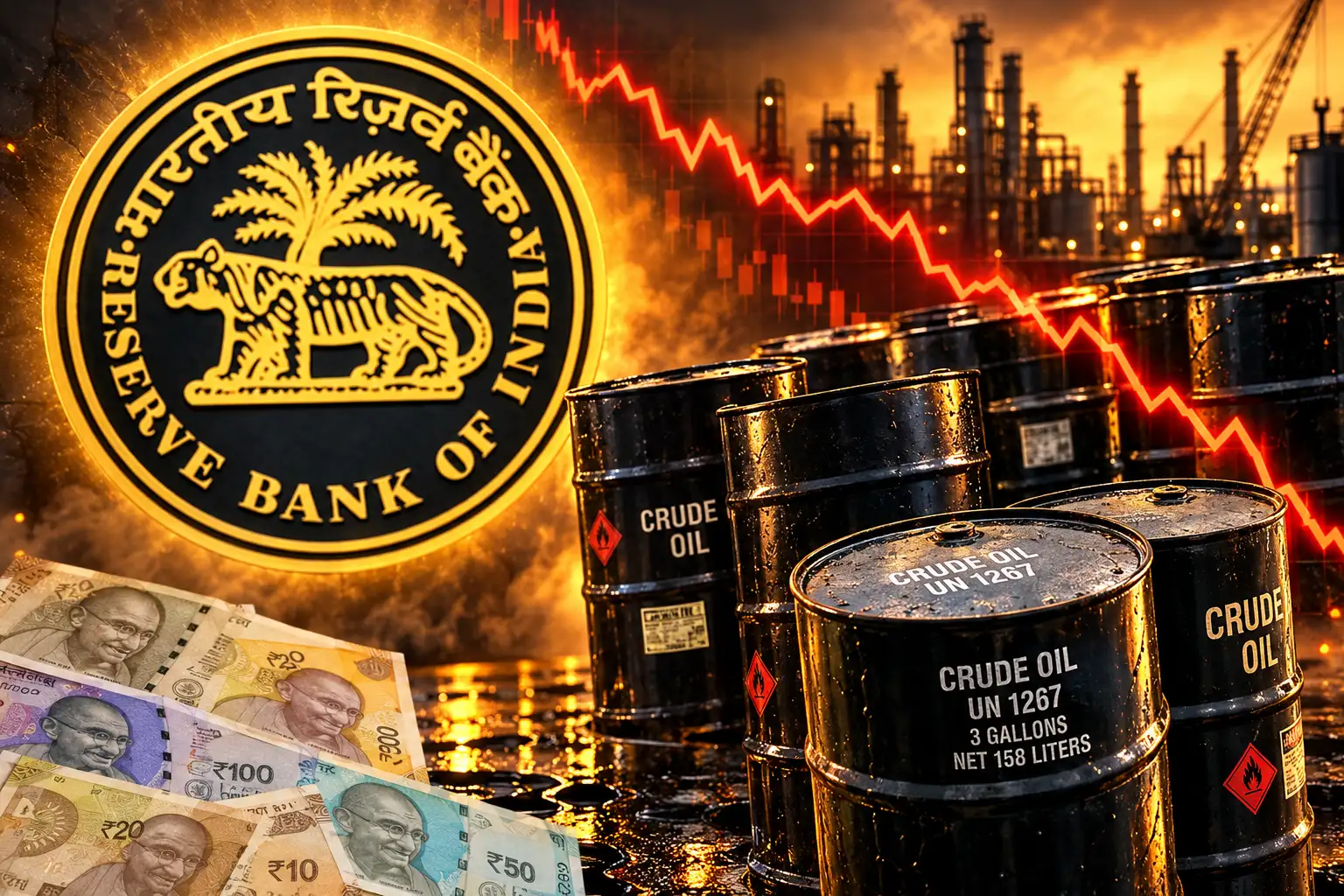
The Monetary Policy Committee, in its 63rd meeting from October 5 to 7, raised the policy repo rate to 5.50 percent from 5.25%, a 25 basis-point move, and changed the stance from neutral to calibrated tightening. The hike was unanimous. The stance passed 4-2, with Nagesh Kumar and Ram Singh voting to keep it at neutral. The standing deposit facility rate is now 5.25%, and the marginal standing facility rate and the Bank Rate are 5.75%.
It is the first repo increase since February 2023. Governor Sanjay Malhotra said inflation and its outlook are “not benign” as they were last year, with headline CPI seen averaging almost 5.8% over the next three quarters. The central bank now projects CPI at 5.2% for 2026-27, with the third quarter at 6.0%, and core inflation at 4.4%. Real GDP is projected at 7.1% for the year after a 7.8% first-quarter print.
Given the current conditions, rate cuts are off the table in the near term and policy action ahead can only be a rate hike or a pause, depending on the evolving conditions and the outlook.
Sanjay Malhotra, Governor, Reserve Bank of India, October 7 policy statement
The rupee still fell on Wednesday, closing at 96.75 per dollar after an intraday probe of the record low near 96.96. Goldman Sachs called the move a hawkish hike and expects another 25 basis points in December. That did not stop dollar demand. Anil Kumar Bhansali, head of treasury at Finrex Treasury Advisors, said corporate importer orders and safe-haven flows overpowered the new stance until state-run banks stepped in.
On Thursday the pair opened at 96.71 and recovered 10 paise to 96.65 on likely intervention. Treasury desks have been watching 97, a line that, if broken, tends to pull importers into hedges and keep exporters from selling dollars. Forex traders also pointed to a $50 billion drop in reserves over three weeks from a September high of $786 billion.
THE 48 HOURS AROUND THE HIKE
- October 5 to 7, 2026: The MPC meets under Malhotra; CPI for August is already at 4.8%, up from 4.5% in July, with core at 4.2%.
- October 7, 2026: The repo rate goes to 5.50%, the stance flips to calibrated tightening, and the Indian crude basket is listed at $121.05 a barrel.
- October 7, 2026: The rupee closes at 96.75. Foreign funds sell ₹6,121 crore of equities. The Nifty settles at 22,603.05.
- October 8, 2026: The Nifty opens at 22,527.65. The rupee bounces to 96.65. Paytm locks 10% lower on the MDR delay talk.
Minutes of the meeting are due on October 21. The next gathering is scheduled for December 2 to 4. Until then the currency still has to live with oil invoiced in dollars and a central bank that has already said the next move is a hike or a pause, not a cut.
A $121 Barrel on the Indian Basket
Brent at $102.31 is the number on the futures screen. It is not the number on the import invoice. The Petroleum Planning and Analysis Cell listed the Indian crude basket at $121.05 a barrel on October 7, more than $18 above that Brent futures print. The October month-to-date average was $120.34.
That gap is the physical market. Dated Brent, the price of North Sea cargoes, was assessed between $113.96 and $120.92 a barrel on every trading day from September 22 to 29. From March the official basket was rebuilt so that Dated Brent carries most of the weight, around 61% at the start of that shift, against about 21% before. The basket now tracks the grades India actually buys, which is why a softer futures print does not cut the bill on the same day.
INDIAN BASKET, MONTHLY AVERAGE
| Month, 2026-27 | Indian crude basket ($/barrel) |
|---|---|
| April | 114.48 |
| May | 106.23 |
| June | 83.22 |
| July | 82.04 |
| August | 90.19 |
| September | 116.09 |
| October, month to date | 120.34 |
| October 7, daily | 121.05 |
August to September is the jump that reached the current account. The basket averaged $90.19 in August and $116.09 in September. Cell figures for April to August put the crude import bill at $74.8 billion, up 48.4% from $50.4 billion a year earlier, an extra $24.4 billion, even as volumes slipped 0.4% to 100.7 million metric tonnes. India still buys more than 88% of the crude it burns.
G7 governments agreed on October 2 to release 100 million barrels from emergency stocks over four months. That is a time-buy, not new supply. Motilal Oswal has said the current account deficit could widen to 1.7% of GDP, about $71 billion, if crude stays above $90 a barrel for a large part of the second half of 2026-27. The first-quarter deficit was already $4.2 billion, or 0.5% of GDP.
Why Paytm and MobiKwik Fell on Thursday
The index dip is not why One 97 Communications, One MobiKwik Systems and Pine Labs were sold. Traders and industry groups asked the finance ministry and the National Payments Corporation of India to push the new UPI merchant discount rate from October 15 to January 1, 2027, so the festive season stays free of the levy. The request is under consideration. No final order had been issued when the shares broke.
Paytm fell 10% to ₹1,558 and was the top loser on the Nifty 500, its largest one-day drop since February 1, from a previous close of ₹1,732. MobiKwik was at ₹235.8, down 8.3%. Pine Labs was at ₹170.9, down 4%, and already below its issue price. Goldman Sachs, the same morning, raised its Paytm target to ₹2,070 from ₹1,500.
The fee had been treated as near-term revenue. Paytm has said UPI person-to-merchant flow is 85% of its gross merchandise value, and that 35% of that value would be eligible for MDR. MobiKwik had said it would earn both as a third-party app on eligible consumer payments and as an acquirer on merchant volume. A slip from October 15 to January 1 would park that income past Diwali, Christmas and the wedding calendar.
The levy itself is a merchant cost. It is not a charge on the person paying. That distinction is why some users shrugged. It is also why the listed names still fell: October 15 cash had been in the price.
THE UPI FEE AS WRITTEN
- The rate: 0.4% MDR on specified person-to-merchant UPI payments above ₹2,000, paid inside the merchant chain.
- The cap: ₹300 a transaction once the ticket reaches ₹75,000.
- The flat slice: ₹5 a payment above ₹2,000 for fuel, insurance, telecom, railways and some farm inputs.
- What stays free: Person-to-person transfers, merchant payments up to ₹2,000, and small merchants taking up to ₹1 lakh a month on UPI QR, a set NPCI has put at about 96% of person-to-merchant volume.
- The calendar: Written start October 15, 2026; trade bodies want January 1, 2027; the decision is still open.
NPCI recorded 24,068 million UPI transactions in September, worth ₹29,37,396.67 crore. Malhotra said on October 7 that a small fee was unlikely to dent volumes. Retail groups had planned a “No UPI Day” on October 2, then dropped it after meeting Finance Minister Nirmala Sitharaman. A delay would be a gift to merchants and a haircut to the payment companies that had already booked the start date.
Foreign Funds Sold ₹6,121 Crore on Wednesday
Exchange data showed foreign institutional investors as net sellers of ₹6,121 crore of Indian equities on October 7, more than double the prior session. Domestic institutions bought ₹4,597 crore, covering about three-quarters of that outflow. Over the past 30 days, foreign selling is ₹69,810 crore and domestic buying is ₹80,455 crore.
THE OCTOBER 7 FLOW
- FII, one day: Net sales of ₹6,121 crore on October 7, a fourth straight October session of foreign selling.
- DII, one day: Net purchases of ₹4,597 crore, the buffer that kept the Nifty from a round-number break on the policy day.
- Thirty days: Foreign accounts out ₹69,810 crore; domestic accounts in ₹80,455 crore.
- The other tape: The dollar index near 102.28 and the US 10-year yield near 5.29% kept global money expensive.
That mix is why a 0.34% open looks small and still feels heavy. Domestic funds have been the bid. Foreign money has been the offer, and it is pricing a tighter RBI, a weaker rupee, and an oil bill that has already jumped by $24.4 billion in five months.
Pump Prices Have Not Moved Since May
Retail petrol in Delhi is ₹102.12 a litre and diesel is ₹95.20. Those prices have been frozen since May, after an excise cut of ₹10 a litre in March that was meant to offset some of the hit on oil marketing companies. The inflation RBI is fighting is still in food and in the pass-through that has not yet shown up at the pump. CPI in August was 4.8%, with food at 5.95% in the same stretch of data the policy team cited.
A $121 import barrel and a frozen pump is a margin problem for the marketing companies before it is a household price problem. Airlines, paint makers, tyre plants and chemical producers pay the product prices that move with crude even when the retail board does not. InterGlobe Aviation’s place among Thursday’s Sensex laggards is that channel showing up in the index. Upstream producers, by contrast, keep the higher realisation for longer.
The rupee at 96.65, even after the morning bounce, still makes every dollar of that invoice dearer in local currency. Importers who did not hedge into Wednesday’s close had to buy the greenback on Thursday with Brent up 2.13% and the Indian basket already above $120. Exporters who waited for a round 97 had a reason to keep sitting on receipts.
The Nifty’s 0.34% open, then, is the least of the three prices on the tape. The barrel India is paying is $121.05. The rupee needed help the morning after a hike to 5.50%. And the payments stocks told you that a fee written for October 15 is no longer in the bag. The December MPC can hike again or wait. The import invoice will not.
Disclaimer: This article is news reporting and market analysis for information only. It is not investment advice, a recommendation to buy or sell any share, currency, commodity or fund, and it is not a forecast of the Nifty 50, the rupee, crude oil or any named company. Readers should consult a SEBI-registered investment adviser or a qualified financial planner before acting on any price, policy decision or corporate development discussed here. Levels, percentages and policy statuses reflect the cited official releases and market prints as of October 8, 2026, and can change in the same session.

IT Stocks Climb as Sensex Falls After RBI Hike

Anthropic Prices Claude Haiku 5.5 as a Subagent Worker

Nifty Falls While India Pays $121 a Barrel

OpenAI’s 722 Math Papers Leave the Checking to Humans

Flipkart Recruits Sellers and Riders for Big Billion Days

Consumer Sentiment Falls to 51.7 as Future Outlook Darkens

Pluto’s Heart Glacier Still Pushes Liquid Nitrogen Upward

Netflix Weighs Hosting Peacock and Fox One in Its App

Take-Two Subpoenas Microsoft While GTA 6 Preorders Soar

UMMC Will Rebuild 30-Year-Old Cancer Labs With $2.4 Million
-
 BUSINESS2 months ago
Consumer Sentiment Falls to 51.7 as Future Outlook Darkens
-
 NEWS2 months ago
Pluto’s Heart Glacier Still Pushes Liquid Nitrogen Upward
-
 GAMING1 month ago
Take-Two Subpoenas Microsoft While GTA 6 Preorders Soar
-
 ENTERTAINMENT1 month ago
Netflix Weighs Hosting Peacock and Fox One in Its App
-
 NEWS2 months ago
UMMC Will Rebuild 30-Year-Old Cancer Labs With $2.4 Million
-
 BUSINESS1 month ago
Abbott Pays $670 Million to Exit a Missouri Food Verdict
-

 NEWS1 month ago
Water-Shedding Coatings Charge the Drops That Pierce Them
-

 GAMING1 month ago
GTA 6’s 80-Hour Run Counts Goals That Change the Story