
BUSINESS
Nifty’s Green Open Collapsed on a $128 Oil Bill
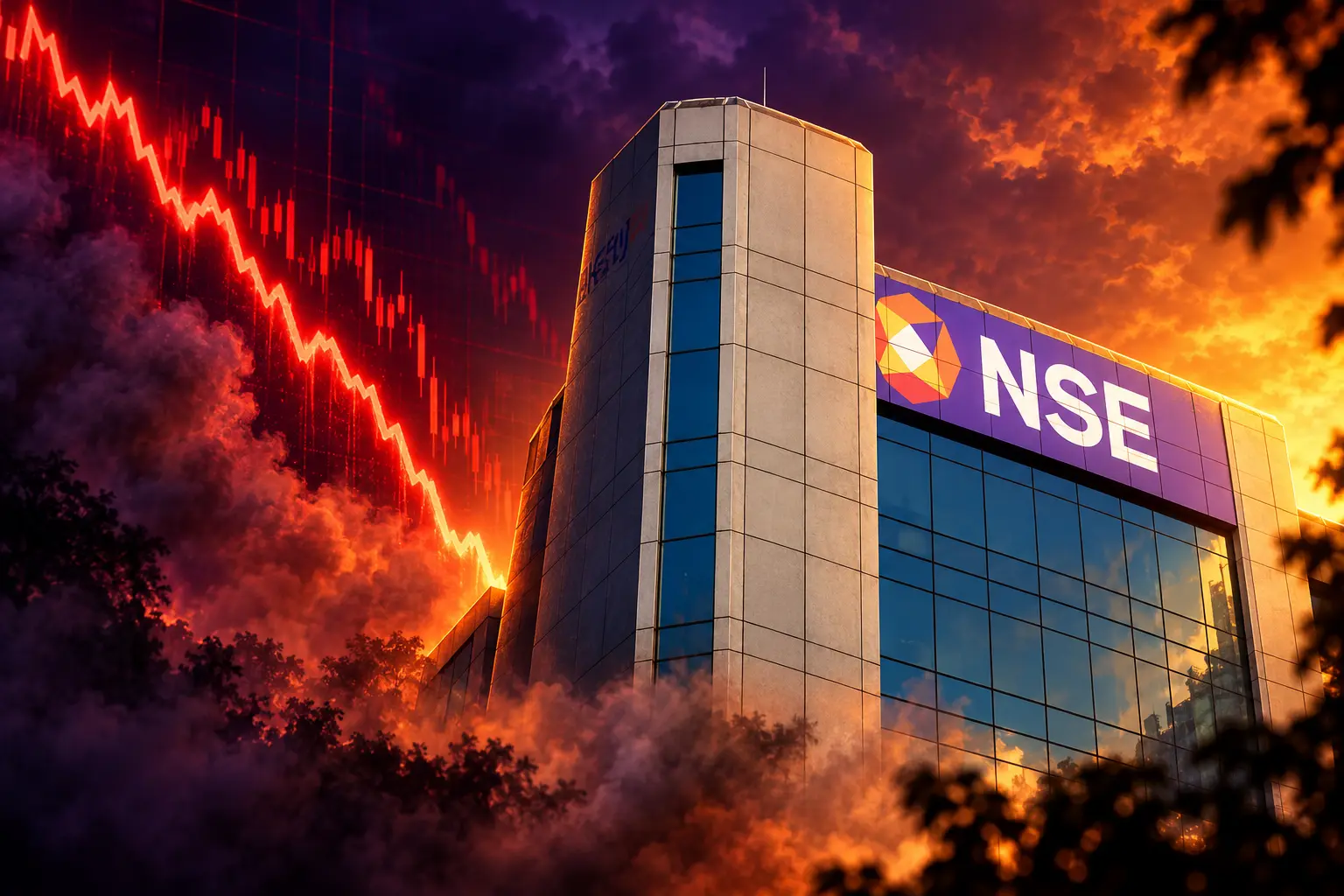
Nifty 50 fell 1.19% to a five-month low after a failed gap-up as India’s crude basket hit $128.70 and the rupee slid to 95.96.

The Nifty 50 closed at 23,118.60 on Tuesday, September 15, down 279.50 points, or 1.19%, after a gap-up that failed by mid-morning. The Sensex settled at 74,003.82, down 777.94 points, or 1.04%, and both benchmarks finished at or near the session low. Markets had been shut on Monday, September 14, so the tape was pricing a long weekend of oil, yields and a weaker rupee in one sitting.
The Indian crude basket had already printed $128.70 a barrel on September 14, and the rupee ended at 95.96 per dollar. Brent futures, the number most desks still quote, only got as far as $107.8. That gap is what sold the open.
Tuesday Opened Higher and Closed on the Low
The Nifty opened at 23,576.15 against Friday’s close of 23,398.10 and tagged 23,592.85 in the first burst. The Sensex opened at 75,369.63, against 74,781.76, and reached 75,436.44. From that high it dropped 1,432.62 points. The Nifty gave up 474.25 points from its peak and closed exactly on the low.
Fifteen of 16 major sectors finished lower. Nifty breadth was 10 advances and 40 declines. On the BSE, 1,197 shares rose, 3,286 fell and 201 were unchanged. The BSE 150 MidCap Index dropped 2.17% and the BSE 250 SmallCap Index lost 2.40%. More than Rs 9 lakh crore came off BSE listed market value, which ended at Rs 472 lakh crore.
THE TUESDAY TAPE
| Index | Friday close | Open | High | Close | Change |
|---|---|---|---|---|---|
| Nifty 50 | 23,398.10 | 23,576.15 | 23,592.85 | 23,118.60 | -1.19% |
| Sensex | 74,781.76 | 75,369.63 | 75,436.44 | 74,003.82 | -1.04% |
| Bank Nifty | 56,606.55 | 56,884.00 | – | 55,794.75 | -1.43% |
Bank Nifty gapped to 56,884.00, then shed 811.80 points to 55,794.75 and also closed on its low. Banks were the drag, not the cushion. India VIX rose 9.27% to 13.43. September 15 was also a derivatives expiry, and during the closing auction the Nifty’s indicative print briefly showed 22,879, about 2.2% under Friday’s close, before settling at 23,118.60, the weakest finish since April 6.
A gap-up only locates the open. Weak breadth, a close on the low and a rupee-oil pairing did the rest. Nifty IT still finished 2.19% higher, the one major group in the green, as money moved toward dollar earners while rate-sensitive names and energy were sold.
The Indian Basket Is Already at $128
Spot prints put the Indian crude basket at $128.70 a barrel on September 14, up $9.01, or 7.53%, from $119.69 on September 11. That is the mix Indian refiners actually land, a blend of Brent-linked sweet grades and Gulf sour barrels, not the Brent futures contract on a screen in London. Oman was near $121.61 the same week. Murban printed $127.76. The Hormuz disruption is sitting in those physical grades.
The Petroleum Planning and Analysis Cell still shows softer monthly averages for the Indian crude basket because September’s early sessions were cheaper. The September month-to-date average was $104.09 as of September 10, when the daily print was $115.98. August averaged $90.19. July 2 printed $67.16. The March 23 spike of $157.04 remains the year’s high.
THE CRUDE BILL INDIA ACTUALLY PAYS
| Month (FY27) | Indian basket, $/bbl |
|---|---|
| April | 114.48 |
| May | 106.23 |
| June | 83.22 |
| July | 82.04 |
| August | 90.19 |
| September (to Sept. 10) | 104.09 |
PPAC data show India imported 81.9 million tonnes of crude in April-July, barely changed from 81.5 million tonnes a year earlier, while the bill jumped 56.5% to $63.4 billion from $40.5 billion, or Rs 5.94 lakh crore. July alone cost $13.7 billion against $9.7 billion, on 21.4 million tonnes versus 18.9 million. Crude still covers about 88.5% of what the country burns.
A $10 move in crude adds about $12 billion to $14 billion to the yearly import bill, depending on the desk doing the sum. Motilal Oswal said the first hit on consumer prices can stay small if pump prices are held, and that the second-round pass-through through freight, chemicals, plastics and factory costs is the larger risk. Brickwork Ratings put the CPI lift from a $10 shock at 30 to 50 basis points. An older RBI staff study put it near 49 basis points on CPI and 43 basis points on the fiscal deficit if New Delhi absorbs the whole shock. Sunil Sinha, a former senior economist at the National Council of Applied Economic Research, said a $10 rise can clip 20 to 30 basis points off GDP growth.
Frozen Pump Prices Leave Marketers Eating Losses
PPAC listed Delhi retail petrol at Rs 102.12 a litre and diesel at Rs 95.20 on September 15, with pump prices still frozen. Equirus Securities’ Maulik Patel said that at September’s month-to-date average as of September 12, marketing margins were negative Rs 5 a litre on petrol and negative Rs 23 on diesel, with LPG under-recoveries near Rs 200 a cylinder.
Patel said Hindustan Petroleum is the most exposed of the three state marketers because its refining-to-marketing ratio is only 51%, against 74% at Bharat Petroleum and 80% at Indian Oil. HPCL’s distillate yield is 76%, versus 80% at Indian Oil and 85% at Bharat Petroleum, so it captures less of the diesel and jet-fuel crack when those products are strong. Combined Q1 losses at the three marketers were about Rs 18,150 crore. Broker notes written when crude had cooled in July and August had been looking for a Q2 rebound. A $128 basket puts that rebound back in doubt.
WHO ATE THE OIL SPIKE
- State fuel retailers: Negative marketing margins of Rs 5 a litre on petrol and Rs 23 on diesel, with pump prices unchanged.
- HPCL: Only 51% refining cover, the thinnest buffer of the three state marketers when imported product costs jump.
- Airlines: Jet fuel is about a third to 40% of operating costs at recent prices, and InterGlobe Aviation was among Tuesday’s large losers.
- Paints, tyres and chemicals: Crude-linked inputs hit raw-material bills fast, which is why Asian Paints sat in the 2% to 4% decline pack.
- Realty and autos: Nifty Realty fell 4.04% and Nifty Auto 2.01% as yields rose and the rate-hike debate returned.
Rajeev Sharan, head of research at Brickwork Ratings, said aviation takes the largest hit, then paints, tyres and petrochemicals, while upstream names such as ONGC and Oil India gain on realisations. Logistics, cement and parts of FMCG feel it through freight and packaging. HCL Technologies rose 3.95% to 1,253.70. Infosys, TCS, Tech Mahindra and Wipro also advanced. Bharat Electronics led the Nifty lower, down 5.30% to 382.90. Shriram Finance, Adani Enterprises, InterGlobe Aviation and Grasim followed.
The Rupee Near 96 Makes Every Barrel Cost More
The rupee closed at 95.96 per dollar, down 41 paise from 95.55, its fifth straight decline. Dilip Parmar, a research analyst at HDFC Securities, put near-term resistance at 96.30 and support at 95.45, with the bias still toward the dollar. Soumya Kanti Ghosh, group chief economic advisor at State Bank of India, had already said the rupee had crossed 96 and that the central bank’s job is to stop a slide from feeding on itself.
Each weaker rupee tick raises the landed cost of the same barrel. Combined NSE, BSE and MSEI FII and DII cash-market figures for September 11, the last session before the long weekend, showed foreign investors selling a net Rs 930.90 crore and domestic institutions buying Rs 1,968.17 crore. For September through that Friday, FIIs were still net buyers of Rs 579 crore, while DIIs had taken in Rs 24,987 crore. Year to date, FIIs have sold a net Rs 1.89 lakh crore in the cash market and DIIs have bought about Rs 3.51 lakh crore. Local systematic flows are still the buyer of last resort. They did not stop Tuesday’s fade.
Arun Malhotra, a fund manager at CapGrow Capital, said elevated oil, surging Treasury yields and a line-up of large IPOs explain much of the weakness, and that a US rate hike would push India to tighten as well to defend the currency. The US 10-year yield was near 5%. India’s 10-year was near 7.01% in morning trade.
The Central Bank Has Already Raised Its Oil Assumption
Consumer prices rose to 4.82% in August from 4.45% in July, an eight-month high, according to the statistics ministry. The August monetary policy minutes projected CPI at 5.0% for 2026-27, with 4.7% in the second quarter, 5.9% in the third and 5.5% in the fourth. The April forecasts had assumed oil at $85 a barrel. The June meeting used $95. The August minutes said a further modest revision was needed after Brent and the Indian basket rose 34.5% and 32.5% from end-June levels by July 31.
Q1 merchandise trade deficit widened to $86.6 billion from $68.7 billion a year earlier, the minutes said, driven by crude, electronics and gold. CareEdge and CRISIL have put the full-year current-account gap in a 0.8% to 1.2% of GDP band. HSBC said inflation is likely to jump in September, average above 5% for nine months, and that it expects 25-basis-point hikes in October and December. Motilal Oswal sees a real chance of an October move and does not expect the RBI to wait for third-quarter data to confirm a broadening of price pressures.
$120 per barrel looks imminently in sight. And after $120 per barrel, for the Indian crude basket, as you are saying, we are already paying $10-$15 more, so $110 per barrel is a price beyond which it looks difficult to sustain.
Soumya Kanti Ghosh, Group Chief Economic Advisor, State Bank of India
Ghosh had flagged $100 oil in mid-August, a call that has already cleared. A $10 to $15 premia on a $107.8 Brent future is the arithmetic behind a $128.70 basket print. Manoranjan Sharma, chief economist at Infomerics Ratings, said the policy trade-off is ugly either way: passing costs through at the pump hits transport, food and factory prices, while absorbing them through excise cuts or subsidies strains the budget and the oil marketers.
How Indian Stocks Behaved the Last Time Crude Crossed $100
India has now lived through four $100-plus oil regimes in two decades, and the equity market did not give the same answer each time. The 2026 episode already has a first act. When Brent ran from about $73 to $119 between February 27 and March 9, the Nifty fell from 25,179 to 24,030. It then recovered some of that as oil cooled into the $70s in June, before this second leg took Brent back through $100 on September 9 and the Nifty back toward 23,550.
THE FOUR $100 CROSSES
- July 11, 2008: Brent peaks at $147.27. The Nifty later halves, the rupee drops nearly 25%, and oil then collapses below $40 within six months as the global credit freeze, not the barrel, does the lasting damage.
- 2011 to 2014: Crude stays above $100 for three years. The current-account deficit reaches 4.8% of GDP. The Nifty falls 25% in 2011, then rebounds 28% in 2012 as the Federal Reserve’s QE3 and domestic reform talk offset the oil tax.
- March 7, 2022: Brent jumps from $68 in December 2021 to about $139. The Nifty slides from 17,065 to 15,671, then is back at 17,435 by March 31 with Brent still near $115. Discounted Russian barrels and domestic SIP flows keep the calendar year in the green.
- September 15, 2026: Brent holds near $107.8, the Indian basket prints $128.70, and the Nifty closes at 23,118.60, a five-month low, after a 4.8% slide across five weeks and a 2.1% drop in the week through September 11.
The 2022 template is the one bulls still cite: a geopolitical spike, a short Nifty drawdown, then a look-through once supply fears settle. Two things are different in this round. The rupee is already near 96, not the mid-70s of early 2022, and the physical Gulf barrel India buys is trading far above the Brent future. Calm Investor’s 30-year sample of 24 oil spikes still shows a median 12-month Nifty 500 return of 16.5% after a shock, better than a random start. That sample does not include a $128 Indian basket against a 96 rupee.
Dollar Earners Held Up as Banks and Realty Did Not
Nifty IT’s 2.19% gain sat next to a 4.04% drop in realty, a 2.54% drop in metals and a 1.43% drop in Bank Nifty. HDFC Bank still rose 1.27%, one of the few large financials that did not follow the index lower. The split is the rupee trade in miniature: exporters get more rupees for each dollar of revenue, while banks, developers and manufacturers eat higher yields, higher freight and a dearer energy bill. Q1 manufacturing results compiled by CMIE from more than 1,700 companies already showed sales up 25.6% and raw-material costs up 40%, with the materials-to-sales ratio jumping more than 8 percentage points to 75.3%.
GIFT Nifty later implied a start near 23,191.50, about 73 points above the cash close. That is a small bounce against a session that opened at 23,576.15 and died at 23,118.60. The Federal Reserve’s September meeting sits in the same week, with US yields already near 5%. Until Brent, the Gulf physical barrel and the rupee stop moving together, a green tick at 9:15 a.m. is just a price, not a bid.
The Nifty closed exactly on its low of 23,118.60. There was no bounce into the bell.
Disclaimer: This article is news reporting and market analysis for information only. It is not investment advice, a recommendation to buy or sell any security, commodity or currency, or a forecast of Reserve Bank or Federal Reserve policy. Readers should consult a SEBI-registered investment adviser or a qualified financial planner who can consider their own goals, time horizon and risk limits before acting. Index levels, oil prints, currency rates, fund-flow totals and company prices reflect the sources cited for September 15, 2026, and those figures can change in the next session.

IT Stocks Climb as Sensex Falls After RBI Hike

Anthropic Prices Claude Haiku 5.5 as a Subagent Worker

Nifty Falls While India Pays $121 a Barrel

OpenAI’s 722 Math Papers Leave the Checking to Humans

Flipkart Recruits Sellers and Riders for Big Billion Days

Consumer Sentiment Falls to 51.7 as Future Outlook Darkens

Take-Two Subpoenas Microsoft While GTA 6 Preorders Soar

Pluto’s Heart Glacier Still Pushes Liquid Nitrogen Upward

Abbott Pays $670 Million to Exit a Missouri Food Verdict

Netflix Weighs Hosting Peacock and Fox One in Its App
-
 BUSINESS2 months ago
Consumer Sentiment Falls to 51.7 as Future Outlook Darkens
-
 GAMING2 months ago
Take-Two Subpoenas Microsoft While GTA 6 Preorders Soar
-
 NEWS2 months ago
Pluto’s Heart Glacier Still Pushes Liquid Nitrogen Upward
-
 BUSINESS2 months ago
Abbott Pays $670 Million to Exit a Missouri Food Verdict
-
 ENTERTAINMENT2 months ago
Netflix Weighs Hosting Peacock and Fox One in Its App
-
 NEWS2 months ago
FDA Clears Rasonque and Widens Who Can Take It
-

 NEWS2 months ago
The Extra Heat Month Hits Children Where Care Is Thinnest
-

 NEWS2 months ago
UMMC Will Rebuild 30-Year-Old Cancer Labs With $2.4 Million