
NEWS
Omar Abdullah Dares the BJP to Pass the Uniform Civil Code
Omar Abdullah says a Uniform Civil Code limited to BJP states is not universal, after JD(U) drew a hard line at Bihar.

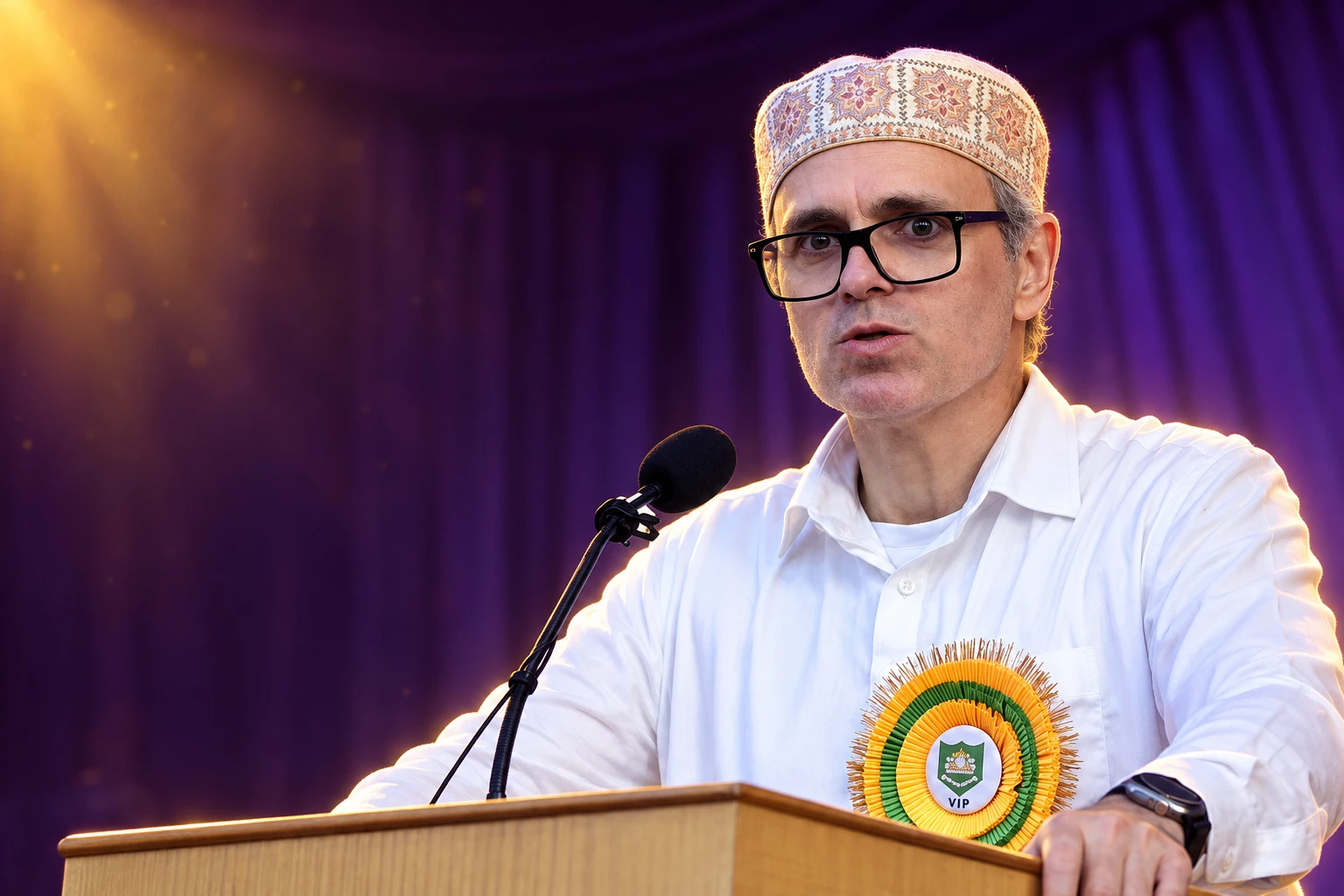
Jammu and Kashmir Chief Minister Omar Abdullah on September 15, 2026 told the BJP to bring a Uniform Civil Code bill to Parliament if it has the numbers. He said a code confined to BJP-run states cannot be called universal.
Home Minister Amit Shah had set a 21-state target two days earlier in Mumbai. The next day the Janata Dal (United) said Bihar would not take the law.
Omar Abdullah Dares the BJP to Count the Votes
Abdullah framed the state-by-state push as a way around the House that represents the whole country. “The government should not take the backdoor route and should instead bring the Bill before the Parliament. If you have numbers, bring it to the Parliament. Why are you doing this through different States?” he asked.
He named JD(U) as an NDA partner opposed to the law in Bihar, and said several allies were not on board. “Not all the NDA allies are in favour of the proposal. I don’t think they will be able to pass this in the Parliament. That is why they are taking the [BJP-ruled States] path,” he said. “If the BJP’s own people are not ready for this, how can they say that it should be implemented in the whole country.”
The whole country is not a BJP-ruled State. There are a number of States and territories that the BJP does not rule. Therefore, if you apply it only to BJP States, it’s not universal.
Omar Abdullah, Chief Minister of Jammu and Kashmir, September 15, 2026
He added that a measure of this kind should not be decided by individual states and must go through Parliament. That is a political dare, and it is also a definition. A code that stops where the BJP’s writ stops is a set of state family laws, not one law for the country.
The JD(U) line he cited is narrower than the claim that the alliance cannot vote the bill through the Lok Sabha. Party leader Shyam Rajak said JD(U) would support a parliamentary bill and still keep it out of Bihar. Abdullah folded that Bihar veto into a larger numbers argument. The gap between those two claims is the live fight inside the NDA.
A 2029 Deadline for 21 NDA States
Shah spoke to reporters in Mumbai on September 13, 2026 and tied the code to a poll clock. “Triple talaq has been abolished, giving Muslim women equal rights. We have introduced the Uniform Civil Code (UCC) in several states and I am confident that in the 21 BJP-NDA ruled states, we will introduce the UCC before 2029,” he said.
The BJP put a common civil code in its 2024 Lok Sabha manifesto. The 2024 result left the party on 240 Lok Sabha seats, down from 303 in 2019, and dependent on the Telugu Desam Party for a majority. A central bill would test those partners in the open. A stack of state bills tests them one capital at a time.
FROM DEHRADUN TO MUMBAI
- February 2024: Uttarakhand’s Assembly passes the first post-Independence state Uniform Civil Code.
- March 11, 2024: The President assents to the Uttarakhand Act.
- January 27, 2025: Uttarakhand brings the code into force, except for Scheduled Tribes and natives who have moved out of the state.
- March 2026: Gujarat’s Assembly passes its bill.
- May 27, 2026: Assam’s Assembly passes its bill, the first in the Northeast, and keeps Scheduled Tribes out.
- July 2026: Madhya Pradesh’s Assembly passes its bill, also excluding tribal communities.
- September 13, 2026: Shah says all 21 NDA-ruled states will introduce the code before 2029.
- September 14, 2026: JD(U)’s Shyam Rajak says Bihar will not take it.
- September 15, 2026: Abdullah tells the BJP to bring the bill to Parliament.
That sequence is the backstory to Abdullah’s question. The Union government is not moving a national draft. NDA governments are writing their own.
Uttarakhand’s Code Is the Only One Live
Four BJP-run states have now passed Uniform Civil Code bills. Only Uttarakhand’s law is in force. Gujarat, Assam and Madhya Pradesh still need presidential assent and a notification before anyone has to register a marriage or a live-in under the new rules.
THE FOUR STATE BILLS
| State | Bill passed | In force | What is still pending |
|---|---|---|---|
| Uttarakhand | February 2024 | January 27, 2025 | Already live; Scheduled Tribes exempt |
| Gujarat | March 2026 | No | Presidential assent and notification |
| Assam | May 27, 2026 | No | Presidential assent; Scheduled Tribes exempt |
| Madhya Pradesh | July 2026 | No | Presidential assent; tribal communities excluded |
Uttarakhand’s text is the template the others have followed. the Uniform Civil Code of Uttarakhand, 2024 covers marriage, divorce, inheritance, succession and live-in relationships, and it was gazetted after presidential assent on March 11, 2024. When Chief Minister Pushkar Singh Dhami switched it on, marriages after the start date had to be registered within 60 days and live-in relationships within a month, through a state portal.
The later bills copy that core and then diverge. Assam’s law, like Uttarakhand’s, keeps Scheduled Tribes out. Madhya Pradesh’s bill adds adoption and has clauses on triple talaq and nikah halala. A family that crosses those borders would not meet one uniform code. It would meet four texts, three of them still waiting on Rashtrapati Bhavan.
Maharashtra, Chhattisgarh and West Bengal have started work on their own drafts, which is how Shah’s 21-state clock is supposed to run. Goa already keeps the Portuguese Civil Code of 1867, a pre-Independence civil law that is often cited beside these new bills and is not the same statute.
Why the Uniform Civil Code Stops in Bihar
JD(U) will back a Uniform Civil Code in Parliament and still refuse it as a Bihar statute, Shyam Rajak said on September 14, 2026, which is why Abdullah could point at an NDA partner and why Shah’s 21-state map already has a hole in it. “When this Bill came to Parliament, our leader (Nitish Kumar) was clear: that we support it but will not let it be implemented in our state (Bihar). We stand by this,” Rajak told reporters in Patna.
Nitish Kumar, the JD(U) chief and a former Bihar chief minister, has long asked for a wide national consensus before personal law is rewritten. National working president Sanjay Jha said the party would take the matter to Shah. “We will discuss it with the Home Minister,” Jha said.
That is not a small regional sulk. JD(U) has 12 Lok Sabha MPs and four Rajya Sabha MPs. Bihar is an NDA-run state on Shah’s 21-state list. If the Bihar partner will not allow a state law, the 2029 map is already a political document, not a legislative one.
WHERE THE ALLIES STAND
- JD(U): Supports a parliamentary bill and will not allow the code in Bihar; Jha is to meet Shah.
- TDP: Sixteen Lok Sabha MPs; Lavu Krishna Devarayalu said the party “will be supporting it” and will involve stakeholders before Andhra Pradesh adopts it.
- Shiv Sena: Thirteen Lok Sabha MPs; Shrikant Shinde called the code a long-standing line of Balasaheb Thackeray and said Eknath Shinde is committed to it.
- LJP (Ram Vilas): Five Lok Sabha MPs; Chirag Paswan’s party wants a public draft and talks with those affected before it takes a final view.
- HAM(S): One Lok Sabha MP; Santosh Kumar Suman welcomed Shah’s statement.
The TDP had once said it would stand with Muslims on the code, before it joined the NDA after 2024. Devarayalu’s new line is support with consultations, not a veto. The contrast with JD(U) is the point Abdullah was reaching for, even if he overstated the parliamentary arithmetic. The partner he named is blocking the state path, not promising to sink a central bill.
A national family law is being stress-tested in four assemblies rather than in the one House that sits for every state. If Shah already has 21 governments, the cheaper political question is why the bill is not on the national list of business.
The Concurrent List Already Lets States Write Family Law
The legal door Shah is using is not a secret clause. Personal law sits on the Concurrent List, so Parliament and the states can both write statutes on marriage, divorce, adoption and succession, along with wills, intestacy, joint family, partition and other matters that used to run under personal law.
Then Law Minister Kiren Rijiju put that in the record on December 15, 2022, answering Rajya Sabha Unstarred Question 1068. After citing Article 44, he said those personal-law heads “relate to Entry 5 of List-III-Concurrent List of the Seventh Schedule to the Constitution, and hence the states are also empowered to legislate upon them.”
State power is not unlimited. Where a state law on a Concurrent List subject collides with an existing central law, Article 254 lets the state Act prevail inside that state only if it is reserved for the President and gets assent, and Parliament can still override it later. That is why the Gujarat, Assam and Madhya Pradesh bills are waiting in the same queue Uttarakhand already cleared.
Abdullah is not arguing that Dehradun or Guwahati lacked the ink. He is arguing that using that ink in BJP capitals, while leaving the rest of the map on older personal law, empties the word uniform. The Constitution gives states the tool. It does not require them to build a national code out of unmatched parts.
A Uniform Code That Leaves Tribes Out
Article 44 of the Directive Principles says the State shall endeavour to secure for citizens a uniform civil code throughout India. It is not a court-enforced right. It is a governing aim, and the aim is territorial. Throughout the territory of India is the phrase. A cluster of NDA states is not that territory.
The new state laws punch a second hole by design. Scheduled Tribes are kept outside Uttarakhand’s code and Assam’s bill, and Madhya Pradesh’s bill excludes tribal communities. Shah has said the common code should not interfere with tribal custom. That choice tracks Fifth and Sixth Schedule practice and the exemptions already written into earlier codes. It also means the “uniform” law does not cover everyone who lives under the same state gazette.
Live-in registration, polygamy bans, equal inheritance and compulsory marriage registration are the shared load-bearing rules. They are also the clauses that will travel badly across state lines if only some governments adopt them, and if tribal households in the same district remain on customary law. Uniformity was the sales pitch. Patchwork is the product on the table.
Abdullah’s line that the whole country is not a BJP-ruled state is the blunt version of that map. Non-NDA states keep their present personal-law mix. NDA states that stall, as Bihar now may, keep it too. The 2029 project can still rewrite family law for tens of millions of people. It cannot, on its present path, keep the promise in Article 44.
Jammu and Kashmir’s BJP Answers With Equality
Jammu and Kashmir Leader of the Opposition Sunil Sharma answered Abdullah on the same day and did not take up the parliamentary-numbers test. He said the BJP had been running the country for 12 years and did not need a certificate from Abdullah. “The ideology and party that Omar Abdullah Sahib comes from have no concept of equality, so it is natural for him to be upset,” Sharma said. “The Bharatiya Janata Party firmly believes that all citizens living in India are equal, and that is why we talk about the Uniform Civil Code.”
That is the BJP’s moral claim, gender-equal inheritance and a single set of marriage rules, set against Abdullah’s institutional claim that only Parliament can make the code national. Both can be stated without dressing either up. A state law can equalise rights inside one boundary and still fail the test of one country, one code.
Jha’s promised meeting with Shah is the next concrete date on this file. Until a central bill is listed, or Bihar’s partner changes its no, the Uniform Civil Code the BJP is building remains a code that a Chief Minister can fairly call unfinished, and that an ally can still keep off his own soil.
Disclaimer: This article is news reporting and analysis of public statements on proposed changes to personal law. It is for information only and is not legal advice, a reading of any marriage, divorce, inheritance or live-in statute, or a guide to how any present or future code would apply to a household. Readers who need advice on rights or duties under current personal law, or under a state Uniform Civil Code, should consult a qualified advocate in the relevant state. Bill texts, presidential assent, party positions and court challenges can change after the statements and documents cited here.

IT Stocks Climb as Sensex Falls After RBI Hike

Anthropic Prices Claude Haiku 5.5 as a Subagent Worker

Nifty Falls While India Pays $121 a Barrel

OpenAI’s 722 Math Papers Leave the Checking to Humans

Flipkart Recruits Sellers and Riders for Big Billion Days

Consumer Sentiment Falls to 51.7 as Future Outlook Darkens

Take-Two Subpoenas Microsoft While GTA 6 Preorders Soar

Pluto’s Heart Glacier Still Pushes Liquid Nitrogen Upward

Abbott Pays $670 Million to Exit a Missouri Food Verdict

Netflix Weighs Hosting Peacock and Fox One in Its App
-
 BUSINESS2 months ago
Consumer Sentiment Falls to 51.7 as Future Outlook Darkens
-
 GAMING2 months ago
Take-Two Subpoenas Microsoft While GTA 6 Preorders Soar
-
 NEWS2 months ago
Pluto’s Heart Glacier Still Pushes Liquid Nitrogen Upward
-
 BUSINESS2 months ago
Abbott Pays $670 Million to Exit a Missouri Food Verdict
-
 ENTERTAINMENT2 months ago
Netflix Weighs Hosting Peacock and Fox One in Its App
-

 NEWS2 months ago
FDA Clears Rasonque and Widens Who Can Take It
-
 NEWS2 months ago
The Extra Heat Month Hits Children Where Care Is Thinnest
-

 NEWS2 months ago
UMMC Will Rebuild 30-Year-Old Cancer Labs With $2.4 Million