
BUSINESS
IT Stocks Climb as Sensex Falls After RBI Hike
The Sensex slipped on Thursday after the RBI’s first hike since 2023, lifting IT exporters while NBFCs, airlines and foreign selling took the hit.

The Sensex traded at 72,408.15 in early dealing on Thursday, with IT shares higher a day after the Reserve Bank of India raised its repo rate to 5.50%. By 11 a.m., the index was at 72,232.67, down 406.03 points, or 0.56%, from Wednesday’s close of 72,638.70, as NBFCs, ports and InterGlobe Aviation fell and TCS, Infosys, HCL Tech and Tech Mahindra advanced.
The Nifty printed 22,507.65 in the same early stretch and 22,445.15 by 11 a.m., down 157.90 points, or 0.70%, from 22,603.05. Brent crude, the global oil benchmark, traded 2.02% higher at $102.2 a barrel. Foreign funds had already sold ₹6,121.37 crore of cash equities on Wednesday.
A Split Tape After the Hike
The 25 basis point move was the first increase since February 2023. It did not produce a uniform selloff. Software names, which take a large share of revenue in dollars, bid up a weaker rupee. Rate-sensitive lenders outside the big private banks, and anything tied to jet fuel, sat on the other side of the same tape.
Wednesday had already sorted the house. The Sensex closed at 72,638.70, down 429.11 points, or 0.59%, after an intraday low of 72,468.72. The Nifty ended at 22,603.05, down 173.05 points, or 0.76%. Metals fell 2.33%, realty 1.77% and autos 1.58%. The IT index lost 1.34% that session, then reversed on Thursday. PSU banks gained 1% on Wednesday, and private banks were barely changed, as traders priced wider lending spreads against slower loan growth.
THE THURSDAY TAPE AT 11 A.M.
| Stock | Move | Bucket |
|---|---|---|
| Tech Mahindra | +1.81% | IT, dollar revenue |
| HCL Technologies | +1.69% | IT, dollar revenue |
| Infosys | +1.48% | IT, dollar revenue |
| Tata Consultancy Services | +1.47% | IT, results due Thursday |
| Trent | +1.25% | Retail gainer |
| ITC | -3.03% | Index laggard |
| Adani Ports | -2.54% | Index laggard |
| Power Grid | -2.29% | Index laggard |
| InterGlobe Aviation | -1.99% | Jet fuel |
| Bajaj Finserv | -1.42% | NBFC |
TCS was also preparing to report its quarter on Thursday, which added a stock-specific bid under the IT pack. Bajaj Finance sat with Bajaj Finserv among the Sensex laggards in the morning, a clean read on how wholesale-funded balance sheets trade when the policy rate is going up, not down.
Malhotra Takes Rate Cuts off the Table
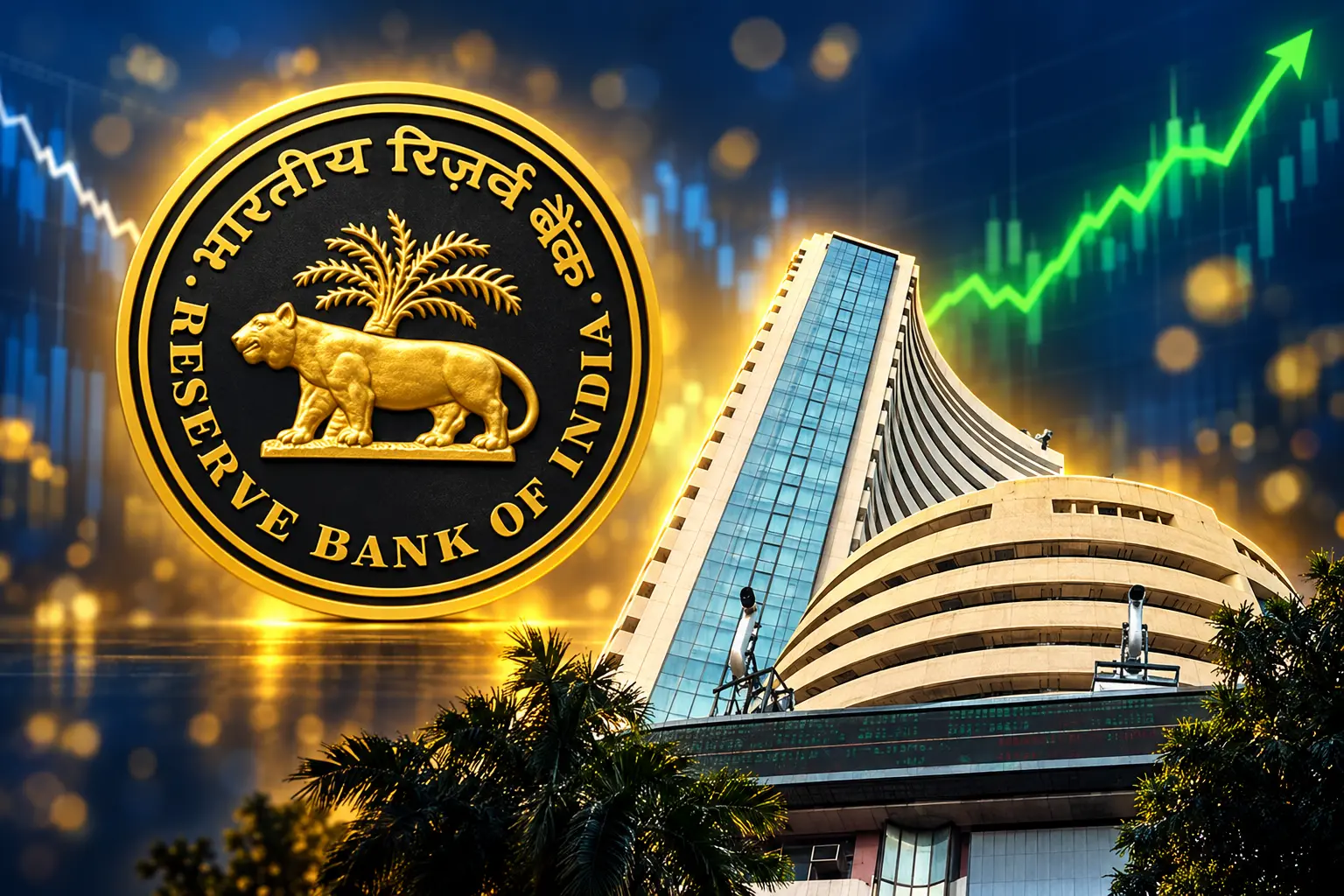
The six-member Monetary Policy Committee, meeting from October 5 to 7 under Governor Sanjay Malhotra, voted unanimously to increase the policy repo rate by 25 basis points to 5.50%. The standing deposit facility moved to 5.25%. The marginal standing facility rate and the Bank Rate moved to 5.75%.
The hike was the part a majority of economists had already put in their notes. The change in stance from neutral to “calibrated tightening” was the piece that was not. HDFC Asset Management’s policy note said a large section of the market had expected the stance to stay put, and that Indian 10-year yields had already risen by about 50 basis points since the August review.
Two Members Held Out on Stance
Dr. Nagesh Kumar and Prof. Ram Singh wanted the stance left at neutral. They lost 4-2. Malhotra told the post-policy briefing that “calibrated tightening” is a milder form of tightening, more data dependent than pre-determined. The resolution is blunter about what the label forbids.
It only signals that given the current conditions, rate cuts are off the table in the near term and policy action ahead can only be a rate hike or a pause, depending on the evolving conditions and the outlook.
Sanjay Malhotra, Governor, Reserve Bank of India, October 7 resolution
The duration and extent of any hike cycle, he said, will turn on underlying inflation, how far price pressures broaden, second-round effects of the supply shock, and demand. Minutes of this meeting are due on October 21. The next sitting is December 2 to 4.
Growth Forecast Rises With Inflation
The same statement that took cuts off the table also raised the growth path. Real GDP for 2026-27 is now put at 7.1%, up 40 basis points from 6.7%, after a 7.8% print in the first quarter. The quarterly path is 7.2% in the second quarter, 6.9% in the third and 6.8% in the fourth, with 7.1% again in the first quarter of 2027-28. A day earlier, the World Bank’s India update had projected to grow at 7.1% in FY27, up from 6.6% in April.
Inflation is the other revision. Consumer prices for 2026-27 are seen at 5.2%, up from 5.0%, with 4.9% in the second quarter, 6.0% in the third and 5.7% in the fourth, then 5.6% in the first quarter of 2027-28. Core inflation is put at 4.4% this year, up from 4.3%. Headline CPI is expected to average almost 5.8% over the next three quarters. August CPI was 4.8%, up from 4.5% in July, with core at 4.2%. About 37% of the CPI basket was running above 4% in August.
Malhotra put the choice in one line: inflation and its outlook are not benign as they were last year, and recalibrating the policy rate is imperative. Q1 growth of 7.8% and a higher full-year forecast are the committee’s argument that it has room to lean against prices without talking the expansion down.
THE REPO PATH BACK TO A HIKE
- February 8, 2023: Last increase of that cycle takes the repo rate to 6.50%.
- April 2023 to December 2024: Rate held at 6.50% for 11 meetings.
- December 2025: Easing cycle, 125 basis points in all, takes the rate to 5.25%.
- February to August 2026: Four holds at 5.25%.
- October 7, 2026: First increase of the new cycle, 25 basis points to 5.50%, stance shifted to calibrated tightening.
Sakshi Gupta, economist at HDFC Bank, said she expects another 50 to 75 basis points of increases in the coming months. That is a path, not a promise. The committee’s own text still allows a pause if the inflation data turn.
₹6,121 Crore Left on Wednesday
Foreign institutional investors sold a net ₹6,121.37 crore in the cash market on Wednesday, buying ₹12,577.96 crore and selling ₹18,699.33 crore, according to exchange figures. Domestic institutions bought a net ₹4,596.57 crore the same day. They did not match the foreign ticket, and the index closed lower.
THREE SESSIONS OF CASH FLOWS
| Session | FII net | DII net |
|---|---|---|
| October 5 | Sold ₹4,699.14 crore | Bought ₹5,181.62 crore |
| October 6 | Sold ₹2,961.30 crore | Bought ₹5,088.92 crore |
| October 7 | Sold ₹6,121.37 crore | Bought ₹4,596.57 crore |
Over the past seven days, foreign investors sold ₹13,782 crore and domestic funds bought ₹14,867 crore. Over 30 days the gap is wider: foreign selling of ₹69,810 crore against domestic buying of ₹80,455 crore. Foreign investors have sold more than ₹4 lakh crore in the cash market this calendar year. Index-futures positioning on October 7 showed a long-short ratio of 0.10, a heavy net short.
Ponmudi R, chief executive of Enrich Money, said the outlook for Indian equities remains cautious after the repo rate moved to 5.50%, tightening domestic financial conditions while global markets already contend with high Treasury yields and geopolitical uncertainty. Tighter domestic conditions and a fragile global risk backdrop, he said, could keep investors defensive.
Domestic institutions have been the bid under this market for months. They can keep absorbing a few thousand crore a day. They cannot, on the evidence of Wednesday, fully offset a foreign sale that large when oil is above $100 and the policy stance has just turned.
Why Software Stocks Bid Up a Weak Rupee
The rupee closed at 96.78 per dollar on Wednesday, a five-month low, after 96.42 on Tuesday. It opened Thursday at 96.72. For an IT exporter, a softer rupee lifts the rupee value of dollar invoices. That is the simple arithmetic behind Thursday’s green screens in TCS, Infosys, HCL Tech and Tech Mahindra, against a falling index.
The same print is a problem for anyone who has to import oil, components or capital goods, and for foreign holders who convert rupee gains back into dollars. That is why the IT bounce and the FII exit can sit on the same morning. One desk is selling India as a dollar asset. Another is buying the companies that earn dollars.
A special FCNR(B) window, opened on June 8 and shut on August 31, mobilised about $133 billion of foreign-currency deposits, with total inflows under the wider swap facility near $144 billion. Malhotra has said forex reserves still cover about 11 months of imports. The rupee still printed 96.78. Dollar deposits raised the reserve line. They did not reverse the equity outflow or the oil bill.
Crude Stays Above $100 With the Rupee Soft
Oil is the supply shock the MPC wrote into the forecast. The resolution cites a re-escalation of the West Asia conflict since the August meeting, sharp swings in crude, and a global shift toward hawkish policy. Deficient monsoon rains and strong El Niño conditions, it said, add risk to farm output and rural demand, even with foodgrain buffers.
Hariselvan Radhakrishnan, founder of HST Wealth, said the overhang is no longer the RBI increase alone, but the prospect of tighter domestic and global monetary conditions lasting longer, which could keep pressure on risk appetite and foreign flows. The RBI’s stance shift, followed by Federal Reserve minutes pointing to another U.S. increase this year, could limit that appetite, he said.
Those minutes, from the September 15-16 meeting and released on October 7, show a unanimous quarter-point rise in the federal funds range to 3.75% to 4.00%. Most participants judged that another increase would likely be appropriate by year end. Sixteen of 18 officials who submitted forecasts expected at least one more move in 2026. Nominal Treasury yields rose about 35 basis points across the 2- to 10-year sector between meetings. The 10-year yield traded as high as 5.35% on October 7, its highest since 2002, before easing toward 5.29% after a firm auction.
THREE PRESSURES ON THE SAME TAPE
- The oil print: Brent at $102.2 a barrel on Thursday morning keeps India’s import bill and the inflation forecast elevated.
- The rupee print: 96.78 per dollar on Wednesday, a five-month low, raises imported costs even as it helps IT invoices.
- The U.S. path: Fed officials still see another hike by the end of 2026, which holds up global yields and pulls capital toward Treasuries.
Asian indices were lower on Thursday, with Japan’s Nikkei 225, South Korea’s Kospi, Shanghai’s composite and Hong Kong’s Hang Seng all quoted down. U.S. stocks had closed lower on Wednesday. None of those tapes needed an Indian rate decision to sell. They made it easier for foreign money to keep selling India.
Nifty Still Rose in the Last Hiking Cycle
A 25 basis point step, flagged in advance, is not the off-cycle shock of May 4, 2022, when a 40 basis point rise sent the Sensex down 2.29%, or 1,306.96 points, to 55,669. This time the committee moved on a scheduled meeting, and most desks had the hike in the bag. What they did not have was the stance label and a $102 oil tape on top of it.
The 2022-23 tightening was much larger, 250 basis points, and still left the Nifty about 7.16% higher by the time the cycle paused at 6.50%. That history is a poor comfort for an NBFC book or a floating-rate mortgage. It is a reminder that an Indian hiking cycle can run next to a rising index if earnings hold, which is the bet inside the RBI’s own 7.1% growth number.
Calibrated tightening was last used in October 2018, and no further hikes followed in that stretch. Malhotra’s version is explicit that the next step is a hike or a pause, not a cut. Whether this cycle looks like 2018 or like 2022 will be decided by crude, food and the December meeting, not by Thursday’s open.
Banks Reprice Faster Than Deposit Costs
Thomas J. Priju, portfolio manager at Karma Capital, said banks can benefit because loan rates may reset faster than deposit costs. That is the NIM argument, and it showed up in Kotak Mahindra Bank’s 2.21% gain on Wednesday, when it led the Sensex, and in the PSU bank index’s 1% rise. Housing-finance names and some state banks found buyers even as the Nifty Bank slipped 73 points to 55,056, a small loss next to the Nifty’s 173-point drop.
NBFCs do not get that reset as cleanly. Their liabilities reprice in the wholesale market as soon as the corridor moves. Realty and auto sit behind the borrower: a higher EMI, a slower booking, a longer waiting period for a car loan. Airlines sit behind the fuel rack. Paint companies sit behind the same crude barrel. That is the loser column, and it was visible in Shriram Finance, Asian Paints and InterGlobe as well as in the Bajaj twins.
WHO KEEPS THE SPREAD
- Large banks: Loan yields can move up before deposit costs fully catch, which is why Kotak, ICICI Bank and the PSU pack held up on Wednesday.
- IT exporters: Dollar revenue converts at a weaker rupee, which is why TCS, Infosys, HCL Tech and Tech Mahindra led Thursday’s gainers.
- NBFCs and housing demand: Wholesale liabilities and floating-rate retail books take the hike immediately, which is why Bajaj Finserv and the realty index lagged.
- Airlines and paints: Jet fuel and input crude at $102.2 a barrel cut margins before any rate pass-through lands in fares or home décor.
The same 25 basis points that pads a bank’s spread raises the EMI on a floating home loan. Gupta’s 50 to 75 basis points of further hikes, if they arrive, would extend that gap. The committee still has a pause on the table. Borrowers will not know which it is until December.
TCS reports its quarter on Thursday. The MPC publishes minutes on October 21 and meets again on December 2 to 4. Until then the tape has a simple job: software and a few banks on one side, oil, NBFCs and foreign selling on the other, with the Sensex stuck counting the difference.
Disclaimer: This article is news reporting and analysis of market prices, central-bank decisions and published forecasts. It is for information only and is not investment advice, a recommendation to buy or sell any security, or a forecast of future returns. Readers should consult a SEBI-registered investment adviser or other qualified financial professional before making decisions about equities, bonds, loans or currencies. Index levels, fund-flow figures, oil prices, exchange rates and policy paths are those published by the exchanges, the Reserve Bank of India, the Federal Reserve and the World Bank for the dates named above, and they can change in the next session.

IT Stocks Climb as Sensex Falls After RBI Hike

Anthropic Prices Claude Haiku 5.5 as a Subagent Worker

Nifty Falls While India Pays $121 a Barrel

OpenAI’s 722 Math Papers Leave the Checking to Humans

Flipkart Recruits Sellers and Riders for Big Billion Days

Consumer Sentiment Falls to 51.7 as Future Outlook Darkens

Pluto’s Heart Glacier Still Pushes Liquid Nitrogen Upward

Take-Two Subpoenas Microsoft While GTA 6 Preorders Soar

Netflix Weighs Hosting Peacock and Fox One in Its App

UMMC Will Rebuild 30-Year-Old Cancer Labs With $2.4 Million
-
 BUSINESS2 months ago
Consumer Sentiment Falls to 51.7 as Future Outlook Darkens
-
 NEWS2 months ago
Pluto’s Heart Glacier Still Pushes Liquid Nitrogen Upward
-
 GAMING1 month ago
Take-Two Subpoenas Microsoft While GTA 6 Preorders Soar
-
 ENTERTAINMENT1 month ago
Netflix Weighs Hosting Peacock and Fox One in Its App
-
 NEWS2 months ago
UMMC Will Rebuild 30-Year-Old Cancer Labs With $2.4 Million
-
 BUSINESS1 month ago
Abbott Pays $670 Million to Exit a Missouri Food Verdict
-

 NEWS1 month ago
Water-Shedding Coatings Charge the Drops That Pierce Them
-

 GAMING1 month ago
GTA 6’s 80-Hour Run Counts Goals That Change the Story