
BUSINESS
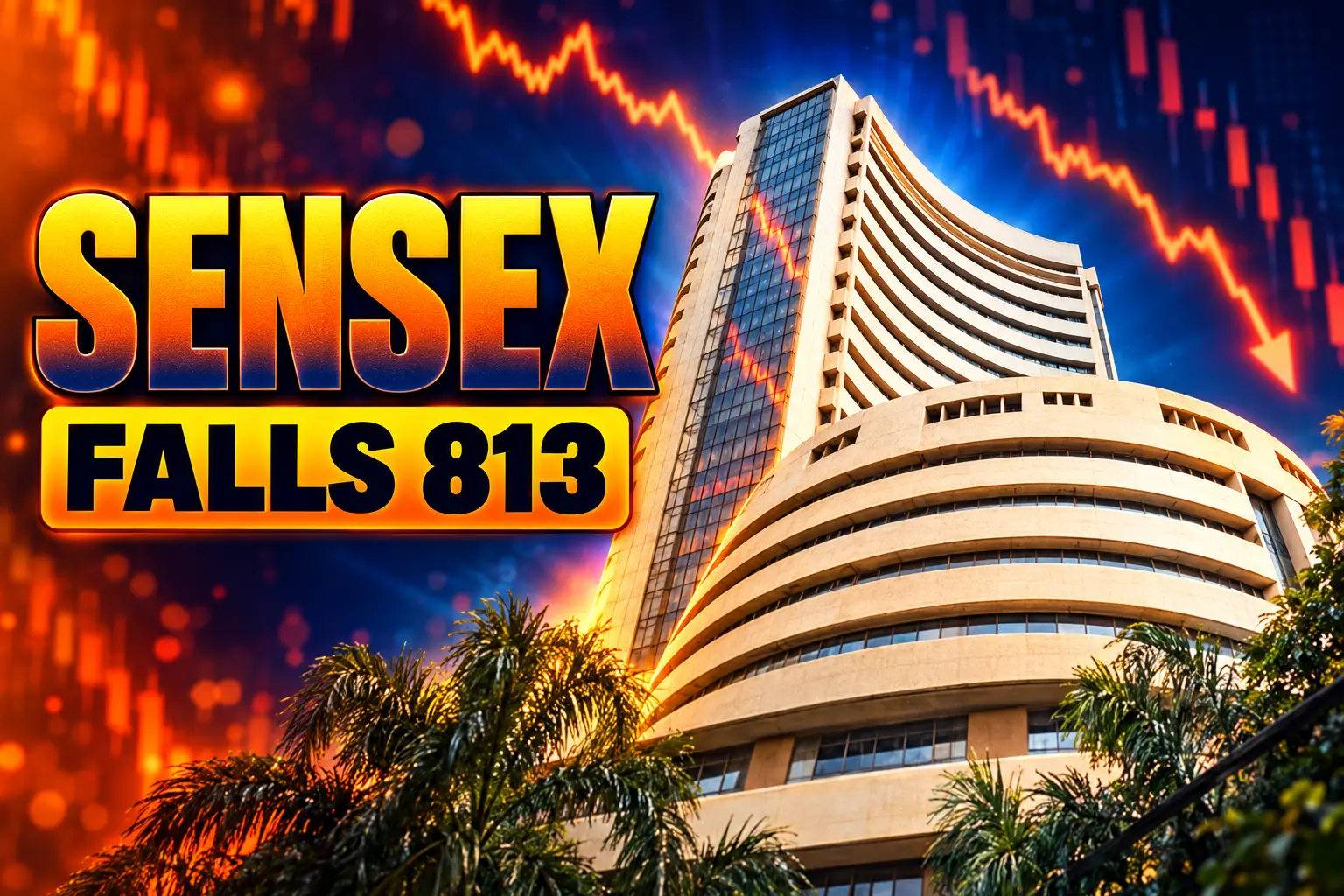
Sensex Falls 813 Points as $100 Oil Reprices India
The Sensex fell 813 points as $100 oil and a 95 rupee reopened India’s import-bill squeeze, with IT leading the drop.

The BSE Sensex fell 813.35 points, or 1.08%, to 74,764.23 on Wednesday, its lowest close in three months. The NSE Nifty dropped 203.60 points, or 0.86%, to 23,431.50 as Brent crude jumped 2.67% to $100.5 a barrel.
IT shares led the tape, and the rupee slipped to 95.08 per dollar. Exporters that collect dollars still sat at the bottom of the Sensex, which is how an oil shock showed up in this market.
Sensex Settles at a Three-Month Low
Both benchmarks finished at the session low after a weak open and a failed afternoon bounce. The Nifty last closed at this depth on June 11. From the August 3 peak of 24,774.30, it is now down 5.4%.
The slide is the third straight session. Monday’s Nifty close was 23,779.15. Tuesday’s was 23,635.10. Across the three days the Sensex has given up 1,751.20 points from Friday’s 76,515.43 close.
WEDNESDAY’S CLOSING LEVELS
| Index | Close | Change |
|---|---|---|
| Sensex | 74,764.23 | -813.35 (-1.08%) |
| Nifty 50 | 23,431.50 | -203.60 (-0.86%) |
| Nifty Bank | 56,295.55 | -482.00 (-0.85%) |
| Nifty IT | 28,914.00 | -969.45 (-3.24%) |
| Nifty Metal | 13,391.40 | +235.45 (+1.79%) |
| India VIX | 11.94 | +6.32% |
Thirty-eight of the 50 Nifty stocks finished lower. On the Sensex, 24 of 30 names fell and only six rose. Midcaps and smallcaps lost 0.51% and 0.48%, so the damage was broad, just milder below the large-cap line. About 180 stocks still printed 52-week highs, a split tape rather than a washout.
India VIX jumped 6.32% to 11.94 from 11.23. That is more hedging, not a panic print. Talk of the Nifty crashing toward 12,000 is running far ahead of the volatility the market is actually pricing. September Nifty futures still settled at 23,530, a 98.5-point premium to cash.
HCL Tech led the Sensex down, dropping 4.55%. Infosys fell 4.43%, Tech Mahindra 3.87%, TCS 2.26%, and HDFC Bank 2.23%. U.S. stocks had already closed lower on Tuesday, with the S&P 500 at 7,673.52, down 0.58%, the Dow at 52,786.07, down 1.18%, and the Nasdaq at 26,421.41, down 0.32%. South Korea’s Kospi and Shanghai’s SSE Composite finished higher. Japan’s Nikkei 225 and Hong Kong’s Hang Seng did not.
$100 Oil Makes a Second Run This Year
Brent’s move through $100 is not a new war. It is the second time this conflict has pushed the benchmark through that line, and it lands after a summer in which India had started to budget for cheaper crude.
The U.S.-Iran fight began on February 28. Brent peaked at $126.41 on April 30. It last traded above $100 on July 24, during a stretch when a pause in fighting let more oil move and the Indian basket cooled. Fighting resumed on August 30. Flows through the Strait of Hormuz, which Rystad Energy chief economist Claudio Galimberti had put at 8 million to 9 million barrels a day in the week before that restart, later fell below 2 million barrels a day.
HOW OIL GOT BACK TO $100
- February 28, 2026: The U.S.-Iran war starts and Gulf shipping risk jumps.
- April 30, 2026: Brent peaks at $126.41 a barrel.
- July 24, 2026: Brent last trades above $100 before the summer pause.
- August 30, 2026: Fighting resumes and Hormuz volumes later drop below 2 million barrels a day.
- September 8, 2026: U.S. Central Command says it attacked five Iranian crude vessels, four in the Gulf of Oman and one near Kharg Island.
- September 9, 2026: Brent settles the Indian session near $100.5 and the Sensex closes at a three-month low.
Iran-backed Houthi strikes on Saudi energy sites this week set facilities on fire and put the Red Sea, the main detour around Hormuz, back in play. Iran also fired ballistic missiles into Jordan, where the armed forces said they engaged 20 missiles and destroyed 18. Goldman Sachs still sees Brent at $85 a barrel by December, a forecast that treats Wednesday’s $100.5 as a disruption premium rather than the new mid-cycle price.
The Import Bill Climbs While Volumes Barely Move
India’s problem is not barrels. It is the dollar invoice. The Petroleum Planning and Analysis Cell put the Indian crude basket at $108.91 a barrel on September 8, above Brent, because the basket mixes sweet and sour grades Indian refiners actually buy. The September average so far is $102.11, against $90.19 in August and $82.04 in July.
INDIAN CRUDE BASKET, FY27
| Month | Average ($/barrel) |
|---|---|
| April | 114.48 |
| May | 106.23 |
| June | 83.22 |
| July | 82.04 |
| August | 90.19 |
| September (to date) | 102.11 |
PPAC’s April to July crude import volumes tell the same story in dollars. India bought 81.9 million tonnes in those four months, almost unchanged from 81.5 million tonnes a year earlier, and paid $63.4 billion against $40.5 billion. Import dependence is over 90%. The current account deficit was 0.6% of GDP in FY26. A $100-plus basket pulls that number wider even if the tanker count does not rise.
Delhi pump prices on September 9 were ₹102.12 a litre for petrol and ₹95.20 for diesel at Indian Oil outlets, so households are not seeing the full $108.91 barrel in real time. That gap is a fiscal choice, and it is the channel that turns an oil spike into a budget problem rather than an overnight CPI spike.
Why Did IT Stocks Lead an Oil Shock?
Nifty IT fell 3.24%, the worst major sector. Five of the Nifty’s top six losers were IT names. Infosys is down for a sixth straight session. TCS is down for a seventh. A weaker rupee usually lifts exporter profits in rupee terms. On this tape that cushion did not show.
The sector had its own calendar. Stronger U.S. jobs data put rate-cut hopes back in reverse, a new visa fee hit the same morning, and Coforge lost its chairman before the open. Crude was the market headline. IT was the index math.
FOUR PRESSURES ON IT SHARES
- Fed odds: CME FedWatch put a September hike at 58% after the United States added 162,000 jobs in August, nearly triple the expected print.
- Visa fees: An expanded 9-11 Response and Biometric Entry-Exit fee took effect Wednesday on routine H-1B and L-1 extensions, a running cost for firms that staff U.S. projects with Indian engineers.
- Coforge: Chairman and independent director O.P. Bhatt resigned with immediate effect after an internal audit of the board evaluation process, and the stock led the early slide.
- Spend mix: Broker Antique has argued that the capex wave is still landing in chips, data centres and cloud networks, not the application work Indian firms bill.
Nitant Darekar, a research analyst at Bonanza Portfolio, said the visa-fee expansion turns an occasional charge into an annual bill and that the Street is reading it straight into margins in a sector already down about 24% this year. Kunal Bajaj at Choice Institutional Equities added higher crude, hawkish Fed expectations and AI-led deflation fears as a near-term overhang. Realty fell 2.23%, and private banks and FMCG each lost about 1%, so IT was the leader, not the only weak group.
Foreign Cash Selling Was Tiny
The foreign-outflow line in Wednesday’s recap is a Tuesday number, and it is small. NSE’s combined FII and DII cash figures show foreign investors sold a net ₹123.19 crore on September 8, buying ₹11,704.84 crore and selling ₹11,828.03 crore. Domestic institutions bought a net ₹1,349.64 crore. Combined, institutions added ₹1,226.45 crore, and the Nifty still fell 0.61% that day, then another 0.86% on Wednesday.
INSTITUTIONAL CASH FLOWS INTO SEPTEMBER
| Date | FII net (₹ cr) | DII net (₹ cr) | Nifty close |
|---|---|---|---|
| September 2 | +6,688 | +2,813 | 23,914.45 |
| September 3 | -2,346 | +4,977 | 23,873.45 |
| September 4 | -3,112 | +8,930 | 23,897.70 |
| September 7 | +280 | +567 | 23,779.15 |
| September 8 | -123.19 | +1,349.64 | 23,635.10 |
DIIs have now bought for 21 straight sessions. FIIs have been net sellers in four of the first six September sittings, yet they are still net buyers of ₹2,531 crore for the month, against DII buying of ₹20,484 crore. The longer drain is the year-to-date book: FIIs have sold ₹3.57 lakh crore in the cash market, while DIIs have put in ₹5.84 lakh crore.
A ₹123.19 crore foreign print cannot carry an 813-point Sensex drop on its own. Wednesday’s FII number is not out yet. Until it is, the leadership of the fall, IT, banks, realty, says more about who got marked down than about a foreign exit in cash.
Adani Ports and Tata Steel Took the Bid
Metal and energy were the only major sectoral gauges to finish higher, up 1.79% and 0.6%. That is the other side of $100 oil: steel and bulk ports catch a bid when commodity prices firm and when a weaker rupee lifts rupee realisations for dollar-linked names.
Adani Ports rose 3.67% on the Sensex. Tata Steel gained 2.42%, Trent 1.12%, and NTPC 0.53%. On the Nifty, Adani Enterprises, Max Healthcare, Adani Ports, Coal India and Tata Steel were the top gainers. Jindal Stainless jumped more than 6% inside the metal pack. BSE utilities rose 1.11%.
Ankur Punj, managing director at Equirus Wealth, said oil’s climb, a sharp drop in the rupee, and weak global cues hit IT, auto, selected banks and realty. Auto closed lower. Banks extended a four-session decline, with Nifty Bank down 0.85%. The winners were the names tied to bulk commodities and cash-flow utilities, not the liquid FII favorites that usually set the Nifty’s day.
A 5.25 Repo Rate Meets $100 Crude
The Reserve Bank’s Monetary Policy Committee, in its August 3 to 5 meeting, voted unanimously to keep the repo rate at 5.25 percent and to stay neutral. The standing deposit facility remains at 5.00% and the MSF rate at 5.50%. CPI inflation for 2026-27 is projected at 5.0%, with the third quarter at 5.9% and the fourth at 5.5%.
Those forecasts already baked in dearer oil than the April round, which had assumed $85 a barrel. The June round used $95. The Indian basket on Tuesday was $108.91. That gap is the second hit from Wednesday’s tape: spot crude is running about $14 above the June working number, and Q3 inflation is already the high point of the RBI path.
In June the central bank also recorded that retail fuel prices had been raised 7.4% for petrol and 8.4% for diesel since May, a direct CPI impulse of about 36 basis points. If the basket stays above $100, that choice, hold pump prices or pass them through, lands back on the fiscal deficit and on the next MPC. The rupee at 95.08 is the FX version of the same squeeze.
Indian equity markets extended their decline for a third consecutive session, with benchmark indices ending firmly lower as persistent selling pressure and a broad risk-off mood kept sentiment subdued. Elevated crude oil prices, lingering geopolitical tensions and a sharp rise in market volatility continued to weigh on investor confidence, reinforcing the market’s prevailing bearish undertone.
Ponmudi R, CEO, Enrich Money
Sandip Sabharwal, a research analyst and former head of equity at SBI Mutual Fund, wrote that the Nifty is now as oversold on technical measures as it has been outside extreme panic falls. U.S. CPI for August is due on Friday, September 11, with the Federal Open Market Committee on September 16. Until those prints, India is trading a $100 barrel, a 95 rupee, and an IT book that is being marked for Washington’s visa desk as much as for Hormuz.
Disclaimer: This article is news reporting and market analysis for information only. It is not investment advice, a recommendation to buy or sell any security, index product, currency or commodity, or a forecast of returns. Readers should consult a SEBI-registered investment adviser or other qualified financial professional before acting on any market move. Index levels, oil prices, rupee prints, flow figures and policy rates reflect the cited exchange, PPAC and RBI sources as of September 9, 2026, and can change in the next session.

IT Stocks Climb as Sensex Falls After RBI Hike

Anthropic Prices Claude Haiku 5.5 as a Subagent Worker

Nifty Falls While India Pays $121 a Barrel

OpenAI’s 722 Math Papers Leave the Checking to Humans

Flipkart Recruits Sellers and Riders for Big Billion Days

Consumer Sentiment Falls to 51.7 as Future Outlook Darkens

Pluto’s Heart Glacier Still Pushes Liquid Nitrogen Upward

The Extra Heat Month Hits Children Where Care Is Thinnest

UMMC Will Rebuild 30-Year-Old Cancer Labs With $2.4 Million

Take-Two Subpoenas Microsoft While GTA 6 Preorders Soar
-
 BUSINESS2 months ago
Consumer Sentiment Falls to 51.7 as Future Outlook Darkens
-
 NEWS2 months ago
Pluto’s Heart Glacier Still Pushes Liquid Nitrogen Upward
-
 NEWS2 months ago
The Extra Heat Month Hits Children Where Care Is Thinnest
-
 GAMING2 months ago
Take-Two Subpoenas Microsoft While GTA 6 Preorders Soar
-
 NEWS2 months ago
UMMC Will Rebuild 30-Year-Old Cancer Labs With $2.4 Million
-
 BUSINESS2 months ago
Abbott Pays $670 Million to Exit a Missouri Food Verdict
-

 ENTERTAINMENT2 months ago
Netflix Weighs Hosting Peacock and Fox One in Its App
-

 NEWS2 months ago
Water-Shedding Coatings Charge the Drops That Pierce Them