
NEWS
Knockoff Flags Amazon Junk Brands the Trademark Office Already OK’d
Josh Pigford’s Knockoff add-on hides Amazon’s alphabet-soup labels, while Shopify stores pay to chase copies that already hold U.S. trademarks.

Josh Pigford’s Knockoff browser extension has 100,000 Chrome installs and dims Amazon listings whose brand names look like keyboard accidents. The software developer shipped it in July after a Sunday search for a trimmer part turned into a wall of copycat names and nearly identical photos.
Shoppers meet a free add-on. The pressure sits somewhere else: small Shopify catalogs getting cloned, and a U.S. trademark register that already treats many of those names as real marks.
Amazon’s Brand Registry Turned Trademarks Into Tickets
Amazon’s public README-level problem is not a secret warehouse of fake Louis Vuitton. It is a search grid packed with trademark-squat labels (SZHLUX, HORUSDY, LATTOOK, DOZAWA) that exist so a seller can join Brand Registry, then sell commodity goods with no company, no warranty, and no reputation behind them.
Brand Registry is free, and it is gated. Amazon’s seller page says you need a registered trademark to enroll, or in some cases a pending application, from a designated government office, and the mark’s text must match the brand name on the application. The same page now sweetens enrollment with 10 percent back on the first $50,000 in branded sales, then 5 percent through the first year until $1,000,000, plus a $200 Amazon Vine credit.
A nonsense string is easy to clear at the U.S. Patent and Trademark Office because it collides with almost nothing. Once it registers, it is a ticket into Amazon’s brand tools, A+ content, and infringement reporting. The junk seller gets a legal wrapper. The shopper gets SUNHZMCKP on a screwdriver, SACATR on a spoon, ROTTOGOON on a lamp.
WHAT BRAND REGISTRY DID TO FILINGS
- Small-business volume: Law professors Jeanne C. Fromer and Mark P. McKenna found annual USPTO applications estimated to come from small businesses roughly doubled, from about 100,000 to about 200,000, after Brand Registry took hold.
- Share of the docket: Those filings rose from about 30 percent of the yearly total to about 40 percent.
- Nonsense marks: Their 2024 study found nonsense marks topped 20,000 a year, up from almost none, or about 0.5 percent of filings to about 4.5 percent.
- The examples: Strings in their sample included ELXXROONM, SUJIOWJNP, XUFFBV, and LXCJZY.
Pigford told an interviewer the consumer tool looks at that linguistic spam and, in the live product, also runs trademark checks to see whether a name is a real brand or a fabrication. On July 8 he said he stood to benefit nothing directly from the add-on. The paid business arrived beside it.
Typical knockoff brands tend to be trademark spam, like someone just smashed their hands on a keyboard and whatever came out is what they named their brand.
Josh Pigford, founder of Knockoff
Fashion Search Is 37 Percent Made-Up Names
Knockoff later published what its users were actually seeing on clothing and accessory results. The sample is the company’s own, not a census of every Amazon listing, and it is still the cleanest public cut of the fashion aisle.
KNOCKOFF’S CLOTHING AND ACCESSORY SAMPLE
| Measure | Figure |
|---|---|
| Distinct brand names encountered | 21,833 |
| Share scored as recognizable brands | fewer than 5 percent |
| Share scored as made-up names | roughly 37 percent |
| Sample made-up strings | ABTIPQM, AIYJWXINP, AFCJLTO |
| Fashion name users reported most | COOFANDY |
Knockoff says COOFANDY showed up in those fashion results more often than Levi’s. The add-on does not claim every dimmed tile is a counterfeit of a famous house. It claims the name has the shape of a squat brand, or sits on a community blocklist, and that shoppers who want a firm with something to lose should not have to hunt for one.
That is a narrower job than “spot the fake handbag,” and it is the job the fashion numbers describe. Most of the 21,833 names are not household labels. A large minority score as invented. The rest sit in the mush between a known maker and a keyboard mash, which is where a shopper wastes the afternoon.
What the Filter Checks on a Listing
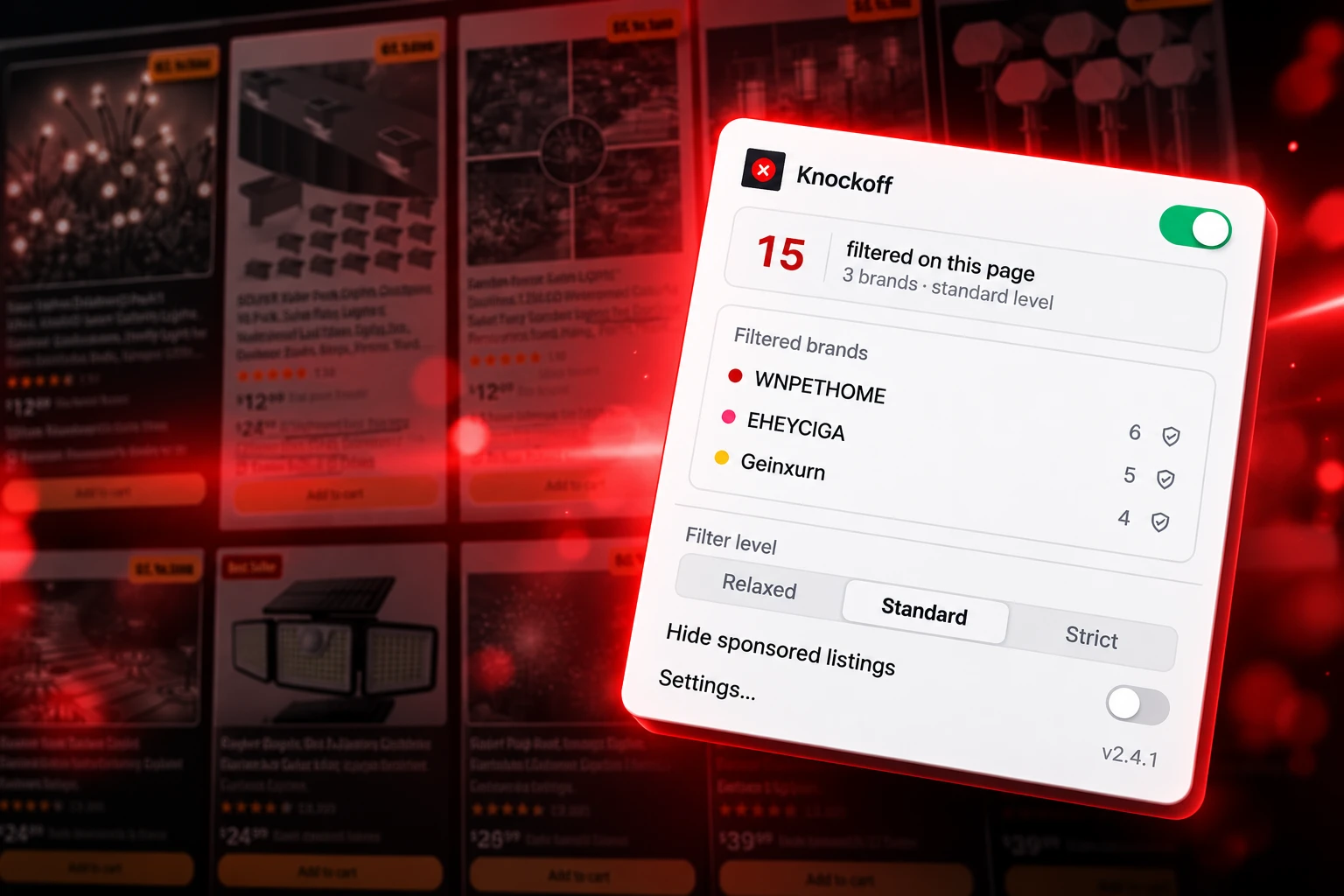
The published Chrome build, version 1.5.0 as of August 25, 2026, appraises the brand on each tile and then hides, dims, or labels the junk. The frozen public code and the store copy agree on the spine: a curated register of more than 5,000 established brands, a seed list of notorious pseudo-brands, optional treatment of known Chinese-owned majors, then a name scorer.
Unknown names get points for ALL-CAPS strings of 5 to 9 characters, missing vowels, unpronounceable consonant runs, un-English letter pairs, and random internal capitals. High scores come back flagged. Mid scores come back suspect. The known-brand list always wins, because ASICS, RYOBI, and HOKA would otherwise look like squatters.
FILTER LEVELS IN THE PUBLISHED BUILD
| Level | What it filters |
|---|---|
| Relaxed | Known pseudo-brands plus the user’s blocklist |
| Standard (default) | Those names, plus suspect-looking names and unbranded listings |
| Strict | Anything not on a known-brands list |
Sponsored tiles can be hidden. Alexa homepage prompts can be hidden. The product page is never yanked out from under you; it gets a verdict chip next to the brand byline. Mixed-case gibberish such as Geinxurn still slips past Standard. Strict mode is the blunt instrument for that. Non-Latin listings are skipped rather than mis-tagged. English heuristics are best-effort on other storefronts.
The Chrome Web Store listing, published by Ordinary Systems, LLC of Chelsea, Alabama, showed 100,000 users on the Chrome listing, a 4.8 rating from 139 reviews, and a Firefox port. GitHub documents a Safari wrapper. A July 13 reply to Pigford said the Safari build was already live. The public repo is now a frozen snapshot so a local copy makes no server calls; the store build refreshes the brand register.
FROM TEASE TO VERSION 1.5.0
- July 6, 2026: Pigford asks whether anyone would use a Chrome add-on that dims mass-produced fake brands on Amazon.
- July 7, 2026: Knockoff goes live, with a public apology to names including WNPETHOME, EHEYCIGA, YXYL, and COOFANDY.
- July 13, 2026: He writes that he has “caught lightning in a bottle” with knockoff.co and now has “to figure out how to not screw it up.”
- August 25, 2026: The Chrome listing shows version 1.5.0.
- September 3, 2026: The official Knockoff account notes Amazon IP Accelerator runs about $1,050 for a one-class U.S. mark, against $350 to file the same class yourself.
People who kept the add-on after the first week were not hunting a novelty. They were tired of reading brand names that do not parse as language. The next request in that thread was a United States-origin filter, which is a different product, because a squat mark can sit on a U.S. certificate just as easily as on a factory invoice.
The $99 Plan That Files the Takedown
The consumer extension is free, local, and built to hide listings. Knockoff Data, LLC sells the other half: brand protection from $99 a month for Shopify stores that cannot dim their way out of a clone.
Connect the store, sync the catalog, and the scanner watches product photos across the places copies actually sell. A match is confirmed only when the original photo appears in the other seller’s own gallery. A reviewer reads every notice. The merchant approves it. Watch and Enforce prepare the packet; Dominate files it as an authorized agent after one letter of authorization.
KNOCKOFF’S SHOPIFY PLANS
- Watch, $99 a month: Photo watching across marketplaces, merchant files the notice.
- Enforce, $299 a month: Prepared takedowns with no monthly cap, including Temu, still filed by the merchant.
- Dominate, $799 a month: Knockoff files approved cases, and the plan adds copycat Shopify storefronts plus design-clone detection for re-shot and AI-made copies.
Covered surfaces on the higher plans include Amazon, eBay, Walmart, Temu, Etsy, AliExpress, Alibaba, DHgate, Shein, Facebook, and Instagram. The company says the product is Shopify-only for now. Its own demo case is a walnut desk organizer at $68, found on Temu on August 14, 2026 for $8.99 with an exact photo match.
A registered trademark is optional here. Knockoff’s own FAQ says product photos are protected by copyright from the shutter click, and copyright claims work on every marketplace it covers. The trademark watch is extra: new USPTO applications that look confusingly similar get flagged at publication.
That split is the business. Shoppers get a dimmer switch. A $68 organizer brand gets a packet, a timestamp, and a form. Enterprise brand-protection firms sell the same category on a demo call and an annual contract. Pigford put a signup form on it.
Xiamen Holds 357 Names on the U.S. Register
Knockoff’s read of USPTO data goes further than ugly consonants. The company says a single e-commerce firm in Xiamen, China, holds U.S. trademarks behind 357 distinct brand names, including invented European designer labels FABIEN SIEFFERT and CHARLIE POMMIER, and that both names were still on the register when it ran the analysis.
Those marks were not pulled from a dark web listing. They were filed, examined, and left alive in the same public system a U.S. maker uses for a real house mark. Amazon then has a certificate it can treat as Brand Registry fuel. The shopper sees a French-looking name on a product that has no French house behind it.
The USPTO is not asleep. Its Trademark Register Protection Office audits marks that are not in use, runs expungement and reexamination for nonuse, and can shut down accounts that game the filing system. Directed post-registration audits now look for digitally altered specimens and printouts from specimen-farm sites. That is a cleanup lane for dead wood. It is slow next to a factory that can mint a few hundred word marks and feed them into Amazon search.
Pigford’s July jewelry post made the same point with a price tag instead of a city name. A shop with 1,800 reviews was selling a “handmade” necklace. He matched it to a $6 necklace on Alibaba.
on the first pass of https://t.co/oHj8T9jpTM for etsy (dropping this week), i want to be careful to not come out guns-blazing claiming something is deceptive, but instead give you *context* while you're shopping. https://t.co/HaQcR0EpZ2 pic.twitter.com/Up7QXYaxlQ
— Josh Pigford (@Shpigford) July 22, 2026
COOFANDY Outranked Levi’s for Some Shoppers
COOFANDY is the name Knockoff users reported most, and the name that out-ranked Levi’s in that fashion sample. It is also a live U.S. registration. Serial 97839026, owned by Shenzhen Sailvan Network Technology Co., Ltd., was filed March 14, 2023, and registered February 20, 2024, for a long list of clothing, including shirts, trousers, jackets, and denim pants. First use in commerce is listed as March 9, 2023.
Call that a knockoff in the street sense and you overshoot. Call it a household brand and you overshoot the other way. The filter is scoring reputation and name shape, not the existence of a certificate. That is why LANEIGE can appear in a jokey launch apology next to EHEYCIGA, and why the badge menu includes a one-click “this is a real brand” report. False hits are a known cost. The community list is how the product tries to pay it down.
Amazon’s own house labels sit in a gray zone the add-on was not built to referee. One early reply asked why the platform itself was not treated as the knockoff. The code does not answer that. It answers whether the string on the tile looks like SZHLUX, and whether anyone with a reputation would mind if the listing vanished.
The patent office will keep auditing unused marks. Shopify owners will keep paying to chase their own photos across Temu and DHgate. Chrome users will keep turning the dimmer up from Relaxed to Strict when a search for a dog bed still opens on WNPETHOME. Pigford already said the hard part is not the launch. It is not screwing up what the launch exposed.

IT Stocks Climb as Sensex Falls After RBI Hike

Anthropic Prices Claude Haiku 5.5 as a Subagent Worker

Nifty Falls While India Pays $121 a Barrel

OpenAI’s 722 Math Papers Leave the Checking to Humans

Flipkart Recruits Sellers and Riders for Big Billion Days

Consumer Sentiment Falls to 51.7 as Future Outlook Darkens

Pluto’s Heart Glacier Still Pushes Liquid Nitrogen Upward

The Extra Heat Month Hits Children Where Care Is Thinnest

Take-Two Subpoenas Microsoft While GTA 6 Preorders Soar

UMMC Will Rebuild 30-Year-Old Cancer Labs With $2.4 Million
-
 BUSINESS2 months ago
Consumer Sentiment Falls to 51.7 as Future Outlook Darkens
-
 NEWS2 months ago
Pluto’s Heart Glacier Still Pushes Liquid Nitrogen Upward
-
 NEWS2 months ago
The Extra Heat Month Hits Children Where Care Is Thinnest
-
 GAMING2 months ago
Take-Two Subpoenas Microsoft While GTA 6 Preorders Soar
-
 NEWS2 months ago
UMMC Will Rebuild 30-Year-Old Cancer Labs With $2.4 Million
-
 ENTERTAINMENT2 months ago
Netflix Weighs Hosting Peacock and Fox One in Its App
-
 BUSINESS2 months ago
Abbott Pays $670 Million to Exit a Missouri Food Verdict
-

 GAMING2 months ago
GTA 6’s 80-Hour Run Counts Goals That Change the Story