
NEWS
Xiaomi Prices Its Thinnest Pack Above the 165W Brick
Xiaomi’s 6mm 5,000mAh magnetic pack costs ₹5,599 in India, ₹600 more than its 20,000mAh 165W brick, while a Qi2.2 10,000mAh pack is cheaper still.

Xiaomi is selling a 5,000mAh magnetic pack in India for ₹5,599, ₹600 above its own 20,000mAh 165W brick. The Xiaomi UltraThin Magnetic Power Bank 5000 15W, the Magnetic Power Bank 10000 45W and the Power Bank 20000 165W were announced on September 8, 2026, with the thin slab and the 165W brick going on sale September 11 and the 10,000mAh pack following on September 15.
The price order does not follow battery size or wattage. It follows how closely each pack mimics a MagSafe battery that Apple stopped selling years ago.
Xiaomi’s Thinnest Pack Costs More Than Its Fastest
Launch materials put the UltraThin at an MRP of ₹5,999 and an offer of ₹5,599. The 20,000mAh 165W model lists at ₹5,499 and ₹4,999 on offer. The 10,000mAh magnetic pack is ₹3,999, or ₹3,699 on offer, and that is the only one that waits until September 15.
Xiaomi India’s own post on September 8 fixed the UltraThin offer at ₹5,599 and the sale date at September 11. The three will run through Amazon.in, Flipkart, mi.com, Xiaomi retail stores, Blinkit, Zepto and Swiggy Instamart.
THE THREE-PACK LAUNCH CARD
| Model | Offer price | MRP | Battery | Peak output | Sale date |
|---|---|---|---|---|---|
| UltraThin Magnetic 5000 15W | ₹5,599 | ₹5,999 | 5,000mAh (18.58Wh) | 15W wireless / 22.5W wired | September 11, 2026 |
| Magnetic 10000 45W | ₹3,699 | ₹3,999 | 10,000mAh (37Wh) | 25W Qi2.2 / 45W wired | September 15, 2026 |
| Power Bank 20000 165W | ₹4,999 | ₹5,499 | 20,000mAh | 165W combined (120W + 45W) | September 11, 2026 |
Four times the cells and more than ten times the peak watts still cost less than the card you stick on a phone. That inversion is the launch.
What ₹5,599 Buys in a 6mm Slab
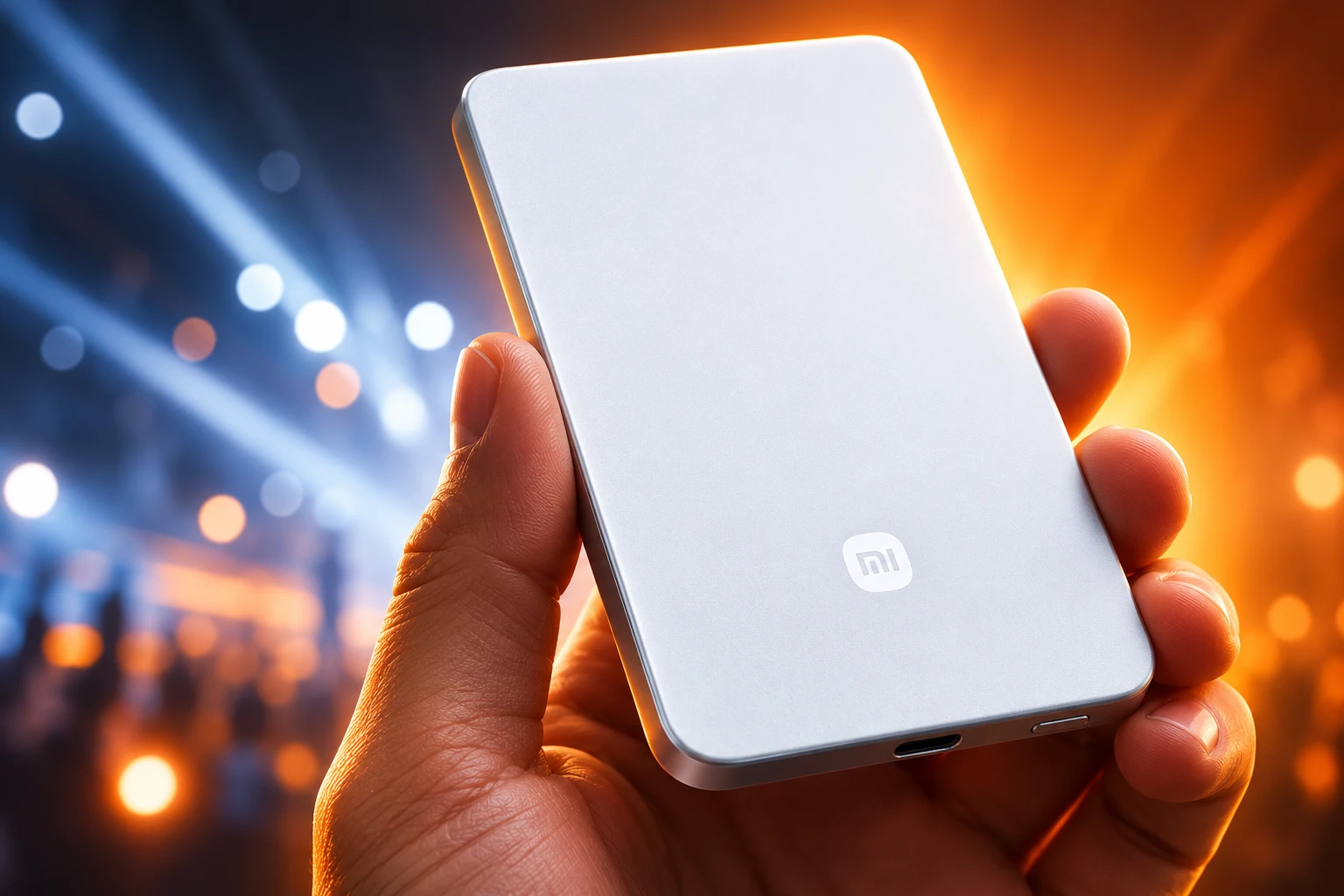
Xiaomi’s India product page calls the UltraThin the thinnest 5,000mAh magnetic wireless pack on sale in the country as of September 2026, citing Counterpoint Research shipment figures for 2025 as the market backdrop. The 6mm card-like body weighing 98g is 98.5 × 71.5 × 6mm, with a silicon-carbon cell that Xiaomi says is 16% silicon and a 4,369mm² graphite sheet behind an aluminium-alloy shell.
Wireless output is 15W on the Xiaomi 17 series and 7.5W on iPhones. Wired USB-C hits 22.5W if you use a 3A cable. Two devices at once drop to 7.5W on the cable and 5W on the coil, and that dual mode needs a press of the power button. Typical capacity is 5,000mAh; rated capacity at 5V/2A is 3,000mAh, and energy is 18.58Wh.
THE SLAB IN THE HAND
- Thickness: 6mm, with a 98g claimed weight that Xiaomi compares with a 100g cotton ball.
- iPhone wireless: 7.5W magnetic charging on iPhone 12 through iPhone 17 series.
- Xiaomi 17 wireless: up to 15W, though a magnetic case is required if the phone has no built-in magnets.
- Music buffer: Xiaomi 17 playback of 15.39 hours stretches to about 24.47 hours with the pack, a gain Xiaomi rounds to 9 hours.
Colours are Radiant Orange, Glacier Silver and Graphite Black. The logo is etched, the face is a fire-resistant fibreglass coating, and Xiaomi lists ten protection layers including foreign-object detection and dual-NTC temperature control. Cases thicker than 2.5mm can break the magnetic link, and the magnetic ring is not in the box.
One published hands-on test with an iPhone 17 Pro Max saw the pack add 15 percentage points in 46 minutes from a 30% start, then run empty near 80% after just under three hours. That is the physical limit of a 5,000mAh cell feeding an iPhone at 7.5W: a top-up, not a second full charge.
Snap, charge, and move! Say goodbye to tangled cables during your daily hustle. The Xiaomi UltraThin Magnetic Power Bank 15W gives you effortless magnetic charging on the go. Limited time period offer starting from ₹5,599. Sale starts 11th September.
Xiaomi India, official X account, September 8, 2026
Snap, charge, and move! Say goodbye to tangled cables during your daily hustle.
The #XiaomiUltraThinMagneticPowerBank15W gives you effortless magnetic charging on the go.
Limited time period offer starting from ₹5,599*. Sale starts 11th September.
Know More:… pic.twitter.com/vXiowyPL50
— Xiaomi India (@XiaomiIndia) September 8, 2026
The marketing is about pockets and snap-on charging. The lab notes are about 7.5W on the phones that actually have MagSafe magnets built in.
Qi2.2 Lives on the Cheaper 10,000mAh Pack
The Magnetic Power Bank 10000 45W is the one that behaves like a modern magnetic charger. Xiaomi’s India page rates it at 10,000mAh typical (two 5,000mAh cells), 5,900mAh at 5V/3A, and 37Wh. Wired output is 45W on a single USB-C port, including a built-in cable. Dual-port wired output falls to 15W. Wireless is Qi2.2 wireless charging at 25W, which Xiaomi says is up to 88.9% faster on an iPhone 17 Pro Max than its older 33W magnetic 10,000mAh pack.
Hold strength is listed at 13N. The casing is a matte shell with a silicone magnetic face in white or black. Self-charging through two USB-C ports at 30W takes about 2 hours 20 minutes in Xiaomi’s 25°C lab test. Wireless turns off by default when the built-in cable is in use unless you double-press the battery button. Xiaomi lists 16 safety features, including a nail-penetration test, a 14kN crush test and a 135°C hot-box run.
30-MINUTE WIRED TOP-UPS
- iPhone 17 Pro Max: 45% in 30 minutes, and about 1.5 full charges from the pack.
- Samsung Galaxy S26: 37% in 30 minutes.
- Google Pixel 10 Pro: 35% in 30 minutes.
- REDMI Note 15 Pro+: 30% in 30 minutes, and about 1.1 full charges from the pack.
Magnetic alignment is listed for iPhone 12 and later, with weaker hold on many Android phones and a fine-print skip for iPhone 16e. At ₹3,699 it undercuts the UltraThin by ₹1,900 and still does the thing buyers actually want from a magnetic pack: Qi2.2 at 25W and a cable that is already attached.
165 Watts Land at ₹4,999
The Power Bank 20000 165W is the opposite object. It is a 20,000mAh brick with a colour display for charge level, in/out status, time estimates and fault flags. Combined output is 165W: one USB-C path at 120W, a second USB-C at 45W, the built-in USB-C cable also at up to 120W, plus a USB-A port. Protocols include Qualcomm Quick Charge 3.5, USB Power Delivery 3.0 with PPS, BC 1.2 and Apple 2.4A.
Xiaomi says a 30-minute session can put more than half a charge into a laptop under its test conditions. That is the only pack in this trio that is honestly a laptop charger. It is also ₹600 cheaper than the 6mm phone slab, and it goes on sale on the same September 11 morning.
165W is surplus for a phone that tops out at 45W or 67W, and a 65W to 80W brick already covers that job. The July 67W 20,000mAh pack is sitting on the same shelves. Anyone who bought that one in late July now owns the slower 20,000mAh Xiaomi, with the faster brick arriving six weeks later at a higher price.
A 67W Pack Went on Sale in July
Xiaomi did not wait until September to sell a big Indian power bank. The Power Bank 5i 20000 67W went up on July 23, 2026, at ₹3,499 on mi.com, with sales from July 28. It uses three 6,700mAh cells, a built-in USB-C lanyard cable, a digital display and 65W input. That pack is the practical daily driver Xiaomi already had for phones, tablets and light laptops.
The September 165W model is a speed bump on the same 20,000mAh class, not a new category. The UltraThin is the new category, and it is priced as if thinness were the scarce resource.
THE ACCESSORY CALENDAR
- September 12, 2023: Apple pulls the $99 MagSafe Battery Pack after the iPhone 15 event, leaving no first-party snap-on pack with USB-C.
- February 2026: Xiaomi launches the UltraThin Magnetic Power Bank 5000 15W globally as a 6mm, 98g silicon-carbon slab.
- July 23, 2026: Xiaomi India launches the Power Bank 5i 20000 67W at ₹3,499, on sale July 28.
- September 8, 2026: Xiaomi India announces the UltraThin, the 10,000mAh Qi2.2 pack and the 165W 20,000mAh brick together.
- September 11, 2026: UltraThin and 165W sales open on mi.com, Amazon.in, Flipkart and Xiaomi stores.
- September 15, 2026: Magnetic Power Bank 10000 45W goes on sale at ₹3,699.
Apple left a hole in 2023. Xiaomi is filling it in India in 2026 at MagSafe-like money, then parking a faster, larger brick next to it for less.
MagSafe Left a Gap Xiaomi Is Pricing Like Apple
Apple’s pack was $99 and is gone. The cheap magnetic alternative in India is already on Anker’s store: the 321 MagGo 5K lists at ₹1,624, down from ₹2,223, and Anker’s MagGo 10K Slim is ₹5,130, down from ₹6,841. Those prices make Xiaomi’s 5,000mAh slab look like a brand tax until you put it next to other ultra-slim Qi2 packs.
UGREEN’s India store sells an 8.6mm MagFlow Air 5000mAh pack at ₹5,990, down from ₹7,999, with Qi2 15W wireless and 20W USB-C. Xiaomi is 2.6mm thinner and ₹391 cheaper on offer, so the UltraThin is not the most expensive slim magnetic 5,000mAh pack in the country. It is only the most expensive pack in Xiaomi’s own three-pack launch, which is a stranger place to lose.
The 10,000mAh Xiaomi at ₹3,699 is the magnetic product that matches how people now charge: Qi2.2, a built-in cable, 45W wired, enough energy for roughly one and a half iPhone 17 Pro Max fills. The UltraThin is a wallet object that happens to charge a phone slowly.
All Three Stay Under the Cabin Battery Cap
Xiaomi prints aviation copy on both magnetic pages. The UltraThin is 18.58Wh and the 10,000mAh pack is 37Wh. The 165W 20,000mAh model is sold as cabin-legal as well. International rules treat power banks as spare batteries: they go in the cabin, not the hold, and they must stay under 100Wh unless the airline signs off on a larger cell.
US guidance on spare lithium batteries in carry-on puts 0-100Wh packs in the cabin without special approval and bars them from checked bags. IATA lithium battery passenger rules say the same for power banks, and a 2026 addendum limits passengers to two power banks, bans recharging a pack on the aircraft, and still caps standard packs at 100Wh. Xiaomi’s own pages tell travellers not to check the pack or use it in flight, and to follow the airline.
That does not change the shelf math on September 11, when the 6mm UltraThin and the 165W brick land on the same store pages ₹600 apart, with the Qi2.2 10,000mAh pack four days behind at ₹3,699.

IT Stocks Climb as Sensex Falls After RBI Hike

Anthropic Prices Claude Haiku 5.5 as a Subagent Worker

Nifty Falls While India Pays $121 a Barrel

OpenAI’s 722 Math Papers Leave the Checking to Humans

Flipkart Recruits Sellers and Riders for Big Billion Days

Consumer Sentiment Falls to 51.7 as Future Outlook Darkens

Pluto’s Heart Glacier Still Pushes Liquid Nitrogen Upward

The Extra Heat Month Hits Children Where Care Is Thinnest

Take-Two Subpoenas Microsoft While GTA 6 Preorders Soar

UMMC Will Rebuild 30-Year-Old Cancer Labs With $2.4 Million
-
 BUSINESS2 months ago
Consumer Sentiment Falls to 51.7 as Future Outlook Darkens
-
 NEWS2 months ago
Pluto’s Heart Glacier Still Pushes Liquid Nitrogen Upward
-
 NEWS2 months ago
The Extra Heat Month Hits Children Where Care Is Thinnest
-
 GAMING2 months ago
Take-Two Subpoenas Microsoft While GTA 6 Preorders Soar
-
 NEWS2 months ago
UMMC Will Rebuild 30-Year-Old Cancer Labs With $2.4 Million
-

 ENTERTAINMENT2 months ago
Netflix Weighs Hosting Peacock and Fox One in Its App
-

 BUSINESS2 months ago
Abbott Pays $670 Million to Exit a Missouri Food Verdict
-

 GAMING2 months ago
GTA 6’s 80-Hour Run Counts Goals That Change the Story