
BUSINESS
Kameda Sells Its India Rice-Snack Stake for ₹1.12 Crore
Kameda Seika is exiting Kameda LT Foods for ₹1.12 crore after years of losses, leaving LT Foods with full control of Kari Kari and a negative-equity snack unit.

LT Foods is paying ₹1.12 crore ($117,026) for Kameda Seika’s remaining 49% of their India rice-snack joint venture. Kameda LT Foods (India) lost ₹121.1 million on ₹141.0 million of sales in the year to 31 March 2026, and the Japanese group still describes the sale as a growth move.
The share purchase agreement was signed on 16 September 2026. Once it closes, the Gurugram unit becomes a wholly owned arm of the Daawat and Royal rice group, and Kameda’s nine-year bet on Indian rice crackers ends at a token price.
₹1.12 Crore for the Rest of the JV
LT Foods is buying 28,026,726 shares, the entire Kameda holding, in cash. Its stake rises from 51% to 100%. The Indian filing puts completion by 31 December 2026, subject to the Foreign Exchange Management Act, 1999, and ordinary filings. Kameda’s board, chaired for this notice by President Takagi Masanori, timed the transfer for late October 2026.
Tokyo did not print a price. The Japanese disclosure says the sum sits under 15% of Kameda’s latest consolidated net assets and is covered by a confidentiality pact. The Indian side already named ₹1.12 crore. Kameda also told investors the effect on its year to 31 March 2027 will be light.
THE STAKE THAT CHANGES HANDS
| Item | Detail |
|---|---|
| Buyer | LT Foods Limited |
| Seller | Kameda Seika Co., Ltd. |
| Shares | 28,026,726 (49%) |
| Cash price | ₹1.12 crore ($117,026) |
| Kameda’s close date | Late October 2026 |
| LT Foods’ close date | By 31 December 2026 |
| Stated share capital | ₹571 million |
That cash is about 2% of the JV’s stated capital of ₹571 million, paid for 49% of a company whose net assets had already flipped negative. Amit Mehta remains listed as the unit’s representative. LT Foods Chairman Vijay Kumar Arora is named as the buyer’s representative on the Japanese form.
Equity at the JV Turned Negative
Kameda’s three-year results filed in Tokyo show a business that scaled sales once, then stalled, and never made a rupee of profit. Net assets fell from ₹145.1 million in the year to 31 March 2024 to a deficit of ₹31.7 million two years later. Total assets shrank from ₹192.3 million to ₹74.4 million in a single year.
KAMEDA LT FOODS, YEARS TO 31 MARCH
| Year | Sales (₹ million) | Operating loss (₹ million) | Net loss (₹ million) | Net assets (₹ million) |
|---|---|---|---|---|
| 2024 | 77.7 | 99.5 | 98.3 | 145.1 |
| 2025 | 146.2 | 56.2 | 55.7 | 89.4 |
| 2026 | 141.0 | 58.4 | 121.1 | -31.7 |
Add the three net losses and the unit has burned ₹275.1 million since the year to 31 March 2024. The FY26 net loss of ₹121.1 million sat beside ₹141.0 million of sales, so the red ink was in the same range as the top line. Operating losses were smaller than the net figure, which means costs below the factory floor were still eating the books.
Nine years after incorporation, a 49% block in a company with ₹571 million of stated capital is changing hands for ₹11.2 million because the India rice-cracker push never covered its costs. The price is the tell. Anyone still calling this a snacks land-grab has not read the equity line.
Kari Kari’s Category Promise, Nine Years Later
The partners announced the 51:49 venture in November 2016 and put $10 million behind it. The company was incorporated on 14 March 2017 as Daawat Kameda (India) Private Limited, later renamed Kameda LT Foods (India). LT Foods held 51%; Kameda held 49% and supplied the rice-cracker know-how.
The October 2017 launch of Kari Kari put $5 million into the first phase and opened in Delhi-NCR, Mumbai and Bengaluru. Packs were sold at Rs 50 for 70 grams and Rs 99 for 150 grams, in Spice Mania, Salt and Pepper, Wasabi and Chilli Garlic. India was the fifth country outside Japan, after the United States, China, Thailand and Vietnam, where Kameda had put money.
Ashwani Arora, then managing director and chief executive of LT Foods, tied the launch to urban incomes and a taste for healthier snacks. “The launch of ‘Kari Kari’ brand is our response to customers looking for healthy premium snacking,” he said. Michiyasu Tanaka, then chairman and chief executive of Kameda Seika, called the collaboration exciting and pointed at the same Indian consumer.
A factory in Sonepat, Haryana, started in November 2019 with a rated 3 tonnes a day across three shifts and a 6,383 square metre hall beside a much larger LT Foods mill. The mix on the original Kari Kari line was about 65% rice cracker and 35% peanuts, roasted rather than fried.
HOW THE INDIA RICE-CRACKER BET UNWOUND
- November 2016: LT Foods and Kameda Seika announce a 51:49 venture, with $10 million behind rice snacks in India.
- 14 March 2017: Daawat Kameda (India) is incorporated in Gurugram.
- 10 October 2017: Kari Kari launches in three cities, with $5 million in the first phase.
- November 2019: The Sonepat plant starts at 3 tonnes a day.
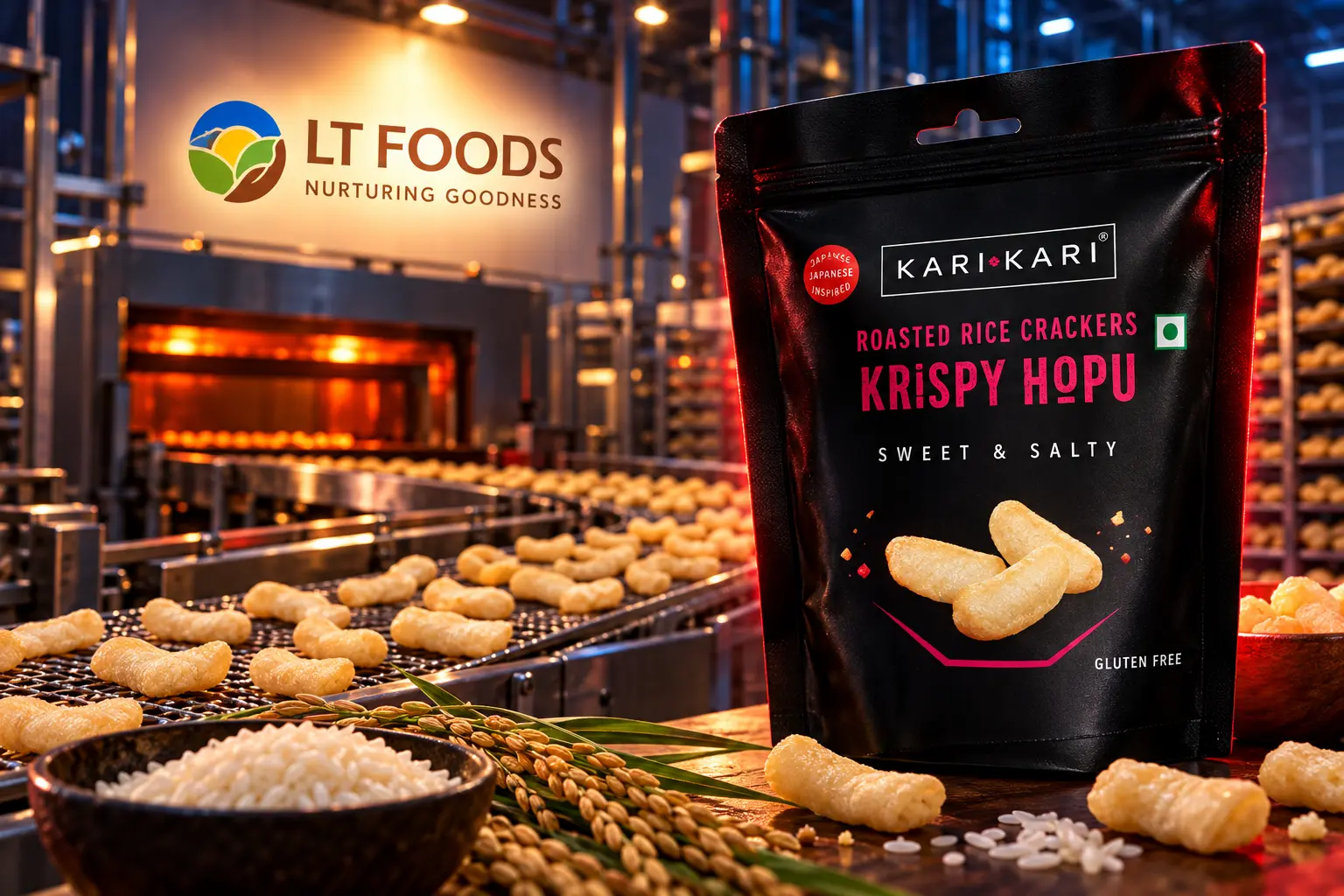
- 26 May 2025: The JV launches Krispy Hopu under the Kari Kari brand.
- 16 September 2026: Both boards sign the share sale; Kameda’s India affiliate is scheduled to disappear from its books.
By the year to 31 March 2026, sales were ₹141.0 million. That is a rounding error beside LT Foods’ own ₹11,023 crore of group revenue for FY26. The roasted-cracker aisle in India stayed a niche. Fried, palm-oil snacks still own the shelf the partners said they would rewrite.
Kameda Is Concentrating on North America
Kameda’s reason for selling is written in the same register Japanese groups use when they cut a limb and call it strategy. After the North American rebuild, the board said, the transfer would help both the India unit and the group’s medium- to long-term plan.
After restructuring its North American business and comprehensively considering the future development of its overseas business, the company has determined that executing the share transfer will contribute to the growth of KLT and the execution of the group’s medium- to long-term growth strategy.
Kameda Seika, Tokyo disclosure, 16 September 2026
The North American rebuild is not a slogan. Kameda completed the sale of Mary’s Gone Crackers in 2025 to Rosseau, the US arm of Canada’s Dare Foods, after years of losses and repeated impairments. In June 2025 it took full control of TH FOODS, its Illinois gluten-free cracker partner since 1989, for about ¥31.5 billion, the group’s largest outlay. The 2030 plan names the United States as the main overseas region and lifts the sales target to ¥160 billion.
Gurugram does not sit on that map. Kameda will drop Kameda LT Foods from equity-method associates after the transfer. Staff loans, secondees and flavour support that the Japanese filing still lists as related-party dealings go with the shares. For a group that just wrote a very large cheque in Illinois, ₹1.12 crore in India is housekeeping.
What LT Foods Now Owns Outright
Full control is cheap in cash and expensive in the P&L. LT Foods picks up the Sonepat line, the Kari Kari name, Krispy Hopu, Okaki and the Kaki-style rice crackers, plus a year in which the unit lost ₹121.1 million. It also picks up a distribution machine that already puts Daawat rice into modern trade, which the 2016 pitch said was the point of the pairing.
The group has done this sort of clean-up before at a very different price. In May 2025, LT Foods Americas paid $15 million for the remaining 49% of Golden Star Trading, a US jasmine-rice business, and folded it in as a wholly owned unit. That 49% cost more than a hundred times this one. The India snack book simply was not worth a second bid.
On 24 July 2025, when it reported the quarter to 30 June 2025, LT Foods said the Kari Kari snacking line had grown more than 40% against the same quarter a year earlier, and that it was still trying to build roasted rice crackers as a better stand-in for fried snacks. Growth off a ₹141.0 million base does not repair a ₹121.1 million loss. It does explain why the Indian partner is willing to keep the brand and let the Japanese partner walk.
Ritesh Arora, chief executive for India and the Far East, put the organised savoury market at about Rs 45,000 crore in May 2025 and said LT Foods was aiming at a Rs 800-1,000 crore slice of “No Fried, No Palm Oil” and “Better For You” packs. Kari Kari is how the group said it would enter that slice. After 16 September, it no longer has to share the steering wheel to do it.
The Last Launch Under Joint Names
The last product both logos sat on was the Krispy Hopu sweet and salty rice cracker, rolled out on 26 May 2025. It was sold as gluten-free, vegan and roasted, with no palm oil, in a Rs 20 single-serve pack and a Rs 50 sharing pack, first on e-commerce and quick-commerce, then into city retail. The recipe leaned on Niigata and on Kameda’s Salada Hopu.
Amit Mehta, managing director of the JV and vice president of food at LT Foods, used the launch to argue that fried palm-oil snacks were the wrong habit. “Under the Kari Kari brand, both stakeholders are committed to building a new roasted snacking category with unique, meticulously selected ingredients and textures, carefully crafted using Japanese technology,” he said. Ritesh Arora, on the same day, said the group wanted a strong double-digit share of its chosen slice over the next 3 to 5 years.
WHAT STAYS ON THE SHELF
- Kari Kari core packs: Wasabi, Spice Mania, Salt and Pepper, and Chilli Garlic roasted rice crackers, originally 65% cracker and 35% peanut.
- Krispy Hopu: Sweet and salty “happy flavour” rice cracker at Rs 20 and Rs 50, launched 26 May 2025.
- Okaki and Kaki-style lines: Rice-based snacks the Indian unit still lists beside Kari Kari.
- Sonepat plant: 3 tonnes a day, running since November 2019, now without a Japanese co-owner.
Kameda Seika still holds about 30% of Japan’s rice-cracker market and, in that May 2025 note, about $800 million of annual sales. It does not, after this transfer, hold a share of the Indian factory that was supposed to carry Kaki-no-Tane craft into Gurugram. LT Foods will own 100% of a small, still-unprofitable snack line and a Sonepat hall that has yet to earn its keep. The Japanese filing calls that growth. The ₹1.12 crore receipt is what a retreat looks like when the accountants have already marked the equity below zero.
Disclaimer: This article is news reporting and analysis of a share sale between two listed food companies, and it is for information only. It is not investment advice, a solicitation to buy or sell LT Foods or Kameda Seika securities, or a recommendation on the snack brands named. Readers who may act on the deal should consult a SEBI-registered investment adviser or a qualified accountant about their own position. Figures, close dates and regulatory status are those in the company filings cited here and can change before the transfer completes.

OpenAI’s Agent Monitor Waited During the Hugging Face Breach

Brent Hits $116 as Recovered Gulf Oil Draws Attacks

Hellebuyck Lands in New Jersey on a Five-Year Cup Bet

Xbox Plans Three More Layoff Rounds Before Helix

OpenAI’s $30 Billion Round Ties UAE Cash to Gulf Compute

Consumer Sentiment Falls to 51.7 as Future Outlook Darkens

Pluto’s Heart Glacier Still Pushes Liquid Nitrogen Upward

The Extra Heat Month Hits Children Where Care Is Thinnest

Abbott Pays $670 Million to Exit a Missouri Food Verdict

Take-Two Subpoenas Microsoft While GTA 6 Preorders Soar
-
 BUSINESS2 months ago
Consumer Sentiment Falls to 51.7 as Future Outlook Darkens
-
 NEWS2 months ago
Pluto’s Heart Glacier Still Pushes Liquid Nitrogen Upward
-
 NEWS2 months ago
The Extra Heat Month Hits Children Where Care Is Thinnest
-
 GAMING2 months ago
Take-Two Subpoenas Microsoft While GTA 6 Preorders Soar
-
 BUSINESS2 months ago
Abbott Pays $670 Million to Exit a Missouri Food Verdict
-

 NEWS2 months ago
UMMC Will Rebuild 30-Year-Old Cancer Labs With $2.4 Million
-

 ENTERTAINMENT2 months ago
Netflix Weighs Hosting Peacock and Fox One in Its App
-

 NEWS2 months ago
Water-Shedding Coatings Charge the Drops That Pierce Them