
BUSINESS
Nestlé Loses Control of Russia Factories After Staying
Nestlé kept six Russian factories running after 2022. A Putin decree has now handed control to a Moscow shell firm, and Vevey is disowning local statements.

A Moscow shell company is now the only party allowed to act for Nestlé Russia. The Russian corporate registry recorded that change on 23 September 2026, replacing chief executive Denis Voityuk six days after President Vladimir Putin put the Swiss group’s local stakes under temporary administration.
Nestlé still holds the shares on paper. It no longer speaks for the companies that run six factories and about 7,000 people inside Russia, the bet it spent four years defending after the 2022 invasion of Ukraine.
A Tiny Moscow Firm Now Speaks for Nestlé Russia
The decree published on 17 September 2026 adds the Swiss and German holding companies’ stakes in Nestlé Russia and Nestlé Kuban to the list of assets under temporary administration. Those interests, held by Société des Produits Nestlé and Nestlé Deutschland, pass to AO L.E.V. Management, a Moscow joint-stock company registered in October 2024.
L.E.V. Management was set up with charter capital of 15,000 rubles ($177). Its listed work is consulting on commercial activity and management. Filings for 2025 show a loss of 15,000 rubles, matching the size of that capital. The general director is Andrei Krayushkin.
THE STAKES PUT UNDER ADMINISTRATION
| Company | Holder | Stake |
|---|---|---|
| Nestlé Russia | Société des Produits Nestlé | 84.082% |
| Nestlé Russia | Nestlé Deutschland | 15.918% |
| Nestlé Kuban | Société des Produits Nestlé | 67.44% |
| Nestlé Kuban | Nestlé Deutschland | 32.56% |
The two Nestlé lines add to 100% in each company. The same decree also moved Russian units of French retailer Auchan, the former Leroy Merlin chain now trading as Lemana Pro, and logistics firms FM Logistic and Bati Logistics to the same manager.
Kremlin spokesman Dmitry Peskov tied the act to what Moscow calls hostile steps by unfriendly countries. “We are talking about European companies from unfriendly countries,” he said, adding that those states were “currently involved in the most active manner in military actions against our country.” He also pointed to “other operational factors” and said only external management was on the table for now.
On 23 September the Unified State Register of Legal Entities listed L.E.V. Management as the sole person entitled to act for Nestlé Russia without a power of attorney. Nestlé Kuban did not get the same swap. Evgeny Ponomarev, its general director since September 2023, remains the named officer there. Auchan, Lemana Pro and FM Logistic all changed chiefs in the same sweep.
THE EIGHT DAYS AFTER THE DECREE
- 17 September 2026: Putin signs the decree transferring the Nestlé, Auchan and related stakes to L.E.V. Management.
- 18 September 2026: Nestlé in Vevey takes note and says it is assessing options. Switzerland’s State Secretariat for Economic Affairs says it is worried and is working toward a reversal. Nestlé shares fall 2.4%.
- 21 September 2026: The Russian Nestlé press service, quoted by TASS, says full commercial work continues and that the transfer is not nationalisation or a change of ownership.
- 23 September 2026: The registry names L.E.V. Management as the only party that can act for Nestlé Russia, in place of Denis Voityuk.
Temporary administration, as used since a 2023 presidential decree on assets from countries Moscow lists as unfriendly, leaves title in place while stripping voting, dividends and board control for as long as the order lasts. The president can lift it. He can also leave it in force until a sale.
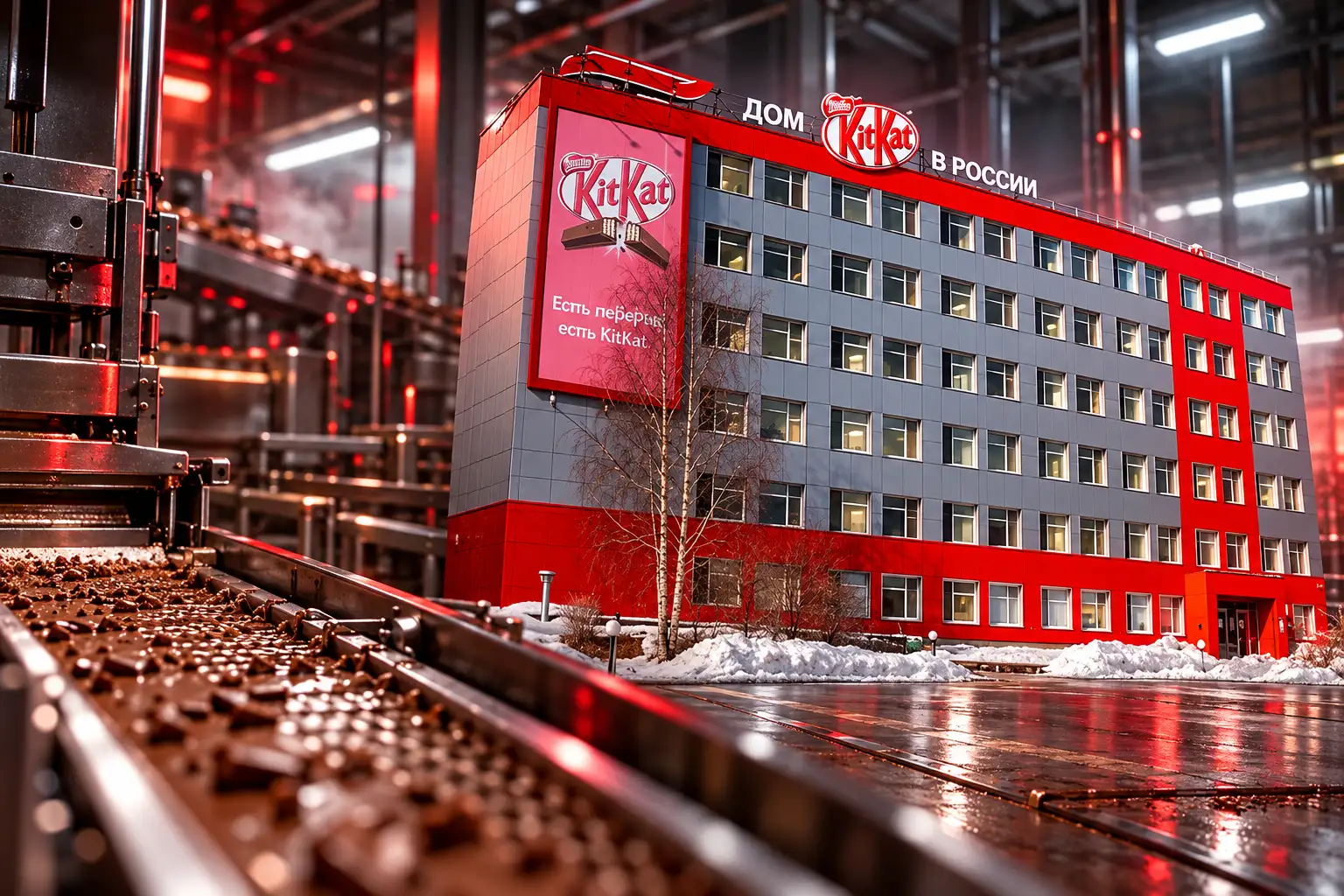
Why Nestlé’s Stay Strategy Became the Charge
The request that preceded the decree came from KS Logistika, a Russian logistics firm. Kommersant reported in August 2026 that the company had asked Putin to put five Nestlé legal entities under outside management, arguing that the existing managers would not expand capacity in Russia and had stopped exporting goods made there.
KS Logistika reported revenue of 1.6 million roubles ($18,735) in 2025. The five names in that ask were Nestlé Russia, Nestlé Kuban, Serial Partners Rus, CPB Nestlé and Atrium Innovations Rus. The published decree covers the first two. Nestlé said at the time that Russian authorities had not contacted the company about the request and that its offices and factories still ran.
That posture is the one Nestlé chose in 2022, when many Western consumer firms sold or shut. It kept legal entities and plants open, cut the range, and described the remainder as everyday food. Ukraine’s President Volodymyr Zelensky had already called on Western companies to pull out.
WHAT NESTLÉ HALTED IN 2022
- Advertising: Brand campaigns inside Russia were stopped.
- New capital: Fresh factory investment was frozen.
- Trade flows: Non-essential imports and exports were cut.
- Some brands: KitKat and Nesquik were among the lines taken off the market.
- Profit: Nestlé said it did not expect to take profit from the remaining business and would give any surplus to humanitarian groups.
The plants themselves stayed. So did the people on the payroll. LeaveRussia still tagged the company as a stay, not an exit, because no sale and no full stop of operations had taken place. KS Logistika’s complaint treated that scaled-back stance as a failure to grow the Russian business. The decree then used the 2023 tool built for unfriendly-country assets.
Staying did not produce a negotiated sale with a price attached. It produced an order that moves control without one.
Six Factories, About 7,000 Staff, a Thin Slice of Sales
Nestlé’s 2025 annual review still counts six factories in Russia. They sit in the Kaluga, Vologda, Samara and Vladimir regions and in the Perm and Krasnodar territories. Nestlé Kuban is the legal vehicle for the Timashevsk site in Krasnodar, which makes instant and freeze-dried coffee and ice cream.
The 2025 review says those plants turn out powdered drinks, dairy products, confectionery, prepared dishes and pet food. Analysts also list infant formula among the lines still made there. Nestlé has been in Russia since the 1990s and once put about CHF 2 billion into local production over two decades.
THE RUSSIA SLICE AGAINST THE GROUP
- People: About 7,000 staff in Russia, against 271,000 in the group at the end of 2025.
- Plants: Six of the group’s 335 factories.
- Last full figure: About 2 billion Swiss francs ($2.4 billion) of Russia sales in 2021, then about 2% of the group.
- Now: Bank Vontobel analyst Jean-Philippe Bertschy puts Russia at around 1% of group sales after the 2022 cuts.
Group sales in 2025 were CHF 89.49 billion. Bertschy said a hit to sentiment and the chance of an asset write-down or a poor disposal were real, and that the group-level money effect should still be small given that share of sales. Barclays and others have used older 2% math; the working figure here is Vontobel’s later 1% estimate, set against the 2021 disclose of about 2 billion Swiss francs.
In the 2025 financial statements, approved by the board on 18 February 2026, Nestlé told investors the war and sanctions “still continue to limit the freedom of Nestlé Russia Region businesses to operate.” It then said the group had “re-assessed and confirmed that the changes in the legal and operating environment of Russia and Ukraine have not impacted the ability to exercise control over the Group entities in these countries.” Seven months later, a 15,000-ruble firm holds the power to act for Nestlé Russia.
Danone and Carlsberg Already Walked This Path
Moscow has used this tool before on food and drink companies that were already trying to leave. Danone’s Russian dairy business went under temporary administration in 2023. Danone later sold that dairy business in 2024 and recorded a €1.2 billion ($1.38 billion) loss. Control passed through Kremlin-linked hands, including people tied to Chechen leader Ramzan Kadyrov’s circle, before the assets were renamed as a Russian dairy group.
Carlsberg’s Baltika breweries were seized the same year, 2023, while the Danish group was hunting a buyer. The stake later moved in a discounted deal. Carlsberg had been one of the Western brewers with the most to lose in Russia; Nestlé’s Russia slice was always smaller, and it had chosen to remain.
HOW THE LAST FOOD SEIZURES ENDED
| Company | Order | Stance at the time | What followed |
|---|---|---|---|
| Danone | 2023 | Already exiting | Sale in 2024, €1.2 billion loss |
| Carlsberg (Baltika) | 2023 | Already exiting | Discounted transfer after the seizure |
| Nestlé | 17 September 2026 | Had stayed, scaled back | Temporary administration; sale not announced |
The pattern is the same legal step. The difference is that Danone and Carlsberg were already on the way out when the order landed, while Nestlé had spent four years arguing that essential food and staff were reason enough to keep the plants open. Fabian Burkhardt, a Russia specialist at the Leibniz Institute for East and Southeast European Studies, has described compulsory administration as a preliminary stage toward a coming quasi-expropriation. Peskov, for the Kremlin, still says no further decision has been made.
Moscow law firm NSP estimated in 2025 that the state had seized more than $50 billion of private property, including assets of foreign companies, under the wartime rules. Exit sales for investors from unfriendly countries have also been forced through steep discounts and a special tax, which is why a delayed departure often costs more than an early one.
Vevey Disowns the Conciliatory Moscow Line
Nestlé’s first public line from Vevey, dated 18 September 2026, was short and legal. It did not bless the new manager and did not promise cooperation.
Nestlé takes note of Russia’s presidential decree, published yesterday, that places Nestlé Russia under temporary external administration. The company is assessing the situation and its options.
Nestlé S.A., press release, Vevey, 18 September 2026
The same note said the group was committed to taking all necessary steps to protect its rights and to keep operations going for stakeholders, “particularly its employees.” That is the parent still assessing the situation and its options.
Three days later the tone in Moscow was different. The Nestlé Group of Companies in Russia said it was continuing commercial work in full and would “unconditionally fulfil all obligations to clients, partners, and employees.” It said the transfer “does not constitute nationalisation of the company or a change of ownership,” and it voiced confidence that work with L.E.V. Management would help the business grow and run more efficiently.
Vevey then drew a line under that local voice. On its Ukraine and Russia update page, Nestlé said that after the September 2026 placement under temporary external administration, its commitment is to safe everyday food and to staff in the region, and that it expects assets and the workforce to be managed for those aims. It added that any statements issued on behalf of the Russian entities “reflect the position of the temporary external administration.” The parent’s own position, it said, remains the 18 September press release.
Switzerland’s State Secretariat for Economic Affairs, speaking for the government, said it was “worried” and was working with Nestlé “toward the reversal of the compulsory administration.” SECO and the foreign ministry had already been in contact with the company for several weeks before the decree, which means Bern was not reading this for the first time on 17 September. France asked Russian authorities to reverse the decision on the French retailers in the same order.
Ulrich Schmid, a professor at the University of St. Gallen, said the timing of the Nestlé share seizure was “certainly no coincidence,” and that the Kremlin’s message to Switzerland was that sanctions had a price in economic relations. Switzerland sits on Moscow’s unfriendly-country list.
Ownership on Paper, Control in a Registry Filing
The local unit is right on one narrow point. The decree does not, by its own terms, transfer title. Nestlé remains the shareholder of Nestlé Russia and Nestlé Kuban. L.E.V. Management cannot, under the standard reading of this tool, simply sell the factories as if it owned them. What it can do is exercise the owner’s rights in the meantime, which is why the registry change on 23 September matters more than the soothing language about continuity.
Auchan, which runs 230 stores and an online business in Russia and employs about 30,000 people, declined to comment when the decree landed. Its stores were still open. Nestlé’s six plants were still making food. The fight is over who gives the orders inside those walls, and over whether a later forced sale will look like Danone’s 2024 exit.
For the group accounts, Russia was already a thin slice. For the stay bet, the cost is the thing Nestlé said it was protecting: operational control of the factories and a voice that is still the company’s own. That voice now belongs, in the Russian registry, to a consulting firm with 15,000 rubles of capital. Nestlé Kuban’s named director has not yet been swapped. The Swiss government is still asking for the order to be lifted. Vevey is still pointing readers back to the 18 September release, and telling them to treat anything said in Moscow as the administrator talking.
Disclaimer: This article is news reporting and analysis of Nestlé’s Russian operations and the presidential decree of 17 September 2026. It is for information only and is not investment advice, a recommendation to buy or sell Nestlé shares, or a forecast of any write-down, disposal or recovery. Readers who may act on company or market information should consult a qualified financial adviser. Figures, registry status and official positions reflect the named company filings, decrees and statements as published, and they can change.

OpenAI’s Agent Monitor Waited During the Hugging Face Breach

Brent Hits $116 as Recovered Gulf Oil Draws Attacks

Hellebuyck Lands in New Jersey on a Five-Year Cup Bet

Xbox Plans Three More Layoff Rounds Before Helix

OpenAI’s $30 Billion Round Ties UAE Cash to Gulf Compute

Consumer Sentiment Falls to 51.7 as Future Outlook Darkens

Pluto’s Heart Glacier Still Pushes Liquid Nitrogen Upward

The Extra Heat Month Hits Children Where Care Is Thinnest

Abbott Pays $670 Million to Exit a Missouri Food Verdict

Take-Two Subpoenas Microsoft While GTA 6 Preorders Soar
-
 BUSINESS2 months ago
Consumer Sentiment Falls to 51.7 as Future Outlook Darkens
-
 NEWS2 months ago
Pluto’s Heart Glacier Still Pushes Liquid Nitrogen Upward
-
 NEWS2 months ago
The Extra Heat Month Hits Children Where Care Is Thinnest
-
 GAMING2 months ago
Take-Two Subpoenas Microsoft While GTA 6 Preorders Soar
-
 BUSINESS2 months ago
Abbott Pays $670 Million to Exit a Missouri Food Verdict
-

 NEWS2 months ago
UMMC Will Rebuild 30-Year-Old Cancer Labs With $2.4 Million
-

 ENTERTAINMENT2 months ago
Netflix Weighs Hosting Peacock and Fox One in Its App
-

 GAMING2 months ago
GTA 6’s 80-Hour Run Counts Goals That Change the Story