
NEWS
A Birthday Bet Put Quantum Chaos on IBM’s Heron
A 2021 birthday bet on steering quantum chaos is now settled on 100 qubits of IBM Heron, with a sharp flip to order at a control rate of 0.495.

A 2021 birthday-party bet that quantum chaos could be steered like a classical map has now been run on 100 qubits of an IBM processor.
The test, published in Nature Physics on 9 October 2026, used mid-circuit measurements and resets on IBM Quantum Heron to push a scrambling circuit through a sharp threshold from chaos into order. The same group’s 2023 theory said the flip would arrive near a control rate of one half. On hardware the fitted critical point was 0.495, and it got sharper as the chain grew.
A Birthday Bet in Highland Park Set the Clock
Jedediah Pixley, a Rutgers physics professor and director of the Center for Materials Theory, was still living in Highland Park, New Jersey, when the argument started. At a friendly bet at a 2021 birthday party for his wife, longtime collaborator Sriram Ganeshan, a physicist at the City College of New York and the CUNY Graduate Center, wagered that a puzzling quantum effect had a counterpart in ordinary physics.
That wager sent the group looking at a classical trick: the probabilistic control of chaos. In that setting a chaotic map runs most of the time, a control map runs with probability p, and at a sharply defined rate the system sticks to an unstable orbit instead of wandering. Thomas Iadecola, then at Iowa State University and Ames National Laboratory, and Justin H. Wilson of Louisiana State University joined Pixley and Ganeshan on the quantum version.
Their 2023 theory of probabilistic chaos control said the same split survives when the control step is a local measurement plus feedback. For the Bernoulli map they chose, the classical control rate sits at 0.5. A chance conversation with IBM physicist Barbara Jones then helped move the model onto hardware. Pixley lost the bet and paid with two scoops of blueberry ice cream after the group met at the Aspen Center for Physics in Colorado.
THE ROAD FROM THE BET TO THE CHIP
- 2021: Ganeshan and Pixley strike the birthday-party wager in Highland Park, and the group starts building a quantum analog of classical chaos control.
- August 8, 2023: Physical Review Letters publishes the theory paper by Iadecola, Ganeshan, Pixley and Wilson, with a control transition at p = 0.5 for their chosen map.
- September 22, 2025: The hardware paper is posted on arXiv after the team runs the protocol on IBM’s processor.
- October 9, 2026: Nature Physics publishes the experiment, received on 3 October 2025 and accepted on 26 August 2026.
Bibek Pokharel, a research scientist at IBM Quantum, and Haining Pan, then a Rutgers postdoctoral researcher, are co-first authors. Pixley and Maika Takita, IBM’s principal research scientist for quantum error correction and dynamic circuits experiments, jointly supervised the work.
IBM’s Heron Ran What Classical Machines Could Not
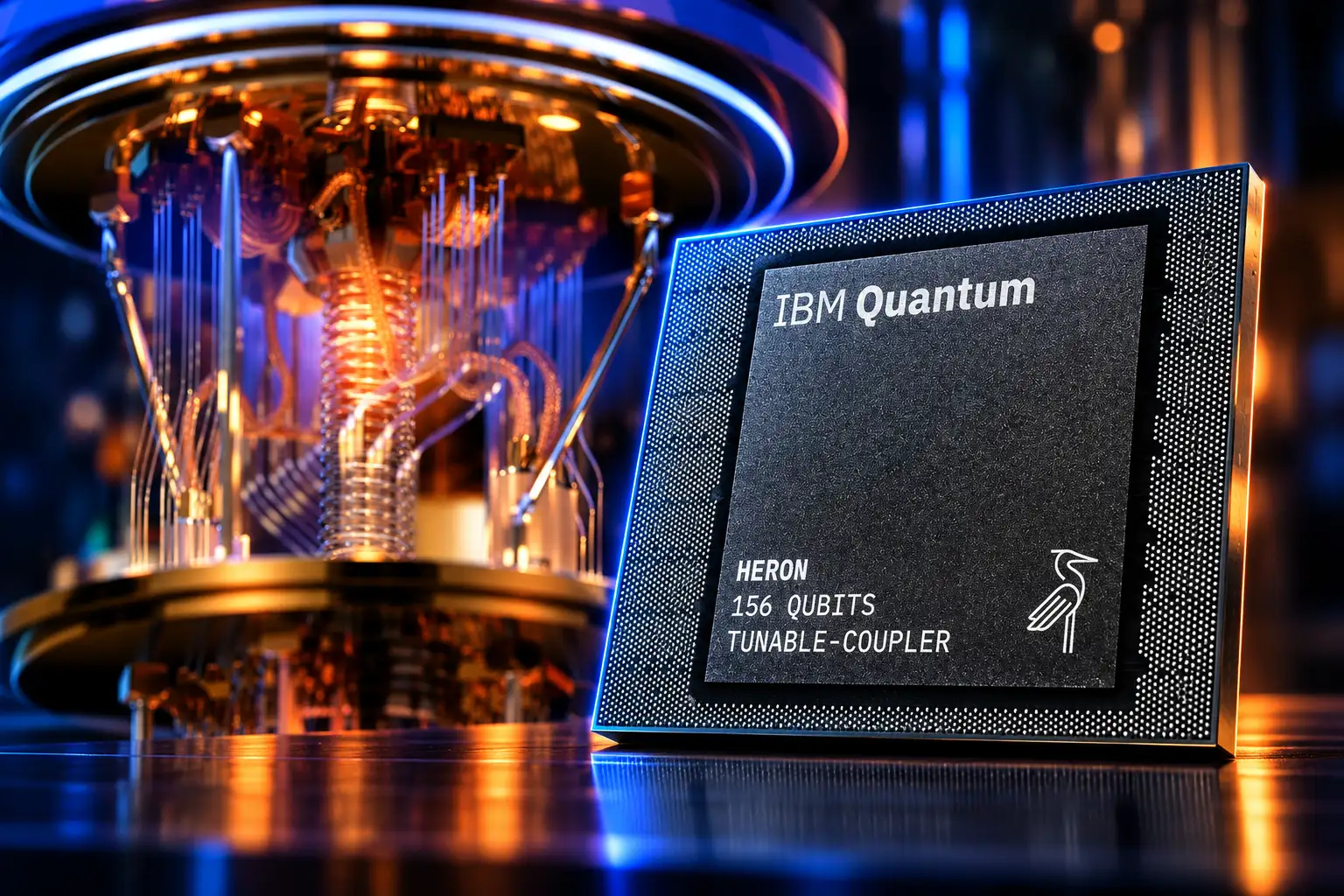
The run used ibm_fez, a 156-qubit IBM Quantum Heron processor. Heron r2, documented by IBM as a July 2024 revision, puts those 156 qubits in a heavy-hexagonal lattice with tunable couplers and a two-level-system mitigation feature. The team picked a connected chain of as many as 100 of those physical qubits. They were not 100 error-protected logical qubits.
Matrix-product simulations on ordinary computers covered sizes from 10 to 40 qubits. The chip went to 100. Pan said the transition became more clearly defined as the systems got larger, and that the match with theory showed collective behavior rather than an accident of a small circuit.
On the days the data were taken, the chosen qubits on ibm_fez had mean relaxation and coherence times of 140 microseconds and 100 microseconds. Single-qubit pulses lasted 24 nanoseconds and two-qubit gates 84 nanoseconds. Readout, which sits inside every reset, lasted 1.6 microseconds. Average errors were 3.0×10⁻⁴ for single-qubit gates, 1.8×10⁻² for two-qubit gates, and 1.3×10⁻² for readout.
“The challenge was not simply to measure a qubit, but to do it repeatedly while the rest of the processor continued to operate,” Takita said. That is the hardware claim the physics paper is actually stress-testing: can present machines keep measuring, deciding, and resetting while neighboring qubits keep running.
The Bernoulli Map Had to Fight Its Own Reset
The circuit is a quantum version of the Bernoulli map, the doubling map that sends a number a to 2a modulo 1. Classically it scrambles a bit string by shifting it and mixing the end. In the experiment a two-qubit scrambling gate on neighboring sites plays that role, spreading information down the chain the way repeated shuffles hide a card in a deck.
The opposing move is a one-body control step. The processor measures a qubit and, if the outcome is 1, applies an X gate so the qubit returns to |0⟩. That is the reset. At each time step the machine draws either the scrambler, with probability 1 – p, or the reset, with probability p, and the site of the action itself performs a biased random walk along the chain.
The target of all those resets is the all-zero state, a fixed point of the map. Magnetization density along z tracks how close the chain sits to that state: near 0 in the scramble-dominated regime, near 1 when control sticks.
THREE PHASES ON THE SAME CHAIN
- Volume-law chaos: For control rates below about 0.3, entanglement across half the chain still scales with system size, and matrix-product states hit a bond-dimension cap of 512.
- Area-law chaos: Between about 0.3 and 0.5 the late-time state is only modestly entangled, yet it still holds exponentially many superposition components, so the dynamics remain quantum.
- Controlled order: Above 0.5 the chain is driven into the all-zero state, entanglement collapses, and the late-time physics is essentially classical.
The control threshold at p = 0.5 is therefore a quantum-to-classical split, not only a change in how tangled the wavefunction looks. The earlier entanglement transition near 0.3 is closer to the measurement-induced transitions theorists have studied for years, and it is harder to read out with ordinary averages. Feedback is what made the later split visible in magnetization, which is why the group could watch it on a chip.
A Control Rate of 0.495 Split Chaos From Order
To reach a steady state the team evolved each circuit for L²/2 time steps, a volume that grows with the square of the chain length. For a 100-qubit chain that is 5,000 steps. They swept p and plotted the averaged magnetization. When scrambling ran more than half the time, chaos held. When resets ran more often, the qubits locked toward the chosen state.
A slight change around 50-50 flipped the whole chain. Physicists call that a phase transition. Here the qubits moved together from chaotic behavior to a state the researchers could steer. Example circuits in the paper sit at p = 0.4 (chaos), p = 0.5 (the threshold), and p = 0.6 (control).
CRITICAL POINT ON THE 100-QUBIT CHAIN
| Quantity | ibm_fez hardware | Matrix-product theory | Statistical-mechanics model |
|---|---|---|---|
| Critical control rate pc | 0.495(1) | 0.4947(5) | 0.4970(5) |
| Correlation-length exponent ν | 1.05(2) | 1.05(2) | 1.0000(2) |
| Dynamical exponent z | 2.00(1) | 2.00(2) | 2.000(2) |
No error mitigation was applied to those magnetization curves. Fifty random circuits were run at each setting, and each circuit’s observables were averaged over 10,000 shots. The hardware points collapse onto the same universal curve as the noiseless simulations once p is rescaled by system size, which is the signature the theorists wanted: a true many-body threshold, not a small-circuit quirk.
At the threshold the front between scrambled and reset regions executes an unbiased random walk. Magnetization then grows with a dynamical exponent z = 2.00(1) on the chip, the value expected for diffusion. Below the threshold the scrambled front eats the chain; above it the reset front gets there first.
Wilson put the sensitivity in everyday terms. Small changes can run away, he said, like the old image of a butterfly stirring a distant storm. “But this out-of-control behavior can be brought under control by randomly intervening, and there is a sharply defined rate at which that happens. It wasn’t obvious that this transition between chaos and control would survive in quantum physics, but our results show that it does.”
The paper also tracked quantum fluctuations of the magnetization, the scatter that comes from different measurement collapses on a fixed circuit. That variance is zero in a purely classical limit. On ibm_fez it peaked near the threshold and scaled with exponents close to the matrix-product and statistical-mechanics calculations, which is how the team argues the processor was sampling a random quantum process rather than incoherent noise dressed up as a transition.
Resetting a Qubit Erases What Error Correction Must Keep
Press notes around the paper reached for fault tolerance, and the abstract itself calls the run a signpost on that road. The protocol does not protect an unknown computational state. A reset writes |0⟩. That is a known state. A fault-tolerant machine has to notice an error without destroying the logical information a coded qubit is carrying, then apply a correction that leaves that information intact.
Pixley was careful on the repetition count rather than on the coding theory. “To build a fault-tolerant quantum computer, we have to make these checks and corrections not just once or twice, but a huge number of times during a calculation,” he said. “This experiment is a landmark on that road. It says, ‘OK, we’ve taken another important step to get there.’”
This experiment shows that present-day hardware can coordinate quantum operations, measurements and resets thousands of times across a large system.
Maika Takita, principal research scientist, IBM Quantum
That coordination is the industrial payload. Dynamic circuits, which measure in the middle of a run and let a classical decision change the next gate, are the plumbing under every superconducting error-correction schedule. The Rutgers-IBM circuit is a many-body physics experiment that happens to demand that plumbing at a brutal duty cycle. It does not save a logical qubit, design a battery, or find a catalyst. It shows a 156-qubit chip can keep asking questions of itself while 100 of those qubits keep evolving.
How Many Operations Did the 100-Qubit Circuit Use?
The abstract’s headline load is nearly 5,000 entangling gates and nearly 5,000 non-unitary mid-circuit operations on systems up to 100 qubits. The supplement is more specific. Problem sizes ran from 10 to 100 qubits in steps of 10, and p ran from 0.2 to 0.85 in steps of 0.05. At p = 0.5 and L = 100, the circuit is most expensive: 5,000 resets mixed with 5,000 two-qubit operations. Lower p packs in more scrambling, and the two-qubit count rises to about 8,000 at p = 0.2 on the 100-qubit chain.
Consecutive resets merge, so the reset count falls once p moves past 0.5 even though a naive count would keep climbing. Circuit duration still peaks at the threshold because a reset, built from a 1.6-microsecond readout plus a conditional flip, lasts far longer than an 84-nanosecond two-qubit gate.
WHAT THE LARGEST CIRCUIT CONTAINED
- The chain: 100 connected physical qubits on the 156-qubit ibm_fez Heron processor.
- The depth: 5,000 time steps at L = 100, set by the L²/2 schedule used to reach steady state.
- The mix at threshold: nearly 5,000 two-qubit gates interleaved with nearly 5,000 measurement-conditioned resets.
- The sample: 50 random circuits per setting, 10,000 shots per circuit, and no error mitigation on the main magnetization plots.
City College of New York, the CUNY Graduate Center, Iowa State University, Ames National Laboratory, Pennsylvania State University and Louisiana State University share authorship with Rutgers and IBM. Jones, who helped open the hardware door, died while the manuscript was being prepared; the paper records the loss.
Pixley paid the 2021 wager in blueberry ice cream at Aspen. The 100-qubit dataset is the receipt. As the chain lengthened, the chaos-to-order split did not wash out. It got cleaner, which is what the bet, once it left the party, had always been about.
Frequently Asked Questions
What IBM Processor Did the Quantum Chaos Experiment Use?
The team ran on ibm_fez, an IBM Quantum Heron r2 backend with 156 physical qubits. Heron r2, introduced in July 2024, expanded the original 133-qubit Heron r1 design, kept the heavy-hex layout and tunable couplers, and added two-level-system mitigation to stabilize coherence across the chip. Only a 100-qubit connected subset was programmed for the chaos-control circuits.
When Did the Group First Predict This Chaos-to-Control Split?
The prediction is in Physical Review Letters volume 131, article 060403, published on 8 August 2023, from a preprint posted on 25 July 2022. Iadecola, Ganeshan, Pixley and Wilson showed that a quantum Bernoulli map with measurement and feedback still has a diffusive control transition, with dynamical exponent z about 2 and correlation-length exponent ν about 1, matching the classical map they started from.
Did the Researchers Use Error Mitigation on the Main Plots?
They did not. The magnetization curves that yield pc = 0.495 were taken without error mitigation. The paper instead compares the raw hardware distributions with noisy simulations and with a statistical-mechanics model, and it uses the quantum variance of magnetization to argue the chip was not merely reproducing classical bit-flip noise.
Who Are the Lead Authors of the Nature Physics Paper?
Pokharel at IBM Quantum’s Thomas J. Watson Research Center and Pan, then at Rutgers’s Center for Materials Theory, are co-first authors. Pixley at Rutgers and the Flatiron Institute and Takita at IBM jointly supervised. Luke C. G. Govia, Kemal Aziz and Abhinav Deshpande are among the other listed authors, with Govia’s present address given as CMC Microsystems in Waterloo, Ontario.
Why Could Ordinary Computers Not Just Simulate the 100-Qubit Circuit?
Matrix-product states store entanglement in a bond dimension χ. In the volume-law regime the authors’ simulations hit a cap of χ = 512, and even inside the area-law chaotic window a slice of trajectories still reached that cap as L grew toward 40. A fully volume-law state would eventually need a bond dimension scaling as 2L/2, which is why the 100-qubit hardware sweep is the part of the phase diagram classical tensor networks could not finish.

OpenAI’s Agent Monitor Waited During the Hugging Face Breach

Brent Hits $116 as Recovered Gulf Oil Draws Attacks

Hellebuyck Lands in New Jersey on a Five-Year Cup Bet

Xbox Plans Three More Layoff Rounds Before Helix

OpenAI’s $30 Billion Round Ties UAE Cash to Gulf Compute

Consumer Sentiment Falls to 51.7 as Future Outlook Darkens

Pluto’s Heart Glacier Still Pushes Liquid Nitrogen Upward

The Extra Heat Month Hits Children Where Care Is Thinnest

Take-Two Subpoenas Microsoft While GTA 6 Preorders Soar

Abbott Pays $670 Million to Exit a Missouri Food Verdict
-
 BUSINESS2 months ago
Consumer Sentiment Falls to 51.7 as Future Outlook Darkens
-
 NEWS2 months ago
Pluto’s Heart Glacier Still Pushes Liquid Nitrogen Upward
-
 NEWS2 months ago
The Extra Heat Month Hits Children Where Care Is Thinnest
-
 GAMING2 months ago
Take-Two Subpoenas Microsoft While GTA 6 Preorders Soar
-
 BUSINESS2 months ago
Abbott Pays $670 Million to Exit a Missouri Food Verdict
-

 NEWS2 months ago
UMMC Will Rebuild 30-Year-Old Cancer Labs With $2.4 Million
-

 ENTERTAINMENT2 months ago
Netflix Weighs Hosting Peacock and Fox One in Its App
-

 GAMING2 months ago
GTA 6’s 80-Hour Run Counts Goals That Change the Story