
BUSINESS
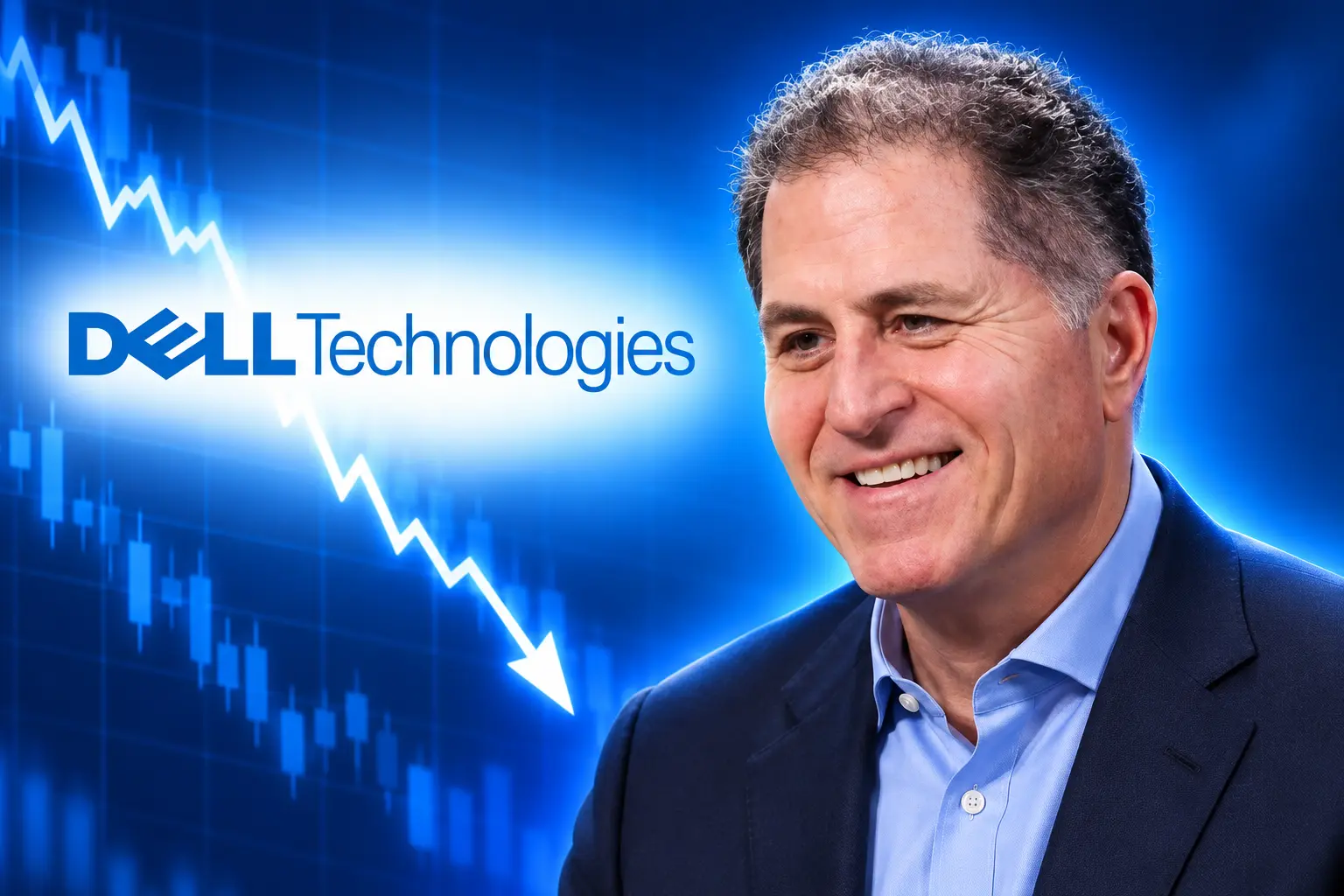
Dell Falls 11% After Barclays Flags Memory-Driven Sales
Barclays cut Dell after a 300% rally, arguing enterprise server growth is memory pricing, not an AI refresh, as a Chinese DRAM claim hits the tape.

Dell shares fell 11% on Wednesday after Barclays tied the company’s enterprise revenue surge to higher memory prices rather than a broad AI hardware refresh. Hewlett Packard Enterprise and NetApp were cut in the same note and fell 8.28% and 7.03%.
Barclays analyst Tim Long still models about $75 billion of AI server sales at Dell this fiscal year. He still dropped the stock to Equal Weight from Overweight, and he cut the price target to $574 from $603.
Barclays Says Dell’s Server Boom Is a Memory Markup
Long covers a cluster of enterprise hardware names that have run about 140% this year, against about 14% for the S&P 500. That group now trades at about 21 times estimated 2027 earnings, above a five-year average near 15 times.
Dell itself is up more than 300% in 2026. HPE has jumped about 160%, and NetApp has doubled. Long wrote that valuations have run, commodity costs have helped revenues, and “we don’t see a meaningful AI inflection yet.”
The note is not a call that AI servers are failing. Long expects that line at Dell to triple this fiscal year, with operating margins stabilizing near 5%, and he sees a path above his $100 billion estimate for fiscal 2028. The cut is about what the stock already prices, and about which dollars are AI demand versus a higher sticker on the same box.
BARCLAYS CUTS ON OCT. 14
| Company | New rating | Price target | Wednesday close |
|---|---|---|---|
| Dell Technologies | Equal Weight, from Overweight | $574, from $603 | down 11% to $507.93 |
| Hewlett Packard Enterprise | Equal Weight, from Overweight | $77, from $83 | down 8.28% to $63.11 |
| NetApp | Equal Weight, from Overweight | $219, unchanged | down 7.03% to $222.20 |
He is taking a more cautious stance on hardware that tracks enterprise budgets, not the hyperscale build. Businesses, the note said, typically put about 5% of IT spending into AI, and only about a quarter of that AI spend goes to hardware. “We believe the strong enterprise revenues are more of a function of memory costs than a move to enterprise AI at this time,” the analysts wrote.
The $95 Billion Backlog Dell Has Not Shipped
The order book Long is marking down is still enormous. Dell’s fiscal second quarter ended July 31, and the company reported on Sept. 1.
DELL Q2 FY27, AS FILED
- Total revenue: $47.0 billion, up 58% from a year earlier.
- AI-optimized servers: $16.4 billion of revenue, up 100%, on $60.9 billion of new orders.
- Backlog: $95 billion of AI servers still to ship, about 5.8 times that quarter’s AI-server revenue.
- Full-year raise: revenue guided to $192.0 billion from $167.0 billion, with AI-server revenue guided to $74.0 billion from $60.0 billion.
That $74.0 billion AI-server guide is about 38.5% of the $192.0 billion company outlook, and it sits $1 billion under Long’s own $75 billion model for the year. Traditional servers and networking rose 122% to $10.5 billion. Storage rose 26% to $4.9 billion. Client systems rose 20% to $15.0 billion. Infrastructure Solutions Group operating income was $4.8 billion, or 15.0% of ISG sales.
That’s clearest in our AI server business where we booked a record $60.9 billion in orders, recognized a record $16.4 billion in revenue and exited the quarter with a record $95 billion backlog.
Jeff Clarke, vice chairman and chief operating officer, Dell Technologies, Sept. 1 earnings release
Clarke was describing a company that, in the same record $95 billion AI-server backlog, also posted a 122% jump in the older server and networking line. Long’s reading is that Dell “executed flawlessly across enterprise categories,” and that the vast majority of the guided growth, just over 100% in enterprise servers and mid-teens in storage and PCs, comes from higher average selling prices to offset memory inflation. He then expects a sharp slowdown over the next two years as those prices ease or fall.
How Much of the Growth Is Price, Not Units?
The worldwide server market already shows the split. IDC’s tracker put a record $166.3 billion in server revenue in the second quarter of 2026, up 52.0%, while unit shipments rose 15.4%. For the full year, IDC sees vendor revenue of $685.1 billion, up 54%, with shipments up only about 12%. Most of the dollar growth, the firm said, is richer configurations and higher component costs.
Dell led branded original-equipment makers in that quarter with 13.4% revenue share and $22.24 billion of server sales, up 165.4%. Super Micro, Lenovo and HPE followed. Direct original-design manufacturers still took 53.9% of the market, down from 60.6% a year earlier, as the brand names grew faster.
Memory has not rolled over. TrendForce, in a Sept. 30 note, still sees DRAM contract prices to rise 10 to 15 percent in the fourth quarter, with NAND up 15 to 20 percent, as suppliers keep advanced capacity on high-end server parts. Server DRAM stays short of demand. Enterprise SSD bit demand is projected to grow more than 80% in 2026 as cloud firms build inference fleets. Long’s “normalize and potentially decline” line is a forecast, not a print already in the contract tape.
That is the bind for anyone who bought Dell as a pure AI-unit story. As long as memory stays dear, Dell can keep raising the invoice and still show 100% server growth. If those prices ease, the same shipment plan puts a lot less revenue on the income statement, even if the racks still go out the door.
A Chinese DRAM Claim Hit Memory Stocks First
The market started repricing that risk before Long published. ChangXin Memory Technologies President Cao Kanyu told a Shanghai industry meeting over the Oct. 10 weekend that the company had made key progress on a 4F-squared memory cell, denser than the 6F-squared layout that dominates production, using a vertical surrounded-gate transistor. CXMT plans a DDR5 registered module for servers, the kind of stick that sits in data-center and AI boxes, before the end of 2026.
The cell area on a 4F-squared design is about 33% smaller than 6F-squared at the same line width. Rivals including Samsung, SK hynix and Micron have been working on the same shift. A South Korean executive, speaking to reporters covering the conference, said heat in a packed vertical structure is still an open mass-production problem, and CXMT has not shown yields.
TrendForce put CXMT’s global DRAM revenue share at 9.5% in the second quarter, up from 7.6% in the first, behind Samsung at 39.4%, SK hynix at 24.9% and Micron at 23.3%. Lee Pei-Ing, president of Taiwan’s Nanya Technology, still called the supply gap massive and said his firm’s gross margin, already more than 85%, should rise further this quarter. The claim hit listed memory names anyway.
THE WEEK MEMORY LOST THE NARRATIVE
- Oct. 10, 2026: Cao describes 4F-squared progress and a year-end DDR5 server module.
- Oct. 13, 2026: Michael Dell, at the New York Stock Exchange, says supply is too tight for an AI bubble.
- Oct. 14, 2026: Long cuts Dell, HPE and NetApp; Dell closes down 11%.
Micron is down 11% on the week. SK Hynix has dropped 13% in U.S. trading. Western Digital is down more than 8%. A denser Chinese server DIMM, even as a plan, is enough to knock the scarcity premium that has been flowing through Dell’s average selling price.
CIOs Are Buying Early Because Gear Got Costlier
Corporate buyers are not sitting still, and they are not staging a broad on-premise AI build either. Morgan Stanley analyst Erik Woodring’s latest CIO survey, shared as Dell was sliding, ranked Dell first in three-year vendor spending intentions, ahead of HPE and Pure Storage. The lift, Woodring found, is higher equipment prices and purchases pulled forward from 2027, more than a jump in on-site AI.
WHAT THE CIO SURVEY SHOWS
- Storage arrays: Prices are up about 15% from a year earlier, and 40% of CIOs have moved some 2027 storage buys into 2026.
- Traditional servers: Prices are up about 14%, and 43% of CIOs are pulling some 2027 server spending forward.
- The 2028 wall: More than 70% of CIOs expect server, storage or PC budgets to flatten or decline by 2028.
- On-site AI share: The portion of AI workloads companies expect to run on their own hardware barely moved quarter to quarter.
That matches Long’s 5% budget slice. It also matches a hardware company that can print huge revenue while CIOs are still waiting to see whether AI pays on their floor. Customers are leaning on cloud providers for AI projects before they buy their own clusters, which leaves Dell’s enterprise catalog exposed to the memory invoice and to a later budget cut once the pull-forward is done.
Oracle and CoreWeave Fell With the Hardware Group
The same session hit names that fund the build with debt. Oracle dropped 9% on Wednesday and is down 33% this year. CoreWeave, the neocloud, dropped 15% and erased its 2026 gain. Super Micro sold off with the group. Barclays did not publish a new rating on those stocks in the Dell note. They still moved as if enterprise offtake had slipped a quarter.
THE WIDER AI-INFRA TAPE ON OCT. 14
| Name | Wednesday or week move | What the tape is pricing |
|---|---|---|
| Oracle | down 9% Wednesday, down 33% this year | A heavy borrower against a longer AI build |
| CoreWeave | down 15% Wednesday | A neocloud whose 2026 gain was wiped out |
| Micron | down 11% on the week | Memory pricing power if CXMT ramps |
| SK Hynix | down 13% in U.S. trading | The same density race, from Korea |
| Western Digital | down more than 8% | Storage hardware tied to the same cycle |
GPU clusters financed off future utilization still have to service the power and the paper if the enterprise purchase order arrives late. That offtake lag is the same timing problem Long put on Dell, HPE and NetApp, only with interest expense attached. Rising rates make that gap more expensive, which is why a server-OEM note can take a borrower with it.
Michael Dell Called Tight Supply the Opposite of a Bubble
A day before the drop, Michael Dell sat at the New York Stock Exchange and rejected the bubble talk. He pointed to a shortage of computing capacity and to rising rental prices for Nvidia H100 chips. He said Dell watches for idle gear and for customers who lack the capital or the building to plug the boxes in, and he has not seen those tells in a way that changes the 2027 outlook.
I don’t think there’s enough supply for it to be a bubble.
Michael Dell, chief executive, Dell Technologies, New York Stock Exchange, Oct. 13, 2026
A new semiconductor plant takes about four years to build, he said, with fresh capacity not really arriving until 2029 or 2030, while models and agents keep adding demand. “So I do think it will get worse next year in terms of demand and supply,” he said. “Maybe it’s a four-year problem because there’s just not enough supply.”
Those comments and Long’s note can both be true. Chips can stay tight, AI server orders can stay large, and the extra dollars on Dell’s enterprise invoice can still be memory. The stock had been priced as if those were the same fact. On Wednesday they split, and Dell closed at $507.93, $66 under a target that itself had just been cut by $29.
Disclaimer: This article is news reporting and analysis of a stock move and an analyst note, and it is for information only. It is not investment advice, a recommendation to buy or sell Dell Technologies, Hewlett Packard Enterprise, NetApp, or any other security, and it is not a forecast of anyone’s results. Readers should consult a licensed financial adviser or broker before acting on any market view. Prices, ratings, backlog figures, and guidance are those published by the companies, the analyst, and the data firms named above as of the dates given, and they can change.

OpenAI’s Agent Monitor Waited During the Hugging Face Breach

Brent Hits $116 as Recovered Gulf Oil Draws Attacks

Hellebuyck Lands in New Jersey on a Five-Year Cup Bet

Xbox Plans Three More Layoff Rounds Before Helix

OpenAI’s $30 Billion Round Ties UAE Cash to Gulf Compute

Consumer Sentiment Falls to 51.7 as Future Outlook Darkens

Pluto’s Heart Glacier Still Pushes Liquid Nitrogen Upward

The Extra Heat Month Hits Children Where Care Is Thinnest

Abbott Pays $670 Million to Exit a Missouri Food Verdict

Take-Two Subpoenas Microsoft While GTA 6 Preorders Soar
-
 BUSINESS2 months ago
Consumer Sentiment Falls to 51.7 as Future Outlook Darkens
-
 NEWS2 months ago
Pluto’s Heart Glacier Still Pushes Liquid Nitrogen Upward
-
 NEWS2 months ago
The Extra Heat Month Hits Children Where Care Is Thinnest
-
 GAMING2 months ago
Take-Two Subpoenas Microsoft While GTA 6 Preorders Soar
-
 BUSINESS2 months ago
Abbott Pays $670 Million to Exit a Missouri Food Verdict
-

 NEWS2 months ago
UMMC Will Rebuild 30-Year-Old Cancer Labs With $2.4 Million
-

 ENTERTAINMENT2 months ago
Netflix Weighs Hosting Peacock and Fox One in Its App
-

 GAMING2 months ago
GTA 6’s 80-Hour Run Counts Goals That Change the Story