
NEWS
Water-Shedding Coatings Charge the Drops That Pierce Them
Hydrophobic films on insulators charge sliding raindrops that then puncture Teflon on copper; the same coating on grounded ITO leaves the metal intact.

Electrically charged raindrops pierced a 60-nanometer Teflon film on copper after 3,000 hits, while uncharged drops left the same film smooth. The charge was picked up in a few centimeters of sliding over leaves, plastic, glass and a water-repelling coating, according to a 26 August paper from the Max Planck Institute for Polymer Research in Mainz.
Rain damage has long been blamed on grit and acid. The Mainz tests point at a third path: the very coatings meant to shed water help electrify the drop that then punches the film.
Rain That Slides Off a Leaf Then Hits Copper
Zhongyuan Ni, a doctoral researcher at the institute, worked with group leader Rüdiger Berger, department director Hans-Jürgen Butt, and colleagues at the University of Bonn, South China University of Technology, MIT and Johannes Gutenberg University Mainz. They already knew, from work published in 2022, how sliding drops pick up charge on hydrophobic surfaces. The new question was whether that charge could wreck a coating.
Each drop was 35 microliters of water with 1 mM sodium chloride, a simple stand-in for rain that is never pure. Neutral drops fell 4 centimeters from a grounded needle onto copper that had been sputtered 35 nanometers thick on quartz, then covered with Teflon AF 1600 and baked at 160 °C. The coupon sat at 10 degrees so each drop ran off. After 3,000 hits, confocal images stayed flat and smooth.
The charged series used a different first surface. Drops landed on a plate tilted at 50 degrees, slid about 4 centimeters, left the edge, and fell 5 millimeters onto the same Teflon-coated copper. The first surfaces were a Tradescantia spathacea leaf (a common houseplant), 3-millimeter PVC foam board, 2-millimeter polystyrene glass from a hardware store, and quartz coated with perfluorooctadecyltrichlorosilane (PFOTS), a widely used water-repelling silane.
Depending on that first surface, each drop carried between 0.2 and 2 nanocoulombs when it left. After 3,000 hits, every copper coupon showed corrosion right where the drop first touched. The paper went up the same day.
Nature research paper: Spontaneously charged water drops induce corrosionhttps://t.co/2fcxya0rsM
— nature (@Nature) August 26, 2026
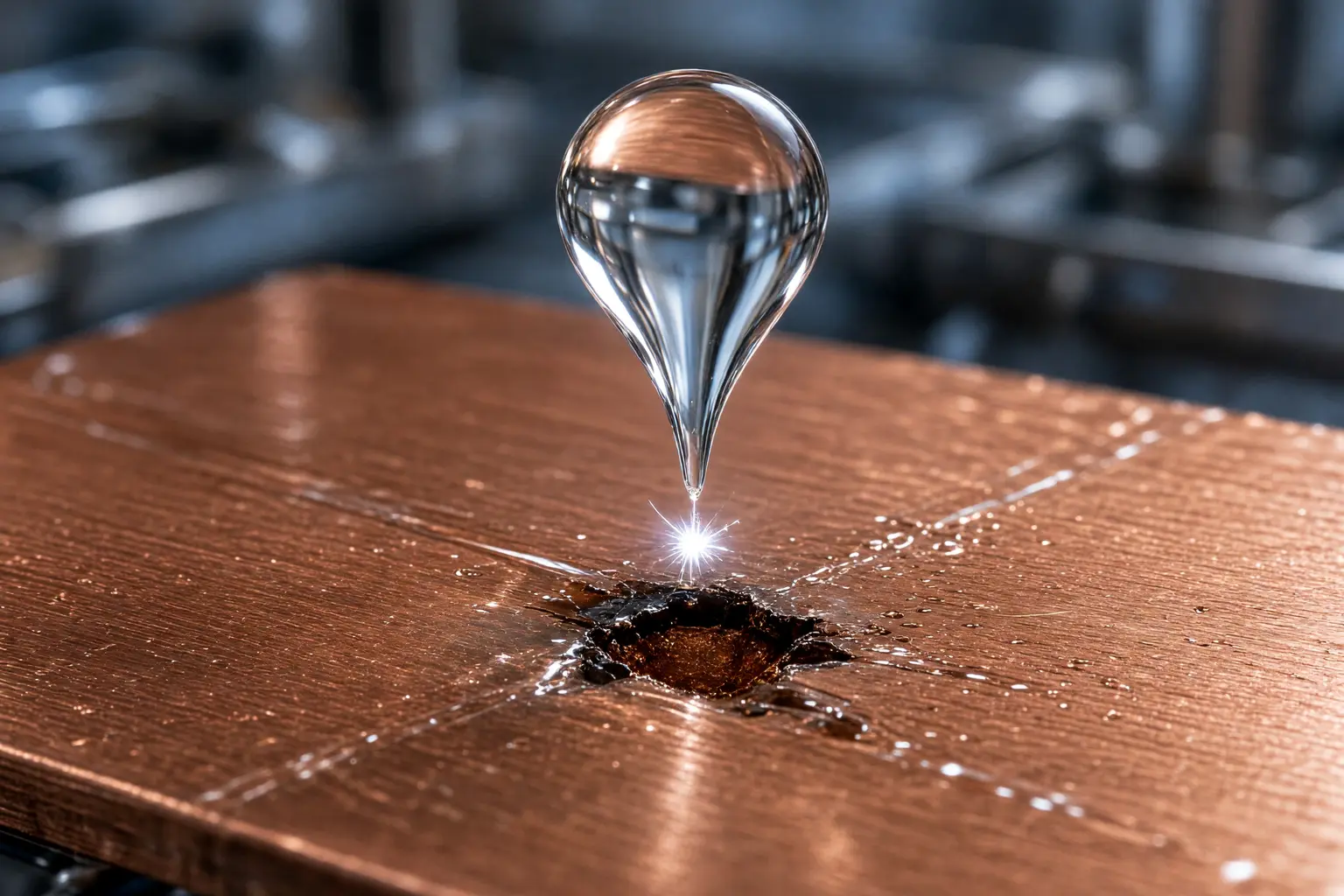
Hole-Like Defects After 3,000 Charged Hits
Atomic force microscopy of the PFOTS-charged case found pits several nanometers deep. Some holes went through the whole Teflon film and into the copper. Berger has described the strike as a local discharge that can puncture the layer like lightning.
Ni said the charge a droplet acquires as it slides depends heavily on the specific surface, and the group measured differences of up to a factor of ten. The leaf sat at the low end of the range, about 0.2 nanocoulombs. PFOTS on quartz sat at the high end. Both still opened pits. Coatings built to beat chemistry and abrasion can still fail as electrical insulation, which is the complaint that keeps coming back whenever this paper is read closely. Posts that treat the Eiffel Tower as the test coupon go further than the lab did. The Mainz release used the tower, and the Golden Gate Bridge, only as steel that already needs paint.
FOUR SURFACES AND WHAT THEY DID TO COPPER
| First surface | Drop charge | Teflon-coated copper after 3,000 hits |
|---|---|---|
| Tradescantia spathacea leaf | About 0.2 nC | Corroded at first contact |
| PFOTS on quartz | +2.0 nC | Corroded; pits through the film |
| Direct fall, no slide | None | Intact, smooth |
| PFOTS on grounded ITO glass | None; no discharge cone | Intact |
PVC foam and polystyrene glass also charged the drops enough to mark the copper. The paper did not publish a single charge number for those two, only the 0.2-to-2 nanocoulomb band for the whole set.
The Drop Forms a Cone Before It Touches
A high-speed camera watching from the side showed why charge, not the splash, did the cutting. Neutral drops kept a smooth arc on the bottom until they landed. Charged drops, after a PFOTS-on-quartz slide, stretched at the base into a cone as they neared the coupon, a shape the authors compare to a Taylor cone in electrospraying, when electrostatic force beats surface tension.
Current amplifiers at three spots tracked the same drop. After a 4-centimeter slide on PFOTS-on-quartz it held +2.0 plus or minus 0.021 nanocoulombs. On impact with the 60-nanometer Teflon-on-copper, +1.8 plus or minus 0.022 nanocoulombs moved into the copper. After bounce-off the drop kept only +0.016 plus or minus 0.003 nanocoulombs, less than 1 percent of what it had carried.
WHERE THE CHARGE WENT
- After the slide: The drop held +2.0 nC on leaving PFOTS-coated quartz.
- At impact: About +1.8 nC transferred into the copper layer.
- After bounce: Only +0.016 nC remained on the drop.
- Drop voltage: Charged sliding drops can reach several thousand volts, and can exceed 1 kV.
The authors treat that dump as dielectric breakdown of the film, the same class of failure that ruins insulation in capacitors and transformers, then ordinary wet corrosion once metal is exposed. Once a hole exists, wetting in the damaged patch holds the next drop longer and sets up small galvanic cells at the liquid-metal line.
Why Hydrophobic Coatings Charge Raindrops
Slide electrification is the name for what happens when a drop moves on an insulator. On hydrophobic films the drop usually leaves with a positive charge and the track behind it goes negative, an ion-transfer process the Mainz group has been mapping for years. Fluorinated surfaces charge drops harder than simple hydrocarbon ones. A 2022 Langmuir study from the same circle showed how to tune sliding-drop charge by changing the top chemistry, including amine groups that can flip the drop from positive to negative.
That is the bind for outdoor metal. A water-repelling finish is sold so rain runs off. Running off is exactly the motion that loads the drop. Leaves, window glass, painted walls and plastic already do this in the open, which is why a drop that leaves a plant and lands on a car is not a lab curiosity. Butt has said physicists long assumed liquids would not charge the way solids do when rubbed, because “for a liquid, there is no force which could break a bond.”
When such charged droplets strike a coating, they discharge locally and can puncture the layer in specific spots like a small flash of lightning.
Rüdiger Berger, group leader, Physics at Interfaces, Max Planck Institute for Polymer Research
The paper frames charged water drops induce corrosion as a general effect on metal under an insulating layer, not a Teflon quirk. The outdoor path is a drop that slides, picks up charge, then hits paint, polymer or oxide sitting on steel, copper or aluminum.
Grounded PFOTS Leaves the Copper Intact
The control that cuts through the coating story is almost boring. The team put the same PFOTS chemistry on indium tin oxide, a conductive glass, and grounded it. Drops that slid on that plate did not form a cone as they approached the Teflon-coated copper. After 3,000 hits the copper was intact. PFOTS on insulating quartz, with the same drop recipe, opened pits.
So the silane is not a poison by itself. The charging engine is a water-shedding layer on something that cannot drain charge. Ground the underlayer and the drop stays quiet. Leave it on quartz, plastic or a thick insulator and the drop arrives armed. Commercial FEP film, another fluoropolymer, charged drops at about 1 nanocoulomb and still grew a damaged patch as more drops landed, which a bottom-view camera watched in situ.
That finding is awkward for anyone whose catalog is built on fluorinated, ultra-smooth, high-contact-angle finishes. The film that wins a water-beading demo can be the film that loads the next strike. A conductive primer under a thin hydrophobic topcoat is one way to read the ITO result, though the paper does not offer a product recipe.
Painted Steel Still Has to Beat Acid and Salt
The strike is not limited to 60-nanometer Teflon on copper. After 3,000 charged drops from a PFOTS-on-quartz slide, the group saw the same first-contact damage on a spread of other stacks.
OTHER FILMS THAT PITTED UNDER CHARGED DROPS
- Polystyrene on copper: 60 nm, 200 nm, 1 μm and 5 μm films all corroded at the landing patch.
- Polystyrene on gold: A 200 nm film on sputtered gold showed the same class of damage.
- Silica on metal: A 60 nm sputtered SiO2 film failed in the same first-contact zone.
- Teflon after heavy dosing: After 50,000 charged hits, fluorine and carbon from the film were gone in the pit, while oxygen and chlorine moved in.
Raman spectra and X-ray diffraction on those heavy-dose copper pits found cuprous oxide and basic copper chloride, the pale green mix known from weathered roofs. None of this retires acid rain or road salt. It adds an electrical hole-punch that those older tests never scored.
The Association for Materials Protection and Performance, with the World Corrosion Organization and the European Federation of Corrosion, puts $2.5 trillion in corrosion costs on the global economy each year and says proven control could save up to 35 percent of that. Preet Singh, a corrosion researcher at the Georgia Institute of Technology who was not on the paper, called infrastructure breakdown a trillion-dollar problem and tied better control to safer plants and implants.
I think if you want to have reliable products, whether it’s pharmaceutical or petrochemical or even implants, we need to have very good control on corrosion.
Preet Singh, materials scientist, Georgia Institute of Technology
The Mainz abstract lists cultural heritage, buildings, ships, cars and other metal parts as places where spontaneously charged drops may already add wear. Butt also said charged rain is not a shock risk for people, and that schemes to harvest electricity from rain have not worked at large scale. The group says more work is needed on how to suppress this discharge and on films that can take a charged hit, not only a salty or acidic one.
Frequently Asked Questions
How do sliding water drops become electrically charged?
On hydrophobic coatings the drop usually leaves positive and the wet track goes negative, which researchers tie to ion transfer at the receding contact line rather than dry friction. A 2022 Mainz study found PFOTS started near 1.5 nanocoulombs per drop and leveled off near 0.71 nanocoulombs, while adding amine groups could reverse the drop’s sign without ruining roll-off. That polarity knob is one path to quieter coatings, and it is separate from making the film thicker.
Can a thicker coating stop charged raindrops?
The discharge model in the paper estimates breakdown up to about 10 micrometers for Teflon and about 50 micrometers for polystyrene, far above the 60-nanometer Teflon AF 1600 used in the main copper tests. Polystyrene films up to 5 micrometers on copper still showed first-contact corrosion after 3,000 charged hits, so extra microns help only until the field from a charged drop still exceeds what the dielectric can stand.
What compounds form once the metal is exposed?
After 50,000 charged drops on 60-nanometer Teflon-coated copper, energy-dispersive X-ray maps showed fluorine and carbon loss with oxygen and chlorine gain. Raman work found basic copper chloride in one pit region and cuprous oxide in another, and X-ray diffraction matched those two products on top of the copper background. Those are ordinary wet-corrosion solids; the new step is the electrical hole that lets the electrolyte in.
Are charged raindrops a shock hazard for people?
Butt said charged rain is not electric enough to endanger people, and that attempts to collect rain for power have not worked on a large scale. The hazard in this paper is to thin insulating films on metal, not to bystanders. A 2-nanocoulomb drop is about one billionth of a coulomb, small as stored charge, but concentrated at a point as the drop nears a grounded metal sheet.
Did the tests use real storm rain?
No. Drops were released in the lab every 12 seconds from a needle, slid 4 centimeters, and fell about 5 millimeters. Salt was set at 1 mM to mimic rain that is not distilled, not to copy a named storm. The authors note that rain, dew, ocean spray and meltwater all move on leaves, glass, walls and plastic in nature, but they did not measure how much charge a real cloudburst delivers per square centimeter of paint.
The authors wrote that the work can improve anticorrosion strategies and that protective materials need to resist charge-induced damage from water drops. Until those films exist, a water-repelling layer on an insulator remains a charging path sitting on the metal it is supposed to keep dry.

Netflix Will Post Box Office Grosses It Long Avoided

Nintendo Recasts the Ocarina of Time Remake as an On-Ramp

Knockoff Flags Amazon Junk Brands the Trademark Office Already OK’d

Xiaomi Prices Its Thinnest Pack Above the 165W Brick

Mario Kart 8 Deluxe Gets Eight-Player Split-Screen World Still Lacks

Consumer Sentiment Falls to 51.7 as Future Outlook Darkens

Pluto’s Heart Glacier Still Pushes Liquid Nitrogen Upward

UMMC Will Rebuild 30-Year-Old Cancer Labs With $2.4 Million

Peacock Restages Hilary Banks’s 30-Year New York Exit

Water-Shedding Coatings Charge the Drops That Pierce Them
-
 BUSINESS1 month ago
Consumer Sentiment Falls to 51.7 as Future Outlook Darkens
-
 NEWS1 month ago
Pluto’s Heart Glacier Still Pushes Liquid Nitrogen Upward
-
 NEWS1 month ago
UMMC Will Rebuild 30-Year-Old Cancer Labs With $2.4 Million
-
 ENTERTAINMENT3 weeks ago
Peacock Restages Hilary Banks’s 30-Year New York Exit
-

 BUSINESS3 weeks ago
Abbott Pays $670 Million to Exit a Missouri Food Verdict
-

 ENTERTAINMENT3 weeks ago
Netflix Weighs Hosting Peacock and Fox One in Its App
-

 GAMING3 weeks ago
GTA 6’s 80-Hour Run Counts Goals That Change the Story
-
 NEWS3 weeks ago
FDA Clears Rasonque and Widens Who Can Take It