
NEWS
Russian Missiles Hit Poland Beside a Postwar Ukraine Drill
Russian missiles fell in Poland on November 20 beside a drill for a postwar Ukraine force that Moscow has already threatened to attack.

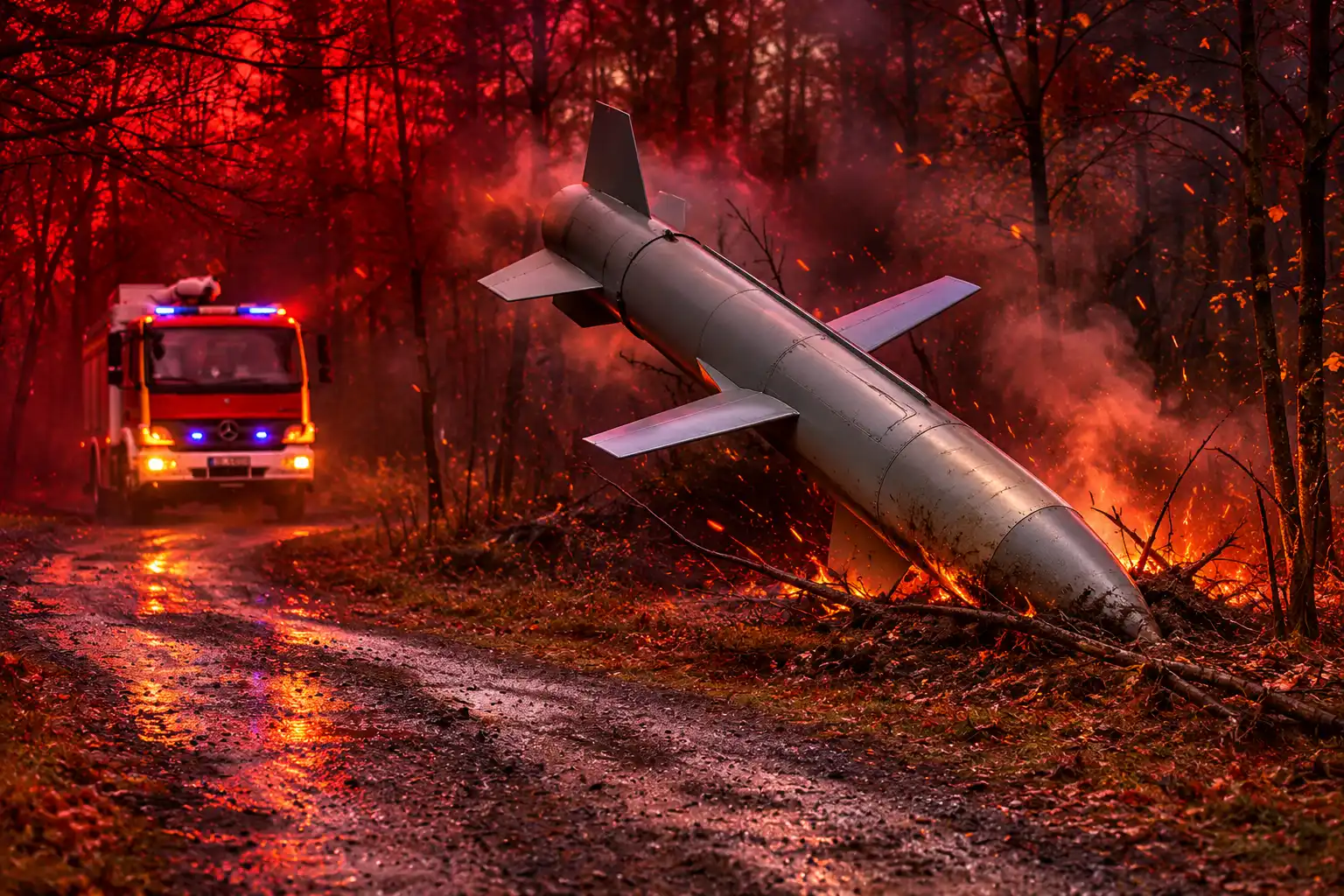
Two Russian missiles and a jet-powered drone came down in southeastern Poland on November 20, one of them 35 kilometers from a drill for a postwar Ukraine force. Prime Minister Donald Tusk said the crashes looked like an intentional provocation. NATO Secretary-General Mark Rutte called the episode a grave violation of Polish airspace. Nobody was hurt, and no infrastructure was damaged.
The objects fell on VIP day at Exercise Koalicja, where five defence ministers were watching Europe’s first rehearsal of a multinational force meant to enter Ukraine after a ceasefire. Moscow has already said it would treat that force as a target. NATO treated Friday as a dangerous airspace breach, not as an attack on the alliance.
A Kh-101 Came Down 35 Kilometers From the Drill
Defence Minister Władysław Kosiniak-Kamysz said a Kh-101 cruise missile came down in a field near Nowy Lipowiec, about 50 kilometers from the Ukrainian border, around 06:30 local time. A second missile fell at Rudnik nad Sanem, 35 kilometers from the Nowa Dęba training ground. A jet-powered drone, which operational commander Ireneusz Nowak said could have been a Geran-5, came down at Mołodycz, about 30 kilometers from the border.
Polish command tracked 11 missiles and drones over western Ukraine that could have entered Poland and confirmed that three objects did. Tusk told reporters one of them exploded. There was no destruction and no casualties, he said, and Warsaw knew for certain the wreckage came from Russia. Natalie Szponar, a resident near the Kh-101 site, said she was getting her children ready for school when she heard a “whistle and a dull impact.”
THE THREE CRASH SITES
| Place | Object | Where it sat |
|---|---|---|
| Nowy Lipowiec | Kh-101 cruise missile | 50 km from the Ukraine border |
| Rudnik nad Sanem | Missile, type unconfirmed | 35 km from the Nowa Dęba drill |
| Mołodycz | Jet-powered drone | 30 km from the Ukraine border |
First warnings reached Polish command at 01:40. Patriot batteries around Rzeszów and Świdnik were brought up, and controllers left the tower at Rzeszów-Jasionka, the logistics hub that feeds military aid into Ukraine. Polish F-16s and Swedish Gripens flew with a Dutch tanker, and NATO coordinated the response through the Combined Air Operations Centre at Uedem.
WHAT WE KNOW
- The wreckage: Poland has identified one Kh-101 and says all three objects were Russian.
- The human toll in Poland: No injuries and no damage to critical infrastructure have been reported.
- The nearby drill: Five defence ministers and eight allied military chiefs were at Nowa Dęba for VIP day when the objects came down.
WHAT IS UNCONFIRMED
- The second missile: Nowak said it could have been another Kh-101; Warsaw has not closed that identification.
- The flight paths: Officials have not published tracks proving the objects were aimed at the training ground rather than spilling over from the Ukraine strike.
- Moscow’s account: Russia had issued no comment on the three crashes by November 21.
Tusk said the United States would get access to the debris, then added that he does not always agree with the American reading of these incidents. That gap is already the political fight inside the alliance.
The Force in Nowa Dęba Was the Audience
Koalicja is not a NATO exercise. It is the first field drill of Multinational Force-Ukraine, the British- and French-led military arm of the Coalition of the Willing, a political group of 37 states set up in March 2025 to back a postwar presence in Ukraine. The two-week manoeuvres run from November 9 to 22 at Nowa Dęba, about 100 kilometers from the Ukrainian border.
About 2,800 troops from partner countries are taking part, with just under 2,000 Polish troops on logistics, for a total of almost 5,000. The British defence ministry has sent 300 personnel plus Typhoon and Voyager aircraft. Belgium, Estonia, Germany, Lithuania, the Netherlands, Spain and Sweden have units on the ground. Turkey is working the maritime piece from Istanbul, without sending troops to Poland. Poland has said it will not put its own soldiers on Ukrainian soil in any later mission.
Lt. Gen. Tom Bateman, the British officer who commands the force, said before the opening that the drill would show “a real, capable, readily deployable force that represents a serious commitment from Coalition of the Willing nations to Ukraine’s long-term stability and security.” UK Defence Secretary Wes Streeting, who was at Nowa Dęba on Friday with his French, Lithuanian, Estonian and Polish counterparts, has called it a real force, ready to help Ukraine once the fighting stops.
WHAT THE FORCE IS BUILT TO DO
- Rebuild the army: France says instructors would help Ukraine restore and strengthen its forces after a ceasefire.
- Reopen the sky: Air missions are meant to let civilian aircraft fly again in Ukrainian airspace.
- Clear the sea: The maritime piece, led in this drill by Turkey, is rehearsing mine clearance on Black Sea routes.
- Protect itself: The force is framed as defensive, not as a peacekeeping or ceasefire-monitor mission, and would still need combat power for its own protection.
- Stay off Polish combat duty: Warsaw is hosting the rehearsal and offering logistics, while repeating that Polish troops would not deploy into Ukraine.
The Institute for the Study of War timed to the Nowa Dęba drill as a Kremlin effort to deter that coalition and to test how NATO answers. Kosiniak-Kamysz went further in public.
This attack was no accident. It was closely coordinated with today’s demonstration of the Coalition of the Willing’s capabilities. It was directed against our citizens, intended to undermine society’s resilience and destroy cooperation within NATO, the European Union and the Coalition of the Willing.
Władysław Kosiniak-Kamysz, Defence Minister of Poland, Nowa Dęba, November 20, 2026
Tusk put the same point in plainer words. It was no coincidence, he said, that the objects landed near manoeuvres by a coalition of the willing supported by Polish troops in Nowa Dęba.
Moscow Already Called Those Troops Legitimate Targets
The warning did not start on Friday. On September 5, 2025, at the Eastern Economic Forum in Vladivostok, President Vladimir Putin was asked about foreign contingents in Ukraine and answered as a wartime commander, not as a diplomat.
If any troops appear there, especially now, during the fighting, we assume that they will be legitimate targets for destruction. And if decisions are reached that will lead to peace, to a long-term peace, then I simply see no point in their presence on Ukrainian territory.
Vladimir Putin, President of Russia, Eastern Economic Forum, September 5, 2025
When Koalicja opened, Moscow repeated the line against this specific force. On November 9, Foreign Ministry spokeswoman Maria Zakharova said any military units in Ukraine would be regarded by Russian forces as legitimate targets, with all the risks that entails. She called the exercises proof that the West would not weigh Russia’s security concerns and said Europeans had no place at the negotiating table.
💬 #Zakharova:
We reiterate that the deployment of foreign military contingents in Ukraine is categorically unacceptable.
🎯 @mod_russia regards any military units in Ukraine as legitimate targets, with all the attendant risks & consequences.https://t.co/NpIAjudZDx pic.twitter.com/7WjH1Yj9gM
— MFA Russia 🇷🇺 (@mfa_russia) November 9, 2026
That is the hidden stake. Friday’s wreckage sat on NATO soil, which is why Rutte used alliance language. The people in the firing solution, if the force ever moves east, are British, French, German, Swedish and other European troops rehearsing a job Putin has already said he will shoot. A French soldier at Nowa Dęba told colleagues the phone alert on Friday morning was lifted before anyone went to a shelter. The drill went on.
Why Polish and NATO Jets Did Not Fire
Nowak said Poland and NATO did not try to down the missiles and the drone because the conditions did not meet Polish rules of engagement. The Institute for the Study of War, citing that account, said Warsaw likely judged that a shoot-down would risk casualties and damage on the ground, and that the projected impact points would not. Kosiniak-Kamysz had said on July 31, 2026, that Polish forces will engage incoming projectiles if the engagement could threaten populated areas.
That choice will look cold to anyone who watched the CCTV flash in the trees. It is also how air defences work when a cruise missile is already falling toward empty ground. A miss, or a successful hit that showers a village, would have done what Friday’s wreckage did not.
Carl Bildt, the former Swedish prime minister, wrote after Swedish Gripens joined the NATO response that the objects were probably stray Russian drones and cruise missiles, then added that the recklessness still must not be tolerated. That stray reading is the one Tusk is trying to bury. He said the judgment that this did not look like an accident was shared by foreign partners, including inside NATO, and that “no one will hide this under the guise of an accident anymore.”
Lt. Gen. Matthew Jones, the UK’s chief of defence intelligence, told an audience in Cambridge on Friday he was confident Russia “does not actively seek war with NATO.” His greatest fear, he said, is “the risk of a significant miscalculation,” and he pointed to recent reckless Russian behaviour in which a slightly different incident could have been extremely serious. He did not name Poland. He did not need to.
Warsaw Asks NATO to Reinforce Eastern Sentry
Poland did not invoke Article 4 on November 20, and nobody in Warsaw was reaching for Article 5. The North Atlantic Treaty still says the parties agree that an armed attack against them all is the test, and that each ally then takes the action it deems necessary, including armed force. Article 5 has been used once, after the September 11, 2001 attacks. It is a political decision, not a tripwire, and a crash in a field with no blood does not meet the bar allies have set for themselves.
Kosiniak-Kamysz said he would appeal directly to Rutte for more forces and kit inside Operation Eastern Sentry, and that he wanted AWACS aircraft and allied F-35s. He also wanted partners told, and an extraordinary meeting tied to the incident. Tusk spoke with Rutte on November 20. The secretary-general is due in Poland on November 21. In a post, Rutte called the incident clearly dangerous, a consequence of Russia’s war against Ukraine.
WHAT WARSAW ASKED FOR
- More AWACS: Kosiniak-Kamysz wants extra airborne warning aircraft to track missiles and jet drones before they cross the border.
- Allied F-35s: He named fifth-generation fighters as the other gap he wants filled on the Polish side of Eastern Sentry.
- A wider briefing: He asked that every NATO partner be informed and that allies gather over the November 20 breach.
NATO Eastern Sentry along the eastern flank after Russian drones entered Poland on September 10, 2025. Rutte said then that the concentration of violations was the largest yet, and that Russian recklessness in the air was increasing in frequency. Allies have already used the same language about airspace breaches in Poland and Romania as recently as August 12, 2026, when the North Atlantic Council called them dangerous and unacceptable and said Russia was showing a higher tolerance for risk.
Skipping Article 4 this time is the quiet tell. If every crash is handled as a local air-policing problem plus a press conference, the threshold for a formal allied consultation moves. That is a gift to anyone trying to make this routine.
Poland Shot Drones in 2025 and Held Fire Here
Friday was not the first time Russian metal has come down on Polish fields during a strike on Ukraine. It was the first time in this war that a confirmed Kh-101, a precision cruise missile, was identified on this side of the border while a coalition force was rehearsing a move into Ukraine.
THE POLISH AIRSPACE FILE
- November 15, 2022: A missile kills two people in Przewodów, near the Ukrainian border, during a heavy Russian strike on Ukraine. Poland considers Article 4. NATO does not treat the blast as an attack on the alliance.
- September 10, 2025: Poland reports 19 airspace breaches by drones during a Russian attack on Ukraine. Polish F-16s and Dutch F-35s fire, the first time a NATO member is known to have shot during this war. Tusk tells parliament it is the closest Poland has been to open conflict since World War Two, then says he has no reason to believe the country is on the brink of war.
- September 10, 2025: Poland requests Article 4 consultations after Russian drones. Allies meet in the North Atlantic Council the same morning.
- September 12, 2025: Rutte and Supreme Allied Commander Europe Gen. Alexus Grynkewich launch Eastern Sentry. Denmark, France, Germany and the United Kingdom offer aircraft and ships in the first wave.
- November 9, 2026: Koalicja opens at Nowa Dęba. Zakharova calls any coalition units in Ukraine legitimate targets.
- November 20, 2026: Three Russian objects come down in Lublin and Podkarpackie on VIP day. Poland asks for more Eastern Sentry assets and does not invoke Article 4.
- November 21, 2026: Rutte is due in Poland.
The 2025 drone wave is the useful comparison because Warsaw did shoot, and because it did call allies into formal consultations. Friday’s missiles were faster and heavier, and the nearby audience was a force Putin has named. The response was thinner: jets in the air, Patriots on, wreckage taped off, a request for more AWACS.
Guarantees Were Discussed the Day Before the Crashes
The objects fell during one of Russia’s heavier nights against Ukraine, hours after Putin vowed more painful strikes in reply to Ukrainian hits on the Kerch Strait Bridge. Ukrainian President Volodymyr Zelenskyy said Russia fired 27 ballistic missiles, 84 cruise missiles and 404 Shahed and Gerbera-type drones, and that the strikes killed 8 people. Ukrainian forces intercepted about 94 percent of the cruise missiles and drones and about 11 percent of the ballistic missiles, according to figures published with that package. Hits landed on energy lines, defence plants, apartments and three bridges over the Dnipro in Kyiv. Deputy Energy Minister Artem Nekrasov said the three working nuclear plants had to cut output, with emergency outages in 11 regions.
Russia’s Defence Ministry said it had struck a missile-assembly site, a rocket-fuel component plant and a drone factory. The same night, two unidentified drones crossed Moldovan airspace from Ukraine and went back. The Polish crashes were a spillover from that package, or they were threaded through it. Warsaw says the date was not an accident.
Thursday, November 19, US President Donald Trump met Putin and Chinese leader Xi Jinping in China. Trump’s son-in-law Jared Kushner told European leaders the United States believes Russia is comfortable with NATO-like security guarantees for postwar Ukraine. On Friday, Russian Deputy Foreign Minister Sergei Ryabkov said even a quasi-membership in NATO for Ukraine would be unacceptable, and that Moscow discusses guarantees first as security for Russia itself.
Those two sentences do not sit easily beside a Kh-101 in a Lublin field. A guarantee that sounds like NATO, offered as a path to a deal, is exactly the kind of presence Zakharova said would be a foreign intervention. The coalition force drilling in Nowa Dęba is the practical version of that argument, built without waiting for a treaty text.
European condemnation was quick and familiar. UK Prime Minister Andy Burnham called the breaches utterly unacceptable. European Council President António Costa said Russia continues to spread its threats. Germany’s foreign ministry called them another example of Russia’s ongoing provocations. Ukrainian Foreign Minister Andrii Sybiha said the incident showed the threat Russian aggression poses to all of Europe and the trans-Atlantic community. French Foreign Minister Jean-Noël Barrot wrote that Russia will have to answer for this.
Tusk, after the wreckage was tagged, made the claim that follows from his provocation charge. He said it is clearer than ever that Poland must take part in decisions about the future of Ukraine and security in Europe. That is the smaller country’s price for hosting the rehearsal and catching the overflow. Rutte will hear it in Warsaw on November 21. Moscow has still said nothing about the three crashes, which is its own kind of answer.

GTA 6’s $3.79 Billion Day Was Mostly Pre-Sold

Amazon’s 12-Day Black Friday Sale Still Has Two Drops

NHS Grampian Must Answer for a 2022 Deaths Paper

Harry Kane’s Ankle Tear Puts March on the Clock

Russian Missiles Hit Poland Beside a Postwar Ukraine Drill

Consumer Sentiment Falls to 51.7 as Future Outlook Darkens

Pluto’s Heart Glacier Still Pushes Liquid Nitrogen Upward

Take-Two Subpoenas Microsoft While GTA 6 Preorders Soar

The Extra Heat Month Hits Children Where Care Is Thinnest

Netflix Weighs Hosting Peacock and Fox One in Its App
-
 BUSINESS3 months ago
Consumer Sentiment Falls to 51.7 as Future Outlook Darkens
-
 GAMING3 months ago
Take-Two Subpoenas Microsoft While GTA 6 Preorders Soar
-
 NEWS3 months ago
Pluto’s Heart Glacier Still Pushes Liquid Nitrogen Upward
-
 NEWS3 months ago
The Extra Heat Month Hits Children Where Care Is Thinnest
-
 ENTERTAINMENT3 months ago
Netflix Weighs Hosting Peacock and Fox One in Its App
-

 NEWS3 months ago
FDA Clears Rasonque and Widens Who Can Take It
-

 NEWS3 months ago
UMMC Will Rebuild 30-Year-Old Cancer Labs With $2.4 Million
-

 GAMING3 months ago
GTA 6’s 80-Hour Run Counts Goals That Change the Story