
GAMING
Ubisoft Cuts 166 Quebec Jobs After a Black Flag Beat
Ubisoft cut 166 jobs in Montreal and Quebec City on November 19, hours after a Black Flag-led bookings beat and a wider half-year loss.

Ubisoft cut 166 jobs in Montreal and Quebec City on November 19, the day it credited Assassin’s Creed Black Flag Resynced for a quarterly beat. The company said production needs had changed after projects were cancelled or rescoped, and that people who could not be moved were let go.
The same release called the new operating model fully in place and said fixed-cost cuts remain on track toward March 2028. A remake that sold hard in July did not reopen the slate those Canadian teams were built to fill.
128 Jobs in Montreal, 38 in Quebec City
Antoine Leduc-Labelle, Ubisoft’s public relations head in Quebec, said the cut is 128 jobs in Montreal and 38 in Quebec City, and that the total is less than 4% of the company’s Canadian staff. He said local teams had been relatively spared next to cuts elsewhere in the group over the past year. The two studios still employ about 3,500 people in Montreal and about 500 in Quebec City, so the smaller office is taking a heavier local share even if the Canada-wide figure stays under that 4% line.
THE QUEBEC SPLIT
- Montreal: 128 jobs at a studio of about 3,500 people.
- Quebec City: 38 jobs at a studio of about 500 people.
- Company share: Less than 4% of Ubisoft’s Canadian workforce, per Leduc-Labelle.
- Roles: Production teams and some production support, on work that had been cancelled or changed.
Those affected are being offered severance, extended health cover, and career transition help, the company said. It did not name the cancelled games, and it did not say which live brands lose support people. “As our portfolio evolves, our production needs are changing, requiring us to adjust the size of some teams to ensure our resources are aligned with current production priorities and business needs,” a spokesperson said.
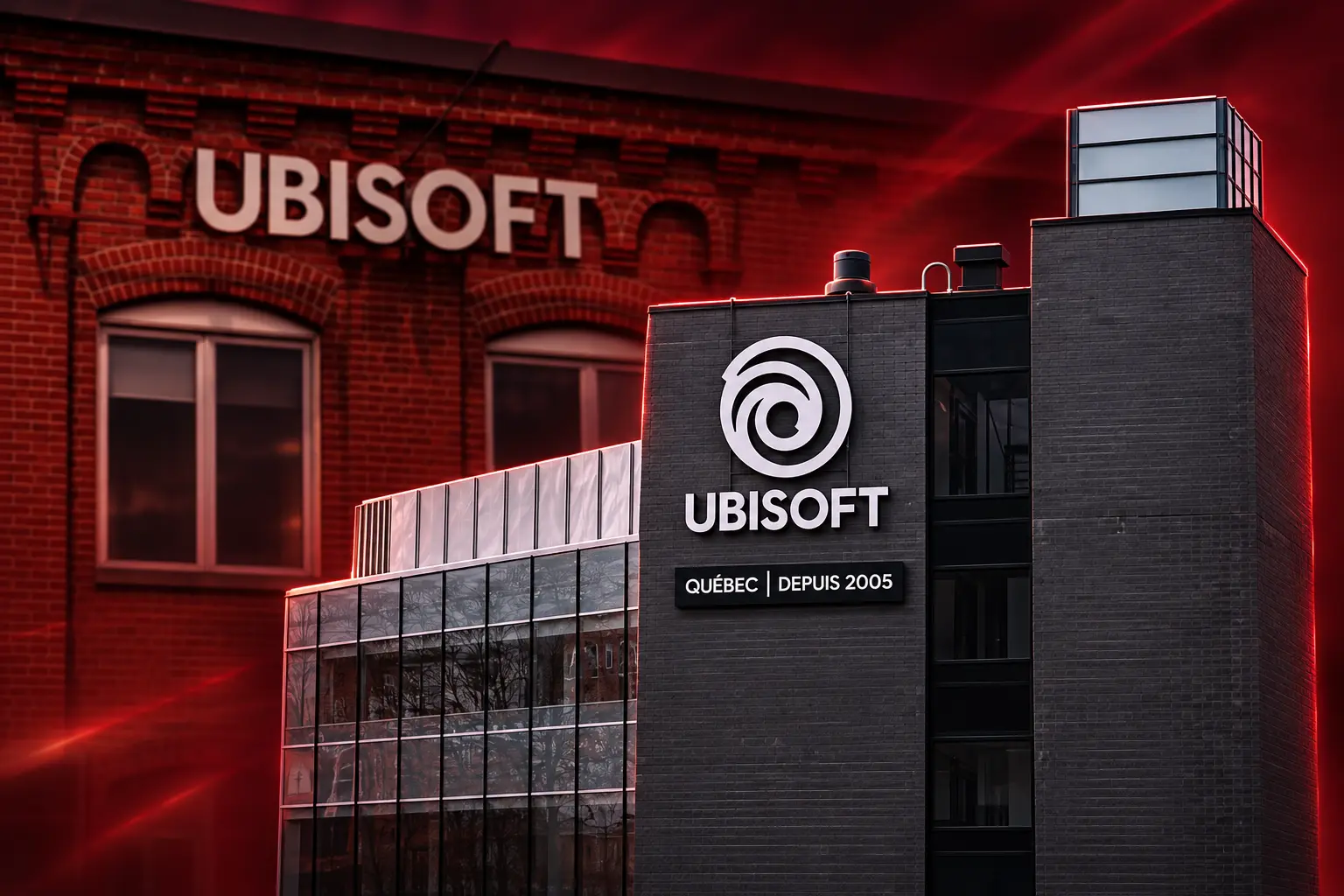
Black Flag Resynced Still Beat the Quarter
Assassin’s Creed Black Flag Resynced, a remake of the 2013 pirate game, launched on July 9. Ubisoft said it sold 2 million copies in the first 24 hours and more than 3 million in a week. In its first-quarter update the company put sell-in at 3.5 million copies in 14 days, which it said had already cleared the full-year target it had set for the title.
BLACK FLAG SELL-IN MARKS
- Day one: 2 million copies, per Ubisoft’s launch update.
- First week: More than 3 million copies.
- Fourteen days: 3.5 million copies, above the company’s annual plan.
The November accounts still lean on that launch. Second-quarter net bookings were €389 million, above guidance of about €370 million, and Ubisoft said the remake was the main reason the quarter cleared the guide. It grouped the title with the industry’s stronger action-adventure remakes and pointed to in-game spending and a richer mix of premium editions. Catalog games in Assassin’s Creed, Ghost Recon, and Invincible: Guarding the Globe also helped. None of that changed the headcount math published the same morning.
Cuts Inside the Tencent-Backed Vantage House
Accounts of Thursday’s round said staff from Vantage Studios were among those cut. Ubisoft has not confirmed teams by name. Vantage is the house built around Assassin’s Creed, Far Cry, and Rainbow Six, the brands Tencent paid €1.16 billion to take a 26.32% economic stake in when the deal closed in November 2025. The unit started work on October 1, 2025, with about 2,300 people across Montreal, Quebec City, Sherbrooke, Saguenay, Barcelona, and Sofia. Yves Guillemot, Ubisoft’s co-founder and chief executive, had sold that structure as focus and autonomy for the flagship IPs.
A protected house still sheds people when the number of live projects falls. That is the January plan working as designed: fewer games in production, then fewer producers and support staff who can be placed. Black Flag Resynced itself shipped as a Vantage title, which is why a beat on a remake and a cut inside the same house can sit on one earnings day without the company treating them as a contradiction.
In the first half of FY2026-27, we continued to make tangible progress on our strategic and operational priorities. Q2 exceeded our expectations, driven by the continued success of Assassin’s Creed Black Flag Resynced and solid contributions from our broader portfolio.
Yves Guillemot, Co-Founder and Chief Executive Officer, Ubisoft first-half results
Progress, in the accounts, means the model is installed and costs are coming down. It does not mean Montreal and Quebec City keep every producer who was waiting on the next full production.
Halifax, Winnipeg and the 2026 Studio List
January’s reset was billed as a third and last phase of cost cuts, aiming for at least €200 million of extra savings and a slimmer game list. Halifax closed that month with 71 jobs gone, weeks after workers there formed a union; Ubisoft said the shutdown tracked the wider plan, not the vote. Stockholm closed in the same wave. Six games were cancelled, among them the Prince of Persia: The Sands of Time remake. Winnipeg was shut in June. On October 14 the company cut 70 jobs in Singapore, about a fifth of that studio, and moved to close RedLynx in Finland, a step that would affect up to 52 jobs. Belgrade went as well. German offices were put through a separate voluntary-exit round in October.
UBISOFT’S 2026 CUTS
- January 2026: Announces the third cost-cut phase, closes Halifax (71 jobs) and Stockholm, and cancels six games including the Prince of Persia: The Sands of Time remake.
- June 2026: Closes the Winnipeg studio.
- October 14, 2026: Cuts 70 jobs at Ubisoft Singapore and moves to close RedLynx in Finland, affecting up to 52 positions.
- November 19, 2026: Cuts 166 jobs in Montreal and Quebec City and publishes first-half results.
Thursday’s Canadian round is smaller than a studio closure and larger than a quiet attrition week. It is also the first time this year’s plan has taken a named bite out of the two Quebec studios that still carry the company’s biggest single-player brands. Leduc-Labelle’s “relatively spared” line only holds if the comparison is Halifax or Singapore. Against a year in which Montreal was told, in June, that there were no local layoff plans, 128 jobs is a change of story.
How Ubisoft’s First-Half Accounts Landed
The half year that closed on September 30 is a beat inside a decline. Q2 net bookings of €389 million cleared guidance, and bookings excluding partnerships rose more than 50% year on year in that quarter. The six-month picture is weaker, and the losses are wider than a year ago.
UBISOFT’S FIRST-HALF LEDGER
| Line | H1 FY2026-27 | Comparison |
|---|---|---|
| Net bookings | €644.7 million | Down 16.5% from €772.4 million |
| IFRS 15 sales | €673.6 million | Up 2.4% from €657.8 million |
| Q2 net bookings | €389 million | Above about €370 million guidance |
| IFRS operating income | Loss of €189.2 million | Loss of €120.2 million a year earlier |
| Non-IFRS operating income | Loss of €155.9 million | Profit of €27.1 million a year earlier |
| Net income to parent | Loss of €254.5 million | Loss of €161.3 million a year earlier |
| Headcount | Down close to 1,100 | Over the first half |
| Fixed costs | €660 million | Down 6% year on year |
Digital bookings were €548.2 million, down 20.1%. Player recurring investment fell 33.4% to €316.6 million. Back-catalog bookings dropped 40.8% to €438.8 million, a slide Ubisoft tied in part to a high comparison base that had included partnerships and Assassin’s Creed Shadows. Console monthly active users held at 34 million and unique active players at 88 million, both flat on last year. Rainbow Six Siege was cited as a live-game bright spot after a year of anti-cheat and gameplay work, ranking in the top 10 for monthly active users on Xbox and PlayStation combined.
Cash stood at €1.03 billion at the end of September. A put on the 2028 OCEANE bonds was exercised for €453 million and paid from cash in mid-November. Non-IFRS net debt was €541 million, down from €1.149 billion a year earlier. The third cost-cut phase still aims for a €1.25 billion annualized fixed-cost run rate by March 2028. First-half net bookings of €644.7 million are the figure management is asking investors to read next to that cost path, not next to the 166 names taken off the Quebec payroll.
Motherbrain Opens on the Same Thursday
The earnings print also said Motherbrain is now a dedicated subsidiary for AI used in gameplay, set up to support teams across the company. Two live-ops creative houses were merged under one leader, every house now has a named head, and an outside general manager for Creative House 4 is due in January 2027. A lighter unit will handle brands that sit outside the houses.
That is the other half of Thursday. The company is standing up an AI gameplay shop on the same day it is shrinking production and support groups in the studios that built Assassin’s Creed. The two moves are not a swap of 166 engineers for a chatbot. They are the same operating idea: fewer parallel productions, more shared tools, a smaller bench of people waiting on the next full game. When the bench cannot be reassigned, the January plan shows up as an email.
The 10 a.m. Email That Ended 166 Jobs
Olivier Ernst, managing director of Ubisoft Canada, wrote to Montreal and Quebec City staff at 10 a.m. on Thursday. He said the company was reducing its workforce in both cities and that 166 colleagues were affected. People whose jobs were going received meeting invites minutes later. The public statement that followed used the same production-priorities language Paris has used all year, from Halifax through Singapore.
Quebec City shipped Assassin’s Creed Shadows. Montreal remains the long-time production home of the series. Thursday’s cut is not a studio closure, and both offices stay open at several thousand people. It is the January reset arriving where the company had, until now, done most of its Canadian shrinking by shutting smaller shops. The March 2028 cost target is still in the accounts. The 166 jobs were already gone by the time the bookings beat was on the wire.
Disclaimer: This article is news reporting on Ubisoft’s job cuts and first-half accounts, and it is for information only. It is not investment advice, a recommendation to buy or sell Ubisoft shares, or a prediction of further layoffs or game cancellations. Anyone who holds or is considering the stock should speak with a licensed financial adviser before making a decision. Headcount, bookings, loss and debt figures are those the company published on November 19, 2026, and later filings can change them.

GTA 6’s $3.79 Billion Day Was Mostly Pre-Sold

Amazon’s 12-Day Black Friday Sale Still Has Two Drops

NHS Grampian Must Answer for a 2022 Deaths Paper

Harry Kane’s Ankle Tear Puts March on the Clock

Russian Missiles Hit Poland Beside a Postwar Ukraine Drill

Consumer Sentiment Falls to 51.7 as Future Outlook Darkens

Pluto’s Heart Glacier Still Pushes Liquid Nitrogen Upward

Take-Two Subpoenas Microsoft While GTA 6 Preorders Soar

The Extra Heat Month Hits Children Where Care Is Thinnest

Netflix Weighs Hosting Peacock and Fox One in Its App
-
 BUSINESS3 months ago
Consumer Sentiment Falls to 51.7 as Future Outlook Darkens
-
 GAMING3 months ago
Take-Two Subpoenas Microsoft While GTA 6 Preorders Soar
-
 NEWS3 months ago
Pluto’s Heart Glacier Still Pushes Liquid Nitrogen Upward
-
 NEWS3 months ago
The Extra Heat Month Hits Children Where Care Is Thinnest
-
 ENTERTAINMENT3 months ago
Netflix Weighs Hosting Peacock and Fox One in Its App
-

 NEWS3 months ago
FDA Clears Rasonque and Widens Who Can Take It
-

 NEWS3 months ago
UMMC Will Rebuild 30-Year-Old Cancer Labs With $2.4 Million
-

 GAMING3 months ago
GTA 6’s 80-Hour Run Counts Goals That Change the Story