
BUSINESS
Anthropic Files for Nasdaq as ANT Without Giving Up Control
Anthropic’s S-1 seeks a Nasdaq listing as ANT after $16.286 billion of first-half sales, with public buyers locked out of control.

Anthropic, PBC filed to list Class A shares on Nasdaq as ANT on October 26, 2026, leaving the share count and the price range blank.
The same filing shows $16.286 billion of revenue for the first half of 2026 and a capital structure that keeps ordinary buyers off the board. A Founder LLC of the seven co-founders will hold one Class F share carrying 50.1% of the vote, while the Long-Term Benefit Trust elects a majority of the directors.
Control Is Locked Before the First Trade
Anthropic’s newsroom said the company had filed for a proposed offering of Class A stock on the Nasdaq Global Select Market under ANT. Goldman Sachs & Co. LLC and Morgan Stanley & Co. LLC will handle the prospectus, heading a group of 22 banks. The number of shares and the price are still undetermined, and the registration is not effective, so no stock can be sold until the SEC declares it so.
The issuer is a Delaware public benefit corporation, formed on January 26, 2021, with offices at 548 Market Street in San Francisco. Its charter purpose is the responsible development and maintenance of advanced AI for the long-term benefit of humanity. That legal form lets the board weigh the mission beside stockholder returns, and the S-1 layers two more locks on top of it.
Because the trust can elect a board majority, Anthropic will be a controlled company under Nasdaq rules. It says it expects to use that exemption only for its nominating and corporate governance committee. The Nasdaq Global Select Market listing standards still require an independent audit committee; they do not require a majority-independent board once the controlled-company box is ticked.
Class A stock will carry one vote a share, and the class as a whole is capped at 49.9% of the votes on ordinary matters. Buying ANT is a claim on Claude’s cash flows. It is not a claim on the board.
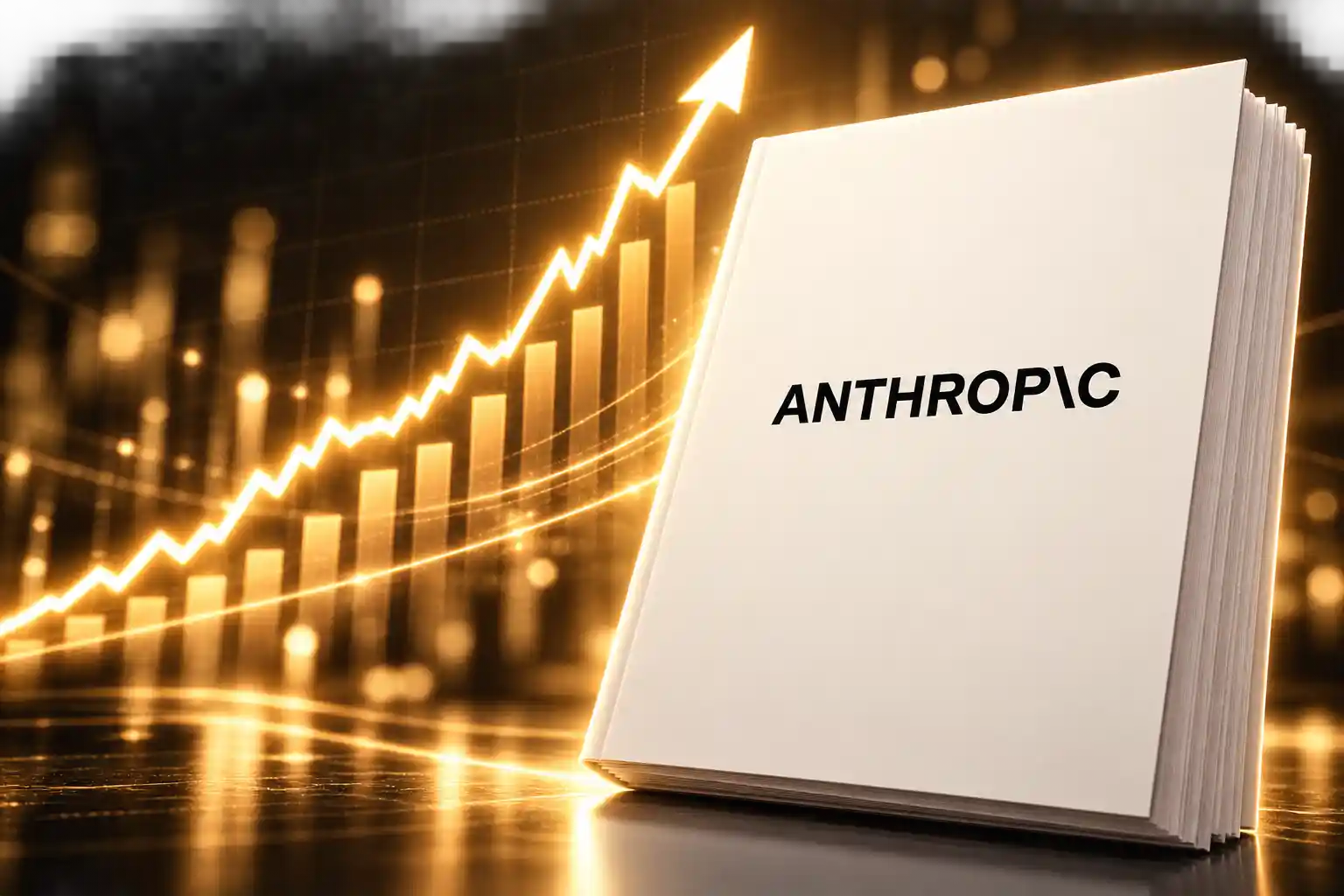
First-Half Revenue Hit $16.286 Billion
The registration statement on Form S-1, accepted at 9:00 a.m. Eastern on October 26 under file number 333-299633, is the first full public look at the lab’s books. Revenue was $41 million in 2023, $386 million in 2024, and $4.585 billion in 2025. The first half of 2026 did $16.286 billion, up 1,300% from $1.163 billion a year earlier.
The June quarter alone brought in $11.555 billion and the first operating profit the filing reports, $974 million. The March quarter, at $4.731 billion, was larger than all of 2025. For the half, operating expenses still topped sales, and the operating loss was $693 million, down from $2.135 billion in the first half of 2025.
The headline net loss is $80.75 billion. About $72.4 billion of that is a fair-value charge on convertible notes, derivatives, and related instruments, booked as the private valuation rose. Operating cash flow in the same half was $3.93 billion the other way, positive, and adjusted operating income, which strips stock-based pay and a few other items, was $1.62 billion.
THE BOOKS IN THE S-1
| Metric | FY2023 | FY2024 | FY2025 | H1 2025 | H1 2026 |
|---|---|---|---|---|---|
| Revenue | $41 million | $386 million | $4.585 billion | $1.163 billion | $16.286 billion |
| Compute and infrastructure | $433 million | $2.522 billion | $7.326 billion | $2.334 billion | $8.945 billion |
| Compute as share of revenue | 1,056% | 653% | 160% | 201% | 55% |
| Operating income (loss) | $(551) million | $(2.980) billion | $(8.060) billion | $(2.135) billion | $(693) million |
| Net loss | $(1.531) billion | $(8.309) billion | $(41.965) billion | $(12.969) billion | $(80.75) billion |
| Operating cash flow | $(1.627) billion | $(5.692) billion | $(2.637) billion | $(1.513) billion | $3.93 billion |
Compute and infrastructure, the largest cost line, fell from 201% of revenue in the first half of 2025 to 55% in the first half of 2026, or $8.945 billion against $2.334 billion. Personnel cost $3.152 billion in the 2026 half, and sales, marketing, and partnerships added $3.17 billion. Consumption, metered in tokens, was $13.1 billion, or 80% of first-half sales; subscriptions were $3.2 billion. Anthropic holds the customer contract even when AWS, Google Cloud, or Azure collect the bill, and those marketplaces handled 48% of the half.
The company says it does not expect to pay a dividend in the foreseeable future. It also says it does not expect revenue to keep growing at comparable rates. At June 30 it held $112.4 billion in cash and $19.3 billion in short-term investments, $131.7 billion together, after raising $141.1 billion in all. A May 2026 round, Series H, brought in $65 billion at a $965 billion post-money value. The S-1 does not state a target valuation for ANT.
CUSTOMERS AT SEPTEMBER 30
- Large accounts: More than 11,900 customers had $100,000 or more of trailing-twelve-month revenue, up from more than 950 a year earlier, and more than half of the Fortune 500 sat in that group.
- Million-dollar book: More than 1,900 customers generated at least $1 million, and about 250 generated at least $10 million.
- Net revenue retention: About 900%, excluding Claude Pro and Max subscribers, meaning customers active a year earlier were spending about nine times as much in the September quarter.
- Concentration: The top five customers were about 25% of revenue in the first nine months of 2026, with no single customer above 10%.
Headcount was about 5,300, up about 170% in a year, and trailing-twelve-month revenue per employee was more than $6.6 million, against $1.4 million a year earlier. Anthropic names Google and OpenAI as its primary competitors. It launched 250 model versions, platform features, and applications in the first nine months of 2026, and it says models released in the six months to September 30 accounted for over 80% of that quarter’s revenue. In September, Claude wrote over 90% of the contributions to Anthropic’s own codebase.
Who Gets a Vote After the Offering?
Immediately before the offering, Anthropic will issue a single Class F share to a Founder LLC whose initial members are Dario Amodei, the chief executive; Daniela Amodei, the president and board chair; Tom Brown; Jack Clark; Jared Kaplan; Sam McCandlish; and Christopher Olah. Benjamin Mann, often described as a co-founder, is not in the LLC and has no say in how that share is voted.
The Class F share has no economic rights and cannot be diluted in the ordinary way. It carries 50.1% of the voting power on matters submitted to stockholders, including the election of every director the trust does not already pick. Each continuing founder has one vote inside the LLC on how the share is cast. Each may name a ranked list of up to 10 successors, kept confidential, and a founder can sell or donate most of the economic stock and still sit in the LLC after retaining 2% of that founder’s IPO-era shares.
Dario Amodei beneficially owned about 245.3 million Class A shares as of September 30, 2026, including 4.6 million he votes under proxy agreements with donor-advised funds. Daniela Amodei owned about 241.4 million. Tom Brown held the most among the seven, about 244.2 million. Dario’s 2025 pay was nearly $18 million, mostly stock and options; Daniela’s was $16.4 million.
HOW THE SHARES VOTE
| Class | Who holds it | Economic rights | Voting power |
|---|---|---|---|
| Class A | Public buyers and insiders | Yes | One vote a share, class capped at 49.9% |
| Class F | Founder LLC (one share) | None | 50.1% on ordinary stockholder votes |
| Class T | Long-Term Benefit Trust (one share) | None | Elects and removes a board majority |
| Class E | Employees other than the founders | None on ordinary dividends | Votes only on a narrow set of mission and trust questions |
| Class N | Strategic partners | Yes | None, generally converting to Class A on a sale to an outsider |
The Long-Term Benefit Trust, set up in 2023 as a Delaware noncharitable purpose trust, holds Class T. The S-1 says Class T “generally has the authority to elect and remove the Class T directors, who together will constitute a majority of the authorized members of our board of directors.” After the offering the board will have seven seats. Four are Class T: Reed Hastings, Vas Narasimhan, Christopher Liddell, and one vacancy. Dario Amodei, Daniela Amodei, and Yasmin Razavi are elected by Class A and Class F voting together.
The trustees are financially disinterested. The seats are chaired by Dr. Neil “Buddy” Shah of the Clinton Health Access Initiative, with Richard Fontaine of the Center for a New American Security, former Federal Reserve chair Ben Bernanke, and Harvard physicist Christopher Stubbs; one of five seats is vacant. Each trustee is paid $400,000 a year in cash, the chair an extra $25,000, and the pay “will not vary with or be conditioned upon the profits or any action or inaction of our company.” Trustees may not buy Anthropic securities. Class T has no economic rights, and the S-1 says neither the trust nor the trustees have day-to-day management or strategy authority.
Unwinding the trust is hard on purpose. If the trustees agree, it still takes 80% of the authorized board and 80% of the trustees in office. If they object after Class F is gone, it takes 85% of outstanding Class A. The filing warns that “the LTBT may have interests that differ from yours.”
The Compute Bills Are Due Whether Claude Sells or Not
Revenue is scaling. The purchase agreements behind it are larger, longer, and in several cases due even if usage never shows up. At June 30, 2026, expected future fixed or minimum guaranteed commitments under compute agreements were about $265.6 billion, with terms from one year to 20 years, up from $54.6 billion at the end of 2025 on the subset then counted as having more than a year left. New and amended leases and commercial deals as of December 31, 2025, carried about $417 billion of future minimum payments, and the company signed or amended about $245 billion more after June 30, some of it still subject to conditions.
The filing does not print one grand total, and the named lines are not all the same kind of promise. Some are floors due regardless of use. Some are leases. Some can be cancelled on notice after an initial period. Extra TPU capacity for 2028 to 2031 is estimated at $125 billion to $150 billion and is left out of the commitments table.
NAMED COMPUTE FLOORS AND LEASES
- Google Cloud: At least $114.5 billion from April 2026 to July 2033, with a true-up if spend falls short, owed regardless of actual usage and not cancellable except for the provider’s uncured material breach.
- Amazon: At least $110.0 billion from May 2026 to April 2036, on the same take-or-pay and true-up pattern.
- Microsoft: At least $44.9 billion from 2026 to 2033, also regardless of usage; those three floors alone are $269.4 billion.
- Broadcom: About $161.2 billion of rent under master equipment leases for TPU-based systems, non-cancellable during the lease period, with room to issue up to $42.0 billion of convertible notes if needed to pay.
- SpaceXAI: Up to $120.5 billion for Nvidia capacity into 2029, cancellable by either side on 90 days’ notice after initial lockups.
Smaller named lines include up to $44.6 billion with Nscale through 2033 and about $41.3 billion with Lambda through 2034. AMD is expected to exceed $20 billion if the first tranche fills, with no fixed dollar commitment. Anthropic trains and serves Claude across AWS Trainium, Google TPUs, Nvidia GPUs, and AMD GPUs and treats that capacity as one pool. Q2 revenue grew 1,368% year over year while compute expense grew 300%.
Amazon and Google Collect on Both Sides
The S-1 says Amazon, Google, and Microsoft are at once investors, customers, distribution partners, competitors, and compute suppliers. It flags fights that could follow over access, price, and whose workloads get the next rack. That is the commercial knot public stockholders inherit and cannot vote off the board.
Amazon still held $6.2 billion of notes at June 30 that convert at the IPO, subject to a cap that keeps Amazon at or below 12% of the company. Google bought about $10 billion of Series G-2 preferred in March 2026 and another $10 billion of Series H in May, on terms that have long capped the stake near 15% with no board seat and no vote. Both firms also resell Claude in their clouds, which is how nearly half of first-half revenue was collected.
The public book therefore funds a lab whose largest future checks are written to shareholders who already sit inside the cap table. Those shareholders build their own models too. Amazon’s Trainium and Google’s TPUs are in the same “fungible pool” the S-1 describes, which is diversification on a slide and concentration in the contracts.
A Public Benefit Corporation Goes Looking for Public Money
Anthropic has never sold an advertisement, and the filing sketches no ad tier, sponsored answer, or audience product. The business is usage and subscriptions. The governance is the mission, written into the charter and then insulated from the people who will own ANT.
The specific public benefit that the Corporation will promote is to responsibly develop and maintain advanced AI for the long term benefit of humanity.
Amended and Restated Certificate of Incorporation of Anthropic, PBC, Exhibit 3.1 to Form S-1
The S-1’s risk factors run for dozens of pages and include warnings of catastrophic existential risks to humanity, including behaviors seen in safety tests that look like resistance to shutdown, concealment, and coercion. The same document is the path to a public float. That pairing is what the filing actually does: it asks outside capital to pay for more capable models while telling those investors that the product can, in a bad case, impose losses on people who never bought a share.
On October 18, eight days before the public S-1, Anthropic said that, subject to stockholder approval, it would commit 5% of Anthropic’s shares to a new Public Benefit Fund, with another 2% at the board’s discretion for every 50% rise in company value above a set baseline. Combined with the co-founders’ pledges to donate 80% of their equity, which the S-1 calls voluntary and revocable, and an employee match that about half the staff uses, the company says roughly 20% of shares will be pointed at the public good. The Fund is an LLC, not a charity, and the equity in it will not be used for lobbying.
The trust’s job, in the S-1’s words, is to pick directors who can balance “our tripartite goals as a PBC”: stockholders’ pecuniary interests, the best interests of those materially affected by Anthropic’s conduct, and the company purpose. Public Class A holders are one corner of that triangle. They are not the corner with a board majority.
The Offer Price Is Not in the Filing
The S-1 leaves the offering size, the price range, and the date blank. Those lines get filled by a later amendment, after the SEC finishes review and after the banks test demand. Anthropic confidentially submitted a draft on June 1, 2026, and amended it through the fall before the public file went up on October 26. Bankers have discussed starting a roadshow in the week of November 9, with trading possible in the week of November 16. The company itself has not set either date.
PATH TO THE PUBLIC S-1
- January 26, 2021: Anthropic files its Delaware certificate as a public benefit corporation.
- 2023: The Long-Term Benefit Trust is put in place to elect an expanding share of the board.
- May 2026: Series H raises $65 billion at a $965 billion post-money value.
- June 1, 2026: A confidential draft registration statement goes to the SEC.
- October 18, 2026: The company announces the 5% Public Benefit Fund commitment.
- October 26, 2026: Form S-1 is accepted at 9:00 a.m. Eastern, 87 documents, CIK 0002130357.
Copies of the preliminary prospectus, when they exist, will come from Goldman’s prospectus desk at 200 West Street in New York or Morgan Stanley’s at 180 Varick Street. Both the company and selling stockholders will offer Class A shares; Anthropic receives nothing on the selling-stockholder slice. SpaceX raised $85.7 billion in June in a listing also led by Goldman and Morgan Stanley. Anthropic’s filing does not say it will match that haul.
Until the registration is effective, ANT is a ticker on a form. The revenue is real, the compute contracts are dated, and the vote is already assigned. Public buyers are being invited to fund the next stage of Claude on terms that leave the mission trust and the seven co-founders in charge of the company that would list.
Disclaimer: This article is news reporting and analysis of Anthropic’s Form S-1 and related company statements. It is for information only and is not investment advice, a solicitation, or an offer to buy or sell any security. Readers should consult a licensed financial adviser or broker-dealer and read the prospectus before acting on any offering. Share counts, prices, and other terms are taken from the documents named here and will change as the registration is amended and as the offering is priced.

Baker Mayfield’s Foot Strain Tests Tampa’s Run-First Formula

Measles Turns Endemic After the US Loses Elimination Status

California Locks Waymo Off Freeways After a Recalled Defect

Aidan Hutchinson’s Season Ends on a Celebration Jump in Munich

Super El Niño Hits Food Systems Already Under Strain

Consumer Sentiment Falls to 51.7 as Future Outlook Darkens

Take-Two Subpoenas Microsoft While GTA 6 Preorders Soar

Pluto’s Heart Glacier Still Pushes Liquid Nitrogen Upward

The Extra Heat Month Hits Children Where Care Is Thinnest

Netflix Weighs Hosting Peacock and Fox One in Its App
-
 BUSINESS3 months ago
Consumer Sentiment Falls to 51.7 as Future Outlook Darkens
-
 GAMING3 months ago
Take-Two Subpoenas Microsoft While GTA 6 Preorders Soar
-
 NEWS3 months ago
Pluto’s Heart Glacier Still Pushes Liquid Nitrogen Upward
-
 NEWS3 months ago
The Extra Heat Month Hits Children Where Care Is Thinnest
-
 ENTERTAINMENT3 months ago
Netflix Weighs Hosting Peacock and Fox One in Its App
-
 NEWS3 months ago
FDA Clears Rasonque and Widens Who Can Take It
-
 NEWS3 months ago
UMMC Will Rebuild 30-Year-Old Cancer Labs With $2.4 Million
-

 GAMING3 months ago
GTA 6’s 80-Hour Run Counts Goals That Change the Story