
NEWS
Caltech’s Space Robot Built One Bay of Eleven
Caltech’s ASTRA robot assembled one bay of an 11-bay truss in orbit while ground crews still sent the commands, leaving eight bays unfinished.

A Caltech robot assembled one new bay of an 11-bay truss in orbit, the first structure built in space without astronauts. The ASTRA payload launched on March 30, 2026, aboard Momentus’s Vigoride 7, under DARPA’s NOM4D program.
Ground engineers still radioed each move in short daily windows. Caltech says the remaining eight bays are unlikely to be finished before the flight ends in December 2026.
The Robot Added One Bay and Stopped
Sergio Pellegrino, the Caltech aerospace professor who leads ASTRA, said the machine had done something crews have never done on their own. “This is the first time that a structure has been autonomously constructed in space,” he said after the university posted the result on November 5, 2026. DARPA, which funds the work, called it the first ever demonstration of automated in-space assembly.
What the photos show is smaller than that sentence. ASTRA launched with two truss bays already built on the ground. Those sections were pushed out of the builder once the launch locks came off. The robot then joined composite fiber tubes and aluminum joints into a third bay, the only section put together in orbit. The full design is a 1.4-meter (4.6-foot) reflector antenna. Eleven bays would hold a netlike Kapton sheet taut enough to act as a mirror. That sheet never became a finished dish.
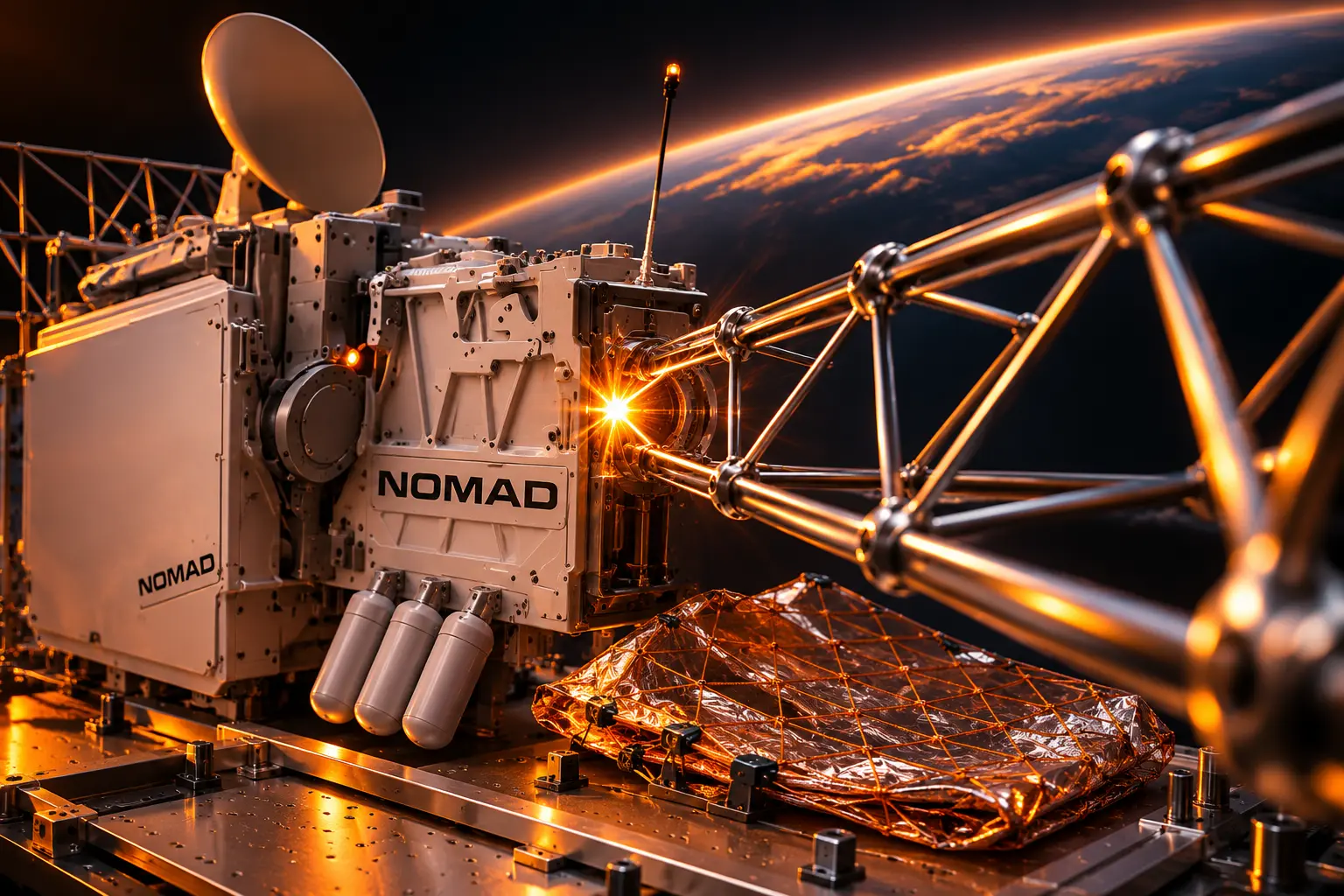
The payload is a three-axis gantry in a box about 1 cubic meter (35 cubic feet) across, not a walking humanoid. Motorized dispensers hold the leftover struts and joints. An assembly plate is the workbench. Eleven cameras watch the plate, and one of those frames, credited to Caltech and Momentus, shows extra tubes and the reflective net still stowed beside the new bay. DARPA also released a view of the payload leaving Vigoride 7 during a solar eclipse, a pretty picture of a job that then got slow.
ASTRA BY THE NUMBERS
| Spec | Figure |
|---|---|
| Payload volume | About 1 cubic meter (35 cubic feet) |
| Robot | Gantry on 3 linear axes |
| Onboard cameras | 11 |
| Daily contact | 7 or 8 windows, about 15 minutes each |
| Host orbit | About 500 km, Momentus Vigoride 7 |
| Reflective skin | Perforated Kapton film, UPenn collaboration |
Andrew Detor, DARPA’s NOM4D program manager, has compared the kit to Tinkertoys or K’Nex: members meet at nodes, one section at a time, inside an assembly box, then get pushed out. He said there are no complicated robotics or advanced algorithms, only a sequence that can be repeated. The sequence stopped after one repeat.
Pasadena Still Had to Talk to the Arm
In February 2025, when DARPA moved this test off the bench and onto a rocket, Detor described Caltech’s experiment as free flying, with no human engagement once it was in orbit. Onboard cameras would watch a gantry build the circular truss on its own. The flight that actually flew still needed Pasadena on the loop.
Charles Sommer, a former Caltech systems engineer, Alan Truong, a Caltech research engineer, and graduate student Tara Venkatadri sent the build commands through Vigoride and checked the result against photos dumped from orbit. They ran the same moves again when something went wrong, and plenty did. Jaden Suh was a Caltech postdoc on the team. He is now an assistant professor at the University of Texas at Austin. “That’s basically the reason you do proof-of-concept testing. There are a lot of differences in the space environment compared to down on Earth,” Suh said. “There are always lots of little surprises.”
Those surprises met a twin. The team had built a flight spare and kept it in Pellegrino’s lab, so each fault could be copied on the ground before a workaround went up. Ground contact exists in only seven or eight windows of about 15 minutes each day, which is a poor clock for a robot that is supposed to keep stacking bays. Sommer put the method in one line: every time they confirm an issue in space, they come to the laboratory and try to mimic the problem on the ground, then relay the fix.
The loud argument around the result treats “autonomous” as a finished antenna built while no one watched. The useful reading is narrower. No astronaut touched the parts, and that is new for a free-flying truss. People on Earth still chose the moves, still stared at stills, and still ran out of calendar. Caltech has not said whether the arm, the joints, or that short daily window ate the other eight bays. That missing fault report is the part of the test other builders actually need.
WHAT WE KNOW
- The third bay: Two prebuilt sections were pushed out, then the gantry assembled one new bay from loose struts and joints.
- Who typed: Sommer, Truong, and Venkatadri sent commands through Vigoride and scored them against camera stills.
- The clock: The flight is due to end in December 2026, and Caltech says a full 11-bay truss looks unlikely.
WHAT IS UNCONFIRMED
- The snag: The team has not named which on-orbit surprise stopped the repeat cycle.
- More bays: Nothing public shows another section going together before the December cutoff.
- Illinois launch day: DARPA says that payload still flies later in 2026, with no date locked.
A simple gantry won this round because the job site was a box with dispensers, a plate, and the same joint over and over. Design the workbench that tightly, and the robot can stay boring. The cost of that choice showed up as soon as the boring machine needed a human to clear a jam it had not seen in the lab.
Fifteen Months From a Lab Pivot to Orbit
NOM4D, pronounced like nomad, did not start as a flight program. DARPA introduced it in 2022 to get around the cargo fairing, with a long-term aim of ferrying raw materials from Earth and making the structure where it will live. Early phases even looked at lunar regolith as feedstock. The last phase dropped the Moon work and sent two university teams toward orbit instead.
Detor has been blunt about why. Phase 3 was supposed to be a cleaner lab build than Phase 2. The hardware looked mature enough that a space test would teach more, and a space test would mean performers cannot just sweep challenges under the rug. “It’s the speed and the scale that made this a DARPA project. We went from the idea of an on-orbit demo to launching a working prototype into space in 15 months,” he said. Caltech, working on a slightly different clock, finished, tested, and delivered the payload to Momentus in less than 12 months. Pellegrino called that timeline an enormous undertaking for a small team.
THE NOM4D CLOCK
- 2022: DARPA starts NOM4D to build large structures from parts that do not have to survive as a finished spacecraft in a fairing.
- February 10, 2025: Phase 3 shifts from more lab work to two small orbital tests, Caltech on a free flyer and Illinois headed for the space station.
- March 30, 2026: ASTRA launches from Vandenberg Space Force Base on SpaceX’s Transporter-16 mission.
- November 5, 2026: Caltech and DARPA say a truss bay has been assembled in orbit from loose parts.
- December 2026: ASTRA’s mission is due to end, with the remaining bays still in the dispensers.
Momentus hosted the box, integrated it, and ran power, radio, and imaging from San Jose. ASTRA rode as one of 10 payloads on the Vigoride 7 Orbital Service Vehicle, which Momentus said reached about 500 km after its 1.6-kilowatt solar arrays opened. Suh watched that launch with tears in his eyes. He had wanted to send space structures off the planet since he was a child, and a lot of his original ideas are in this system.
Building in zero gravity? ✅
Autonomously? ✅
With simple engineering principles? ✅Our NOM4D program, with @Caltech, has demonstrated the first automated assembly of a structure in space, marking a major milestone in how we design, build, and operate beyond Earth. pic.twitter.com/nyV0etC9S6
— DARPA (@DARPA) November 5, 2026
Why a Fairing Still Sets the Limit
Large things in orbit have had two paths since the start of the space age. Fold them, pack them, and unfurl them after launch, which is how most big antennas and the James Webb mirror got there. Or send up sections over several flights and have astronauts bolt them, which is how the station’s truss grew. Both still answer to the rocket’s nose cone. NOM4D is the bet on a third path: fly a box of parts that never had to take launch loads as a finished structure, then join them where they will work.
HOW LARGE STRUCTURES GET TO ORBIT
- Fold and unfurl: Build on Earth, hinge it to fit the fairing, then open it in space, which caps size and forces the design to survive launch.
- Crew assembly: Launch modules over many flights and join them by hand, which is slow and burns crew time.
- Build on site: Ship struts, joints, or even uncured feedstock and let a robot, or a chemical reaction, make the structure in orbit.
Detor’s target is not a 1.4-meter dish. He has said “very large” means hundreds of meters or kilometers, and that nothing near that scale can be done today. In the 2025 pivot note he talked about 100-meter-class radio antennas for watching cislunar space, plus depots, habitats, and solar farms. The Caltech flight is a stand-in: thin composite tubes and a surrogate mesh on the inside of a perimeter truss, not a working radio antenna with electronics.
In a future space economy, we’re going to need large things. Think large space depots or habitats, large solar arrays to collect power, or large radio antennas to explore the edges of the universe. Those things require size, and NOM4D gives us a path to accelerate creation of new capabilities.
Andrew Detor, NOM4D program manager, DARPA
The skin on ASTRA is part of that mass bet. Igor Bargatin, a University of Pennsylvania professor, led collaborators who co-invented a perforated Kapton film with the Caltech group. It needs less prestress than the knitted metal mesh used on fold-out reflectors, so the truss can be lighter. In the full recipe, the gantry would hang two of those nets, pull them against each other with springs, then shove the finished bay into the vacuum and start the next one. That hang-and-tension step is still ahead of the hardware that is flying.
Archinaut Never Got Its Flight
Pellegrino’s “first” is a claim about a free-flying structure joined from parts in vacuum, with no crew on the job. Other robots have come close enough that the sentence needs a fence around it. GITAI’s S1 arm assembled panels and structures inside the International Space Station’s Bishop airlock in 2021, a pressurized cabin, not open orbit. NASA’s bigger try at making structure in space did not leave the ground.
Made In Space, later bought by Redwire, spent years on Archinaut, renamed OSAM-2. The plan was to 3D-print a 10-meter beam and a 6-meter beam in orbit and unfurl a stand-in solar array while one beam printed. A 7-meter flight-like beam was printed in ground tests in 2020, and the design passed a critical review in 2022. NASA then concluded in 2023 prior to a flight demonstration. The agency’s project record lists the stop as a funding cut in September 2023. A sister servicing mission, OSAM-1, was cancelled in 2024.
WHO FLEW AND WHO DID NOT
| Project | What it tried | Where it stopped |
|---|---|---|
| GITAI S1, 2021 | Assemble panels and structures with a robot arm | Inside ISS Bishop airlock; interior demo completed |
| OSAM-2 / Archinaut One | Print 10 m and 6 m beams in orbit, deploy a stand-in array | Cancelled in 2023, never flew |
| OSAM-1 | Service Landsat 7 and assemble an antenna | Cancelled in 2024 |
| ASTRA, 2026 | Join composite tubes and joints into truss bays | Third bay built in orbit; eight bays not built |
That table is why a one-bay gantry is being treated as a line in the log. NASA spent years and a large contract on printed beams that never reached a pad. Caltech flew a cubic-meter box on a rideshare and joined a bay in vacuum. The unfinished dish does not erase that difference. It also does not turn one bay into a kilometer of truss.
A Flat Carbon Sleeve Is Next
ASTRA is only half of NOM4D’s orbital pair. The University of Illinois Urbana-Champaign still has to fly. DARPA said on November 5, 2026, that the Illinois payload would go to the International Space Station later in 2026 to try a different trick: curing composite in space, not snapping tubes together. Sameh Tawfick, a mechanical science and engineering professor, leads that team. Illinois has said the Phase 3 award brought its DARPA total to $4.7 million.
The Illinois hardware starts as a flat carbon-fiber sleeve, which Detor has compared to a finger trap, then takes a liquid monomer engineered to sit on a shelf and survive space temperatures. On Earth, a carbon tube is bagged, infused, and baked in an autoclave. There is no 100-meter oven in orbit, so the team uses frontal polymerization: light one end inside the tube and let the hardening reaction run down the length. Tawfick has talked about trusses for telescopes and radio antennas more than 300 meters across, built on demand from tubes made that way. Voyager was the original station partner, with a ride on a cargo flight that had been penciled in for April 2026. That date slipped. The station test is now the last milestone DARPA lists before NOM4D winds down.
A third university team, at Florida, stayed on the ground. It is working on laser sheet-metal bending with NASA’s Marshall Space Flight Center, adding a bend to Marshall’s weld-and-cut toolkit. No Florida hardware is on Vigoride 7, and none is booked for the station in the notes DARPA has posted.
The Next Builder Has to Be Simpler
Caltech says the test has shown the feasibility of the proposed assembly concept and that the design now needs to be simplified and refined. That is the quiet verdict after the applause line. A repeating joint worked in vacuum. The box around that joint, the daily radio diet, and the spare robot in a campus lab did not add up to 11 bays. The next machine has to do more of the work without waiting for a 15-minute pass.
Pellegrino is also co-director of Caltech’s Space Solar Power Project, which wants to collect sunlight in orbit and send it to Earth. That project already flew a small demonstrator on a Momentus Vigoride in 2023, when its MAPLE array beamed power in space and a faint signal to the ground. The arrays that scheme would need are the size of the structures NOM4D keeps naming, and they will not fold into any fairing now flying. “Once you get to the size limit where structures cannot be prebuilt on the ground and unfolded, you have to think about how to build them in space,” Pellegrino said. He listed astronomy, communications, and those solar arrays as the users of a joint that can be stacked without a crew.
The NOM4D Caltech demonstration is not an endpoint; it’s a beginning. Now that we’ve demonstrated a process that can scale to large structures, what do we go make?
Andrew Detor, NOM4D program manager, DARPA
What they made, this time, is one new bay, two sections that flew already built, and a list of surprises copied onto a twin in Pasadena. The flight is due to end in December 2026, with eight bays still in the dispensers.

Baker Mayfield’s Foot Strain Tests Tampa’s Run-First Formula

Measles Turns Endemic After the US Loses Elimination Status

California Locks Waymo Off Freeways After a Recalled Defect

Aidan Hutchinson’s Season Ends on a Celebration Jump in Munich

Super El Niño Hits Food Systems Already Under Strain

Consumer Sentiment Falls to 51.7 as Future Outlook Darkens

Pluto’s Heart Glacier Still Pushes Liquid Nitrogen Upward

Take-Two Subpoenas Microsoft While GTA 6 Preorders Soar

The Extra Heat Month Hits Children Where Care Is Thinnest

Netflix Weighs Hosting Peacock and Fox One in Its App
-
 BUSINESS3 months ago
Consumer Sentiment Falls to 51.7 as Future Outlook Darkens
-
 GAMING3 months ago
Take-Two Subpoenas Microsoft While GTA 6 Preorders Soar
-
 NEWS3 months ago
Pluto’s Heart Glacier Still Pushes Liquid Nitrogen Upward
-
 NEWS3 months ago
The Extra Heat Month Hits Children Where Care Is Thinnest
-
 ENTERTAINMENT3 months ago
Netflix Weighs Hosting Peacock and Fox One in Its App
-

 NEWS3 months ago
FDA Clears Rasonque and Widens Who Can Take It
-

 NEWS3 months ago
UMMC Will Rebuild 30-Year-Old Cancer Labs With $2.4 Million
-

 GAMING3 months ago
GTA 6’s 80-Hour Run Counts Goals That Change the Story