
BUSINESS
Colossus Writes Tech History From Inside a Venture Firm
Colossus magazine won Mark Zuckerberg at home, but Positive Sum already lists the quarterly as the fund’s tool for founder stories.

Colossus spent nearly a year inside Mark Zuckerberg’s houses, gym, and offices for a September cover. The quarterly that got that time is owned by the same Greenwich venture firm that now describes the magazine as how it helps founders talk.
Tech bosses have spent years telling reporters they are the problem. In July, Elon Musk told an editor, “I think you’re the problem, the media,” and added, “You are loathed far more than I am.” Colossus magazine offers them a prettier room to walk into instead.
Colossus Prints the Authorized Version
Patrick O’Shaughnessy built the Colossus podcast network in 2020, the same year he started the venture firm Positive Sum, after selling his father’s quantitative shop, O’Shaughnessy Asset Management, to Franklin Templeton in 2022. He had taken that firm over in 2018. The podcast that made his name, Invest Like the Best, started in 2016 and still sits at the center of the network, with guests who have included Charlie Munger and Sam Altman. He has said episodes draw north of 100,000 downloads. A founder letter on the subscribe page puts cumulative listens at nearly 100 million.
Print arrived in November 2024 as Issue 01. The about page says Colossus publishes a print magazine and a podcast network and wants “the world’s best editorial talent” on “the most interesting people, companies, and ideas we can find in the world of capitalism.” Jeremy Stern, a former Army bomb-disposal officer and State Department adviser, became editor-in-chief in January 2025 after four years as deputy editor at Tablet, where his long profile of Anduril founder Palmer Luckey doubled as his audition tape.
O’Shaughnessy has said he wants the New Yorker profile habit of a writer as obsessed with the person as the person is with the work. The pieces that followed, on Joshua Kushner, Neil Mehta, Sarah Guo, Jeff Yan, Joe Liemandt, and then Zuckerberg, read as cradle-to-empire origin stories. Reddit cofounder Alexis Ohanian wrote that Colossus “gives me hope for journalism.” Bill Ackman called the Kushner cover “by far the best profile I have ever read on a firm.” Reid Hoffman told people to read it.
THE MAGAZINE IN FIGURES
- The price: A personal plan is $299 a year for four print issues.
- The print claim: O’Shaughnessy wrote in September 2025 that Issue 3 had 100,000 copies of print circulation.
- The audio: His founder letter puts total listens near 100 million, on top of the per-episode figure above.
- The next object: Issue 08, titled Marcus Imperator, is listed to ship in December 2026.
Veteran tech reporter Kara Swisher is not in the fan club. “It is PR,” she said. “These people are so fragile and made of papier-mâché that they need Vaseline mirrors to reflect them back at themselves.”
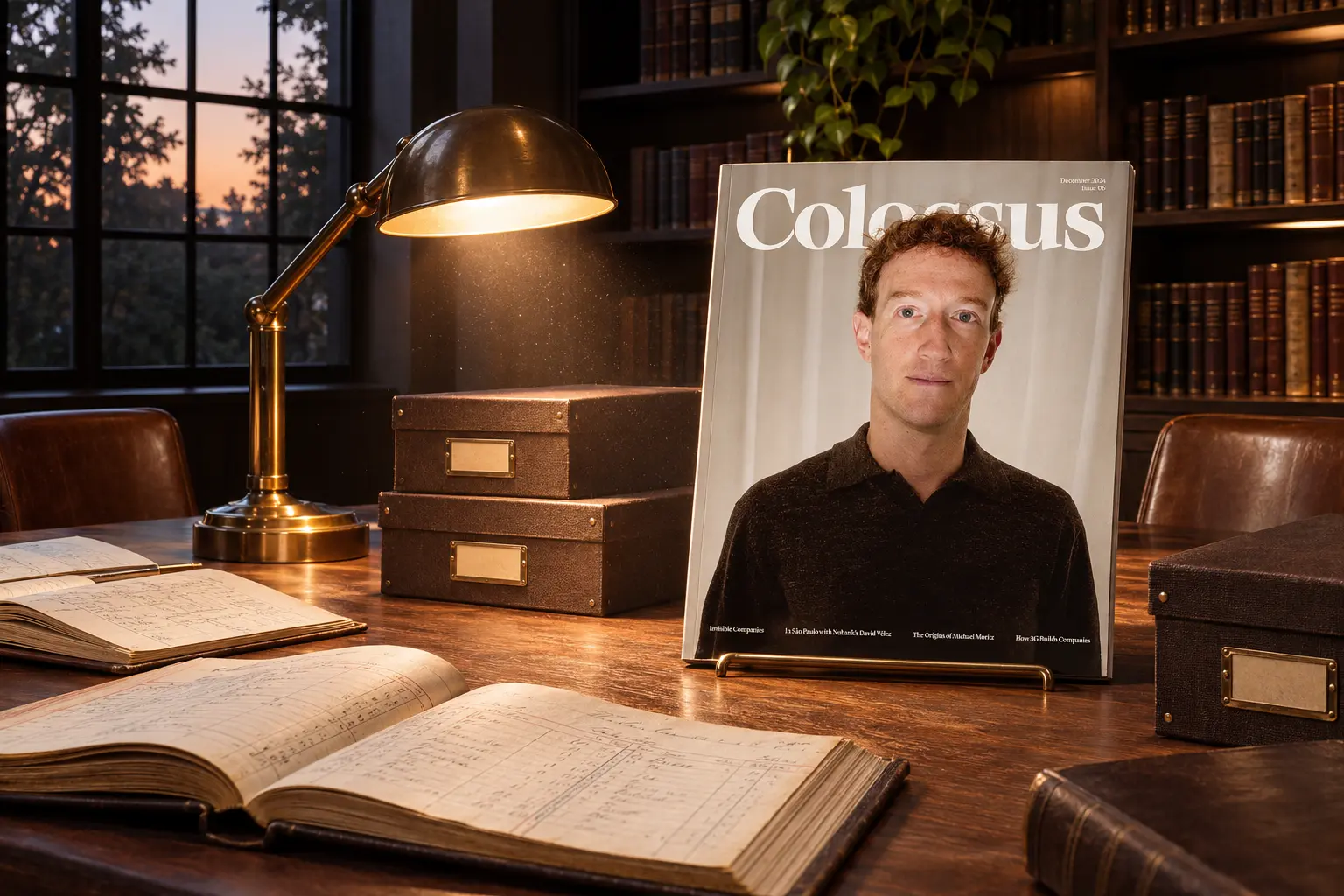
How Mark Zuckerberg Ended Up in Issue 08
Zuckerberg’s own team came to Stern late in 2025 and asked for the piece, which is the mechanism that matters. Stern had made Zuckerberg the villain of the Luckey profile about August 2024; Meta’s founder still gave a comment, and Stern later said that exchange may have helped the two men thaw after Luckey’s 2016 firing. The invitation that followed was not a leak to a beat reporter. It was a year of doors opening inside the company that still treats most of the press as hostile weather.
On 14 September 2026, Colossus said Stern had talked to three dozen people, including Zuckerberg, his MMA coach, critics and rivals at frontier AI labs, and Zuckerberg’s parents, Karen and Ed. He watched their son get punched in the face. The story moves through Meta’s Menlo Park campus, houses in Palo Alto and Lake Tahoe, and a Manhattan warehouse party with Kylie Jenner and Timothée Chalamet. Chase Middleton took the photographs. There is even a peek at Aaron Sorkin’s next Zuckerberg film, which Stern says he got through a Hollywood fixer he first met in Russia.
The magazine’s own September cover story on Zuckerberg frames him as a sovereign who cannot be fired, running what it calls history’s largest nonterritorial empire. It puts that empire at 3.6 billion users and a market value of $1.6 trillion. The scenes are built to feel intimate and slightly oversized, which is the house style.
Everything in a Zuckerberg residence, the flora, the doors, the bookshelves, the light, seems uncannily enlarged, like on a movie set. After walking across the vast lawns of his summer palace and entering one of its smaller structures, it is jarring to find him held aloft like this, the sovereign of history’s largest nonterritorial empire being heaved against his will.
Jeremy Stern, Mark, Colossus Issue 08
That is the specimen. The reporting hours are real. The lens still leaves Phillips Exeter, and a lot of the public case against Meta, offstage, while the profile’s critics are filed under a catchall Stern has used in the pages, “Zuckerberg Derangement Syndrome.” Hiten Samtani, who runs a commercial real-estate media company and has praised the craft, still will not call it news. “To be super clear, it is not journalism,” he said. “Think of it as high-grade, tier-one content marketing.”
Mark, by @colossusjeremy.
This is a story about the head of history's largest nonterritorial empire, who nonetheless remains a prisoner of his rivals. Has he finally found a way out?
The profile has been nearly a year in the making. Stern interviewed three dozen people,…
— Colossus (@colossusmag) September 14, 2026
Positive Sum Calls Colossus Its Distribution Arm
On its site, Positive Sum says it will help founders tell their stories through Colossus, which it names as its sister company. That sentence is the business model in plain type. The fund is not hiding a side hobby. It is selling access to an audience, and to a narrative, as part of what founders get when they take the check.
The staff lists make the same point without a press release. Colossus’s masthead runs from O’Shaughnessy and president Alison Davis Riddell through Stern, managing editor Dom Cooke, creative director Gabi Marques, and a research bench that files “Positive Sum Research” packages inside the issues. A Greenwich firm roster published in October 2026 puts Stern, Cooke, Marques, and the rest of that masthead among Positive Sum’s people as well. In September 2024, O’Shaughnessy announced that Brie Wolfson, who had helped launch Stripe Press, would be chief marketing officer at both Positive Sum and Colossus, and said she would help the portfolio and “tell more stories.” When the magazine later advertised a commercial hire, the contact was brie@psum.vc.
Samtani’s other line is the one that follows. “Their economics are not media company economics. This is at least partly a clout exercise and an access game, and it’s a very smart one,” he said. Stern has told publicist Lulu Cheng Meservey that the job is to avoid becoming “the outlet for founders to get their story out in exactly the pre-cooked way that they have it.” He has also said, in another interview, that as a class he has found these people “full of shit.” Those private asides rarely survive contact with the published copy, which tends to bless “mostly vindicated admirers” and scold “increasingly sheepish critics.”
Nilay Patel, a longtime tech editor, put the reputational problem in an email. “Writing a massive profile of Mark Zuckerberg in which his staggering unpopularity with everyday Americans is treated as an unfortunate byproduct of his ambition just isn’t going to convince anyone of anything,” he wrote. “If Mark actually wanted to be understood as he says he does, he’d sit down for a truly adversarial journalistic interview and try to make his case. But I don’t think he can take the risk.”
The Same Names Keep Turning Up
The magazine’s subjects, the fund’s holdings, and the brands on the audio feeds keep crossing. That is not a conspiracy chart. It is what a small network looks like when the newsroom and the partnership team share a kitchen.
WHO GOT THE COLOSSUS TREATMENT
| Person | The piece | The tie |
|---|---|---|
| Mark Zuckerberg | Mark, Issue 08, September 2026 | His team approached Stern after the Luckey profile |
| Scott Wu, Cognition | The Wu Tapes | Positive Sum is a Cognition investor; Cognition has sponsored Colossus audio |
| Blake Hall, ID.me | Pathfinder | Positive Sum joined ID.me’s September 2025 round |
| Joshua Kushner, Thrive Capital | The New World | The two firms have invested alongside each other; Altman, Jony Ive, and Demis Hassabis appear as named voices |
Vanta, another Positive Sum name, shows up as a sponsor on the same feeds as Ramp, WorkOS, and Cognition. Issue 03 sold an “exclusive peek” at Anduril’s engineering rooms, the company Stern had already wrapped in a sympathetic Tablet life story. The Kushner piece quotes a glittering secondary-source list, yet almost everyone named has a financial relationship with the subject. Brooke Hammerling, who advises tech companies on communications, asked the blunt question: “Who actually subscribes to it other than the other investors and entrepreneurs also seeking their own editorial platforms?”
Print Copies Cost $299 a Year
The shop lists $299 a year for print plus a private audio feed, four issues, shipped in the United States, the United Kingdom, and Canada. That is $74.75 an issue. An office plan is listed at $1,495 a year. Back issues have been sold for $50. O’Shaughnessy has been explicit that major articles stay free, so a reader who only wants the Zuckerberg story never has to pay. The card is charged for the object you can leave on a partner’s table, and for early audio, including Scott Brick, the narrator of Dune and Hamilton, whom the magazine named its official voice in June 2026.
WHAT A PERSONAL PLAN INCLUDES
- The print run: Four oversize issues a year, mailed at the end of each quarter, with Issue 08 due in December 2026.
- The private feed: Early access to select Colossus podcasts and full readings of the long profiles.
- The free layer: The big features, including Mark, are posted on the open site.
- The sales pitch: O’Shaughnessy is now signing print sponsors and hiring a commercial seat whose inbox sits at the fund.
In September 2025, as Issue 3 went out, he wrote that print circulation was 100,000 copies and that the magazine would reinvest the proceeds. He also wrote that Colossus gets only four covers a year and eight to 12 profile slots, which he called a discipline that forces the team “to go after the very best.” The constraint is real. So is the filter. A $299 quarterly with an office SKU north of a thousand dollars is not chasing a general audience. It is building a room where the people in the table above already sit.
Sequoia’s Bankman-Fried Profile Arrived Weeks Before the Crash
Colossus did not invent founder media. It is the first of this wave to spend serious money on paper, photography, and sentences that sound like a glossy. The earlier attempts are useful because they show what happens when the same class writes its own notices.
A SHORT HISTORY OF THE FORM
- 2017: Stripe starts Increment, a quarterly that ran 19 issues before the company shifted energy into Stripe Press and Works in Progress.
- 2021: Andreessen Horowitz launches Future.com, arguing the tech press is shallow and untrustworthy, then shuts it in 2022.
- September 2022: Sequoia publishes a glowing profile of Sam Bankman-Fried weeks before FTX collapses. The writer says, “I couldn’t shake the feeling that this guy is actually as selfless as he claims to be.”
- November 2024: Colossus mails Issue 01, with Graham Duncan on the first cover.
- April 2026: OpenAI buys TBPN, a talk show built for the same audience.
- September 2026: Stern’s Zuckerberg cover goes online. Issue 08 is posted for sale in October, for December delivery.
Casey Newton, a tech journalist, has argued that it is “actually great that venture capitalists are now writing all of the founder hagiography, because it means that when, inevitably, one of these people goes to prison, the blowback will not affect mainstream journalists. It will just affect the venture class, and they can take it.” He is less interested in Zuckerberg’s childhood. “You’ve seen the products. You’ve seen what they do to people,” he said. “Against that backdrop, what kind of kid was Mark Zuckerberg? It’s like, who fucking cares?”
Samtani’s milder version is that this kind of wet kiss always existed, “but it was never done this artfully.” That art is the second-order effect. Beat reporters can still file. They cannot get the year in Tahoe, the parents, the warehouse party, and the MMA gym in one pass, because those hours have already been booked by a title that will not use them to make the subject sweat.
Issue 08 Lands in December
The Zuckerberg story has been free since mid-September. The print issue that carries it, Marcus Imperator, is still scheduled to land on doorsteps in December. One reader, when Colossus posted the piece, was surprised it was not behind a paywall. That reaction is the model working as designed. The long story is a demonstration of access. The $299 object is a souvenir of having been in the room, or of wishing you were.
People now talk about commissioning a Colossus-style profile the way an earlier generation talked about a glossy cover, which is how you know the form has become a status good. Stern can still say the work is to resist the pre-cooked founder narrative. The calendar says the people who used to have to risk Swisher now have a second door, and they have started using it.

Baker Mayfield’s Foot Strain Tests Tampa’s Run-First Formula

Measles Turns Endemic After the US Loses Elimination Status

California Locks Waymo Off Freeways After a Recalled Defect

Aidan Hutchinson’s Season Ends on a Celebration Jump in Munich

Super El Niño Hits Food Systems Already Under Strain

Consumer Sentiment Falls to 51.7 as Future Outlook Darkens

Pluto’s Heart Glacier Still Pushes Liquid Nitrogen Upward

Take-Two Subpoenas Microsoft While GTA 6 Preorders Soar

The Extra Heat Month Hits Children Where Care Is Thinnest

Netflix Weighs Hosting Peacock and Fox One in Its App
-
 BUSINESS3 months ago
Consumer Sentiment Falls to 51.7 as Future Outlook Darkens
-
 GAMING3 months ago
Take-Two Subpoenas Microsoft While GTA 6 Preorders Soar
-
 NEWS3 months ago
Pluto’s Heart Glacier Still Pushes Liquid Nitrogen Upward
-
 NEWS3 months ago
The Extra Heat Month Hits Children Where Care Is Thinnest
-
 ENTERTAINMENT3 months ago
Netflix Weighs Hosting Peacock and Fox One in Its App
-
 NEWS3 months ago
FDA Clears Rasonque and Widens Who Can Take It
-

 NEWS3 months ago
UMMC Will Rebuild 30-Year-Old Cancer Labs With $2.4 Million
-

 GAMING3 months ago
GTA 6’s 80-Hour Run Counts Goals That Change the Story