
NEWS
The SEC Sets a $70.5 Million Luxury Tax
The SEC’s proposed luxury tax sets a $70.5 million roster line, $21.5 million above the Big Ten cap, after a federal bill stalled.

The SEC is circulating a luxury tax that would let a school spend $70.5 million on athletes for a first-year fine of about $7 million. Administrators briefed on the plan described the rates to reporter Ross Dellenger on Nov. 11, and one power-league athletic director boiled it down to a $70 million cap. The top tier sits $21.5 million above the Big Ten’s $49 million institutional ceiling.
That gap is the product. Texas, LSU and the other heavy SEC spenders can still write checks the hardest-capped Big Ten schools cannot match, while Arkansas, Kentucky and Vanderbilt remain tens of millions short of the line the tax pretends to police.
The Tax Ladder Circulated to Dozens of Administrators
The rates went out over several days before Nov. 11 to dozens of administrators, and the league has been sharing the plan with other conferences. It is a tax on roster spend, not a hard stop. Dellenger posted the tiered fines above $70.5 million the same night the details landed.
The first band starts at $22.5 million, just above the $21.6 million House settlement figure the proposal uses, and the percentages rise with the payroll. A school that spends $70.5 million would owe about $7 million in year one, because the top rate is 10 percent of roster spend, not 10 percent of the dollars over the line. The same band gets more expensive if a school stays there.
SEC PROPOSED FINE RATES
| Roster spend | Year-one fine | Later years |
|---|---|---|
| $22.5M to $50.5M | Less than 1% | Rises each cap year |
| $50.5M to $60.5M | 1% | Rises each cap year |
| $60.5M to $70.5M | 3% | 5% the next year |
| More than $70.5M | 10% (about $7M at $70.5M) | 15% the next year; 20% by 2028-29, or $14M to $16M |
Those later-year rates are how the fines climb past $10 million. Fifteen percent of $70.5 million is already above $10 million, and 20 percent lands in the $14 million to $16 million range Dellenger was given for the biggest spenders. Nobody has said where the money would go.
The headline here is that the new cap would basically be $70 million.
Power-league athletic director, to Ross Dellenger
A 10 percent bill on a $70.5 million payroll is a door fee, not a lock. A program that can pay it keeps the players. A program that cannot is still staring at a number it never reached.
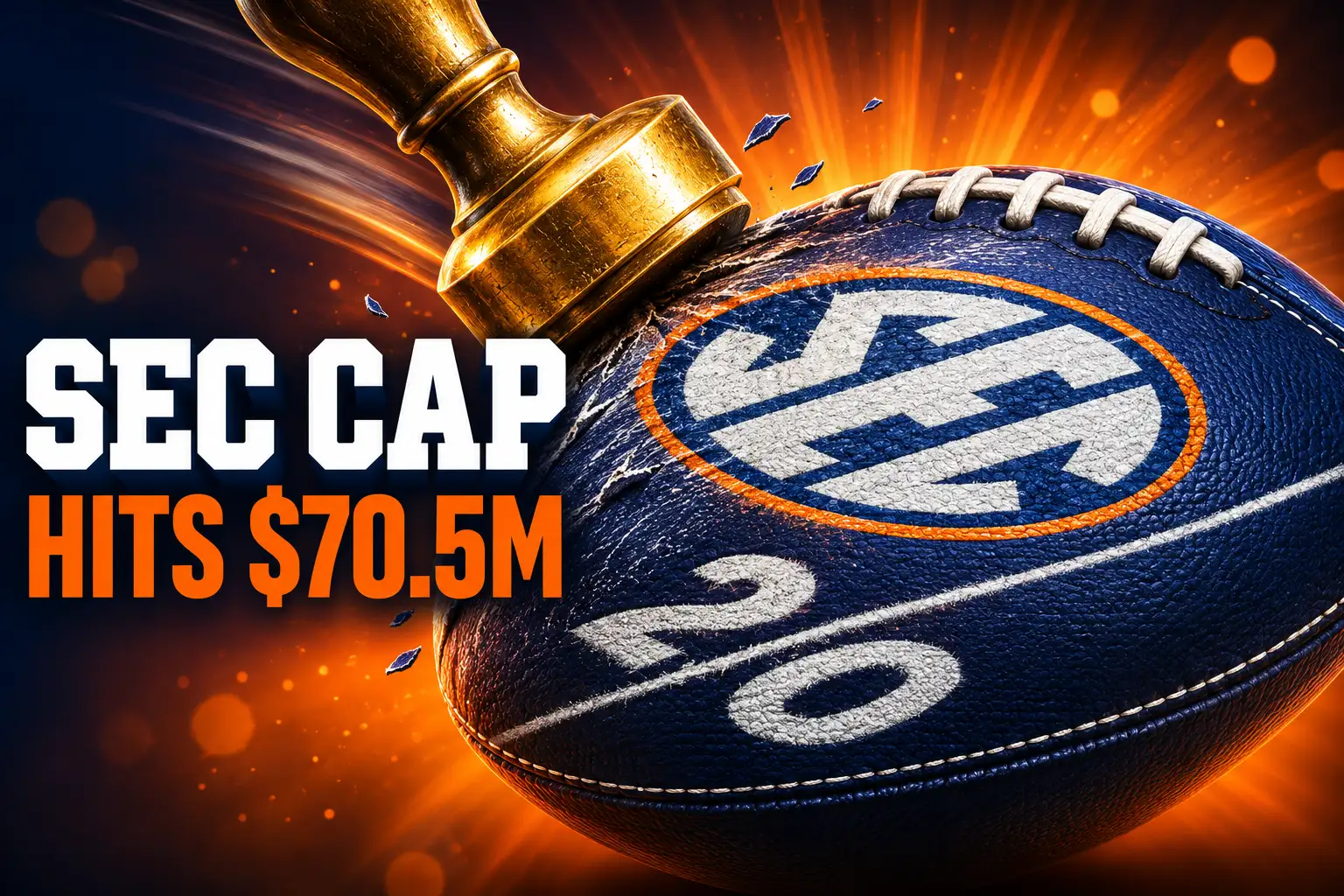
Where Texas, LSU and A&M Sit on the Scale
The cap is school-wide, covering the athletes a university pays, not football alone. Independent 2026 football roster spend estimates still show who already lives near the tax bands on the sport that eats most of the money, with figures rounded to the nearest $250,000.
FOOTBALL PAYROLLS AGAINST THE NEW LINES
| School | Conference | Est. 2026 football spend |
|---|---|---|
| Texas | SEC | $52.00M |
| Oregon | Big Ten | $51.50M |
| LSU | SEC | $50.75M |
| Ohio State | Big Ten | $50.50M |
| Texas A&M | SEC | $48.25M |
| Ole Miss | SEC | $43.50M |
| Tennessee | SEC | $41.50M |
| Alabama | SEC | $40.50M |
| Florida | SEC | $38.50M |
| Georgia | SEC | $31.25M |
| Missouri | SEC | $29.00M |
Texas, LSU and Texas A&M already sit in or against the 1 percent football band before basketball and the rest of the department stack on top. Georgia’s football estimate is $31.25 million, closer to Missouri than to Texas. South Carolina is at $34.00 million, Auburn at $33.50 million, Oklahoma at $33.25 million. Four SEC football rosters fall outside that national top 25, below Wisconsin’s $28.00 million, which is the company Arkansas, Kentucky, Vanderbilt and Mississippi State keep.
A $70.5 million school-wide line does not haul those programs up. It tells Texas and LSU what the receipt looks like if they keep spending, and it leaves the bottom of the league the same distance behind.
The Big Ten Locked Itself at $49 Million
On Oct. 28, Big Ten chancellors and presidents adopted a conference rule that limits school involvement in athlete NIL deals to $49 million. The split is the $21.6 million House figure plus a $27.5 million third-party NIL limit. Pamela Whitten, chair of the Big Ten Council of Chancellors and Presidents, said members needed to plan and build rosters around the economic structure of a federal bill the league still backed. The rule took effect that day, and each school had to attest compliance.
The Big Ten prepares for the Protect College Sports Act economic framework.
More: https://t.co/j7VYJdAeqS pic.twitter.com/ac3SSQI74m
— Big Ten Conference (@bigten) October 28, 2026
Athletes in the Big Ten can still sign NIL deals on their own. School-arranged money is what hits the ceiling. Dellenger wrote that the Big Ten’s own fines escalate too, and that a school can owe as much as $25 million once spending passes $60 million. Oregon’s football estimate is $51.50 million and Ohio State’s is $50.50 million, so both are already living on the wrong side of a $49 million institutional line on football alone.
Put the two conference sheets side by side and the SEC’s $70.5 million tier is $21.5 million higher than the Big Ten’s stop. A 10 percent SEC tax on $70.5 million is about $7 million in year one. A Big Ten school that crosses $60 million can be looking at a $25 million conference fine. That is not the same product.
What Counts as School Pay Under the Plan
The House case is the floor this whole fight sits on. Judge Claudia Wilken of the U.S. District Court for the Northern District of California approved the class settlement on June 6, 2025. The House settlement revenue-sharing rules let a school share up to 22 percent of average Power conference money from media rights, tickets and sponsorships, with a 4 percent rise in each of the first three years. The 2025-26 cap was $20.5 million. RallyFuel’s rundown of College Sports Commission figures shows $1.77 billion went to 34,915 athletes, 319 schools opted in, 307 paid someone, and 63 hit the cap. Past damages are about $2.78 billion over 10 years.
Third-party NIL deals of $600 or more still go through NIL Go, the commission portal built with Deloitte. The SEC plan would treat some school-affiliated third-party deals as “institutional pay,” which is how the league says it would finally apply settlement terms that have not been enforced, and how it would stop sending those contracts through the clearinghouse.
WHAT THE SEC PLAN WOULD COUNT
- Redirected school money: Deals that move athletic-department revenue to athletes through sponsors, multimedia-rights partners or apparel brands would count as institutional pay.
- The Oct. 1 backdate: A retroactive start of Oct. 1 is under discussion, so affiliated deals submitted on or after that date would sit inside the new tax.
- Independent NIL left out: Marketing and endorsement deals an athlete strikes on their own with a business or brand would stay outside the policy.
- The CSC skip: Those affiliated deals would no longer need NIL Go approval, which officials call a money and time saver.
Power-conference leaders told Dellenger that many universities now pay as much as 20 percent to third parties to “wash money” so contracts clear NIL Go. The commission has about 30 staff and more than a dozen active investigations, and it has not penalized a program for cap circumvention. The tax is the SEC’s substitute for an enforcement body that has not issued that penalty.
Open questions remain. Dellenger asked whether booster-backed collectives all count, and whether schools can still route money around the new line. It is also unclear whether NCAA rules, commission policy or the settlement itself would have to change. Amending the settlement takes the NCAA, the five defendant conferences (the Pac-12 included), the plaintiffs and their lawyers, a process officials said could run past January’s football transfer portal.
The Senate Bill Sitting on the House Desk
Conference caps are Plan B. Plan A was Congress. The Protect College Sports Act of 2026, S.4668, sponsored by Sen. Ted Cruz (R-Texas) with Sen. Maria Cantwell (D-Wash.), passed the Senate 77-22 on Sept. 28 and was held at the House desk on Oct. 5. The bill would set national NIL rules, give schools and conferences a limited antitrust shield to pool media rights, and lock in a compensation structure the Big Ten already copied.
THE FEDERAL CLOCK
- June 6, 2025: Judge Wilken approves the House settlement and the revenue-share cap.
- Sept. 28, 2026: The Senate passes S.4668, 77-22.
- Oct. 5, 2026: The House receives the bill and holds it at the desk.
- Oct. 28, 2026: The Big Ten adopts the $49 million institutional cap.
- Nov. 3, 2026: Democrats win the House and the Senate in the midterms.
- Nov. 9, 2026: The House returns for a lame-duck session.
- Nov. 11, 2026: SEC administrators circulate the luxury-tax tiers.
- Jan. 3, 2027: A new Congress is seated and any unsigned bill dies.
Kyle Saunders, a political scientist at Colorado State University, put passage in this Congress at around 5 percent and called the bill “very much on life support.” Dellenger wrote that the predicted failure in the House has conferences going back to league rules they can try to enforce themselves. Four power conferences are expected to try to line up similar caps so they do not create a spending split they cannot defend, and so they do not walk into a collusion claim.
A Big 12 Official Wants a One-For-One Fine
Smaller-spending programs in the Big 12 and ACC already think the SEC rates are too cheap. They want to know if the loophole is closed, and they want a tax that actually hurts.
Anything north of $50 or $60 million should come with a 1-for-1 tax.
Big 12 school administrator, to Ross Dellenger
Major League Baseball’s luxury tax runs 20 to 50 percent, depending on how many years in a row a team has gone over. The SEC’s year-one top rate is 10 percent. House plaintiff attorneys Jeffrey Kessler and Steve Berman have already said the Big Ten’s cap proposal violates settlement terms. The SEC sheet has the same legal weather: a conference writing pay rules without a statute, while athletes can still take true third-party NIL off the books.
If the four leagues do not match, the $21.5 million hole between $49 million and $70.5 million becomes a recruiting flyer. If they do match the SEC’s higher, softer line, the Big Ten’s October vote looks like a month of self-restraint the SEC declined to copy.
Sankey Says Leagues Will Act Without a Law
SEC commissioner Greg Sankey, on The Paul Finebaum Show earlier in November, still asked Congress to pass a bill that would police player movement, eligibility and pay. He also said what the league would do if that bill never reaches a desk.
Perhaps individually, to the extent they can legally, will have to be involved in addressing those issues directly.
Greg Sankey, SEC commissioner, on The Paul Finebaum Show
He added that some of those tools sit in the federal bill, some are old conference policies, and others are new. The luxury tax is one of the new ones. A working group of athletic directors, presidents and general counsels has been on the file for weeks. The plan has not been put to a vote.
WHAT WE KNOW
- The rates: Four spend bands from $22.5 million up, with 10 percent above $70.5 million in year one.
- The backdate: Oct. 1 is the date under discussion for counting affiliated NIL as school pay.
- Independent deals: Athlete-struck marketing contracts stay outside the tax.
- The Big Ten contrast: $49 million institutional cap, $27.5 million of it in school-arranged third-party NIL, in force since Oct. 28.
WHAT IS UNCONFIRMED
- Collectives: Whether every booster-backed NIL deal counts, or only school-redirected contracts.
- The settlement: Whether Wilken’s order, NCAA rules or NIL Go must be rewritten before the tax can stick.
- The fine pool: Who receives the money, and whether it will ever move to lower-resourced schools.
- A vote: No date is set, and the January football portal is the deadline officials keep naming.
Until that vote, the SEC has a price list and the Big Ten has a ceiling. A school that can pay about $7 million to carry a $70.5 million roster will do it. A school that cannot will still be shopping in a different market, in the same league.

Baker Mayfield’s Foot Strain Tests Tampa’s Run-First Formula

Measles Turns Endemic After the US Loses Elimination Status

California Locks Waymo Off Freeways After a Recalled Defect

Aidan Hutchinson’s Season Ends on a Celebration Jump in Munich

Super El Niño Hits Food Systems Already Under Strain

Consumer Sentiment Falls to 51.7 as Future Outlook Darkens

Pluto’s Heart Glacier Still Pushes Liquid Nitrogen Upward

Take-Two Subpoenas Microsoft While GTA 6 Preorders Soar

The Extra Heat Month Hits Children Where Care Is Thinnest

Netflix Weighs Hosting Peacock and Fox One in Its App
-
 BUSINESS3 months ago
Consumer Sentiment Falls to 51.7 as Future Outlook Darkens
-
 GAMING3 months ago
Take-Two Subpoenas Microsoft While GTA 6 Preorders Soar
-
 NEWS3 months ago
Pluto’s Heart Glacier Still Pushes Liquid Nitrogen Upward
-
 NEWS3 months ago
The Extra Heat Month Hits Children Where Care Is Thinnest
-
 ENTERTAINMENT3 months ago
Netflix Weighs Hosting Peacock and Fox One in Its App
-
 NEWS3 months ago
FDA Clears Rasonque and Widens Who Can Take It
-

 NEWS3 months ago
UMMC Will Rebuild 30-Year-Old Cancer Labs With $2.4 Million
-

 GAMING3 months ago
GTA 6’s 80-Hour Run Counts Goals That Change the Story