
BUSINESS
SK Hynix Turns US AI Spending Into an 80% Margin
SK Hynix booked an 80% margin on AI memory, the Kospi jumped 5.8%, and investors now wait on the Fed plus Alphabet and Microsoft.

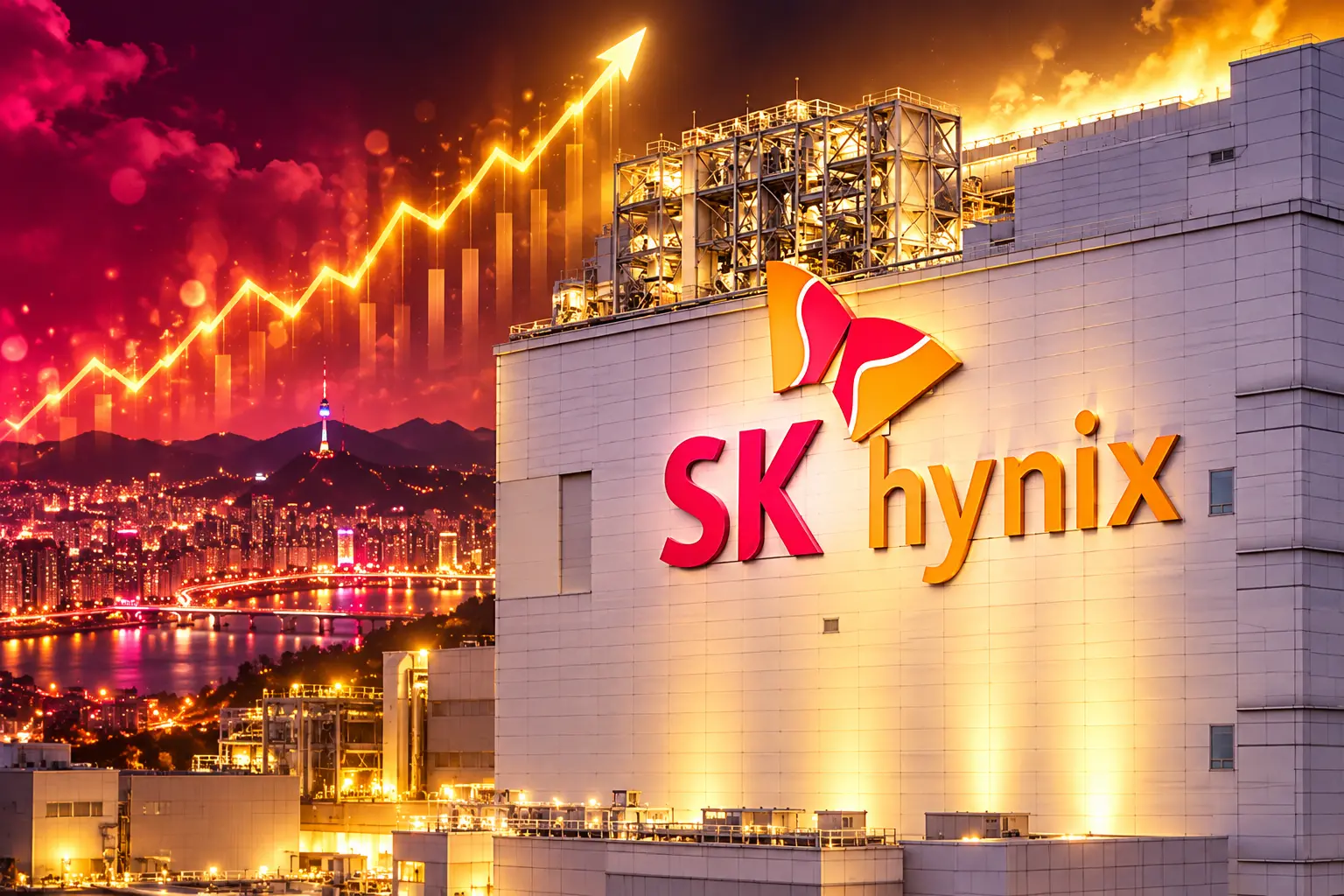
SK Hynix posted 83.3 trillion won ($62.8 billion) in third-quarter operating profit on Wednesday, an 80% margin on AI memory chips. That number is US data-center spending already booked in Seoul, and it is why the Kospi jumped 5.8% while US futures barely moved.
Alphabet and Microsoft still report after the New York close. The Federal Reserve, chaired by Kevin Warsh, is still expected to leave rates unchanged later Wednesday in Washington. The cash, for one quarter at least, has already changed hands.
SK Hynix Books an 80% Margin on AI Memory
The Icheon chipmaker said it recorded 83.3 trillion won in operating profit and 104.6 trillion won in revenue, the first time a quarter has cleared 100 trillion won. Operating profit rose 632% from 11.4 trillion won a year earlier, more than sevenfold, and revenue rose 328% from 24.4 trillion won. The operating margin was 80%, up from 76% in the second quarter and 47% a year earlier.
Net profit was 39.8 trillion won, up 216% from 12.6 trillion won a year earlier. That line fell 58% from 93.9 trillion won in the second quarter, even as the chip business itself got richer. Yonhap Infomax had clustered net-profit estimates near 60 trillion won, so the beat was in operations, not at the bottom line. FnGuide’s operating-profit consensus sat near 77 trillion won. SK Hynix cleared that by about 6 trillion won.
SK HYNIX THIRD-QUARTER LEDGER
| Line | Q3 2026 | Q2 2026 | Q3 2025 |
|---|---|---|---|
| Revenue | 104.6 trillion won | 79.3 trillion won | 24.4 trillion won |
| Operating profit | 83.3 trillion won | 60.5 trillion won | 11.4 trillion won |
| Operating margin | 80% | 76% | 47% |
| Net profit | 39.8 trillion won | 93.9 trillion won | 12.6 trillion won |
The company said prices of key products rose on growing demand for AI memory, and that sales of server DDR5, HBM4 and 321-layer data-center solid-state drives did the work. HBM4 shipments “began in earnest,” and SK Hynix said HBM4 should pass HBM3E in both shipment volume and revenue in the fourth quarter as the M15X plant is taken to full output by year-end. It was the sixth straight quarter of record revenue and operating profit, a run that started in the second quarter of 2025.
Cash and cash equivalents ended the quarter at 114.5 trillion won, up 26.5 trillion won from the prior quarter. Borrowings fell 2.8 trillion won to 15.8 trillion won, leaving net cash of 98.7 trillion won. For 2026 the board is aiming to return about 100 trillion won ($75.4 billion) to shareholders, at least 30 trillion won in cash dividends and at least 60 trillion won in buybacks and cancellations, including the 40 trillion won program completed last week. The third-quarter slice is a 14 trillion won cash dividend, 20,000 won a share, half of it a special dividend from Kioxia investment gains, plus a 20 trillion won buyback of which 10 trillion won will be cancelled.
“Amid market conditions in which prices of key products rose on growing demand for artificial intelligence (AI) memory, the company once again achieved record quarterly revenue and operating profit, driven by its competitiveness in high-value-added products,” SK Hynix said. It also said it expects the memory shortage to last through 2030.
The Kospi Jumps 5.8% While US Futures Barely Move
Seoul did not treat the print as a rounding error. The Kospi opened 2.23% higher at 5,763.85, then kept going. By 11:20 a.m. it was at 5,965.13, up 326.79 points, or 5.8%, from Tuesday’s close of 5,638.34. Tuesday itself had already been a 3.09% bounce. The Korea Exchange tripped a buy-side sidecar shortly before 10 a.m., freezing program buy orders for five minutes.
SEOUL, LATE MORNING
- Kospi: 5,965.13, up 5.8%.
- SK hynix: up 7.76% after Tuesday’s close at 1.34 million won.
- Samsung Electronics: up 7.77%, with SK Square up 8.7% and Samsung Electro-Mechanics up 9.16%.
- Nikkei 225: up 1.4%, a much thinner move than Seoul’s.
The won was at 1,336.0 per dollar at 11:20 a.m., down 9 won from the previous stock session, so the local rally ran even as the currency slipped. US index futures were little changed. EUROSTOXX 50 futures were down 0.03%. The dollar index sat near a two-week high at 102.37. Japan’s tape followed the AI bid. Korea’s tape followed an invoice that had already been paid.
SK hynix and Samsung Electronics make up more than half the Kospi. A record Q3 profit at the HBM supplier is not a sideshow for that index. It is the index. Chris Brigati, chief investment officer at SWBC, put the other half of the day in a single warning. “While we’re expecting strong results across the board, the focus is less about the actual earnings results than about whether the capex spending for AI growth will translate into sustainable revenue growth for these companies, which remains a big question mark,” he said. “The period of a rising market lifting all stocks has started to shift.”
What Alphabet and Microsoft Have to Prove Tonight
That shift is why Wednesday’s US close matters more than the usual beat-and-raise ritual. Alphabet and Microsoft report after the bell, with Amazon.com due Thursday. The three have nearly $1.7 trillion in contracted cloud backlog and plan to spend as much as $600 billion this year. Alphabet has guided 2026 capital spending to $195 billion to $205 billion. Microsoft’s calendar-year bill is about $175 billion including finance leases, with the September quarter alone guided above $50 billion. Amazon’s 2026 figure is about $220 billion.
Investors will look for Google Cloud growth near 90% and for Azure to hold around the 45% pace Microsoft already guided. Consensus sits near $90.7 billion of Microsoft revenue. Alphabet is expected to burn cash for a second straight quarter and Amazon for a third, while Microsoft is still seen generating more than $8 billion of free cash flow. The test is not whether the clouds are growing. It is whether that growth is cash, or just the other side of the same purchase orders that already filled SK Hynix’s quarter.
Meta Platforms has already shown the ugly version of the ledger. After last week’s report it was sitting on its first negative free cash flow since the 2012 IPO, and the shares fell 7%. On Monday it said it would seek as much as $95 billion of financing for the build. SpaceX arranged about $40 billion of debt to lease the GPUs that sit on top of the memory SK Hynix sells. Those tickets landed in the same 24 hours as Anthropic’s IPO paperwork. The spend is not slowing. The question Brigati asked is who, besides the memory vendors, gets paid for it.
Anthropic’s Filing Reads Like a Supplier Invoice
Anthropic, the Claude lab, filed on 26 October for a Nasdaq listing under the ticker ANT. First-half revenue was $16.3 billion, up from $1.2 billion a year earlier, and the filing showed an $80.7 billion net loss that is mostly marks on financing paper. The document is less a software story than a map of who cashes the compute bill.
ANTHROPIC’S LOCKED COMPUTE BILLS
- Broadcom: $161.2 billion of equipment leases, the largest single line.
- Google: $114.5 billion of cloud and TPU capacity.
- Amazon: $110 billion of AWS compute, payable whether it is used or not.
- Microsoft: $44.9 billion, the smallest of the four hard contracts.
Those four add up to $430.6 billion of deals that do not go away if a model launch slips. A separate SpaceX AI-unit contract runs up to $120.5 billion through 2029 and can be exited on 90 days’ notice after early 2027. Value in this cycle is landing with whoever is paid in cash on short terms: the memory makers, the foundries, the chip lessors. The labs are still funding the residual with equity, vendor notes and public listings. GPU rental rates have been rising even as credit for independent data-center operators has blown out, which is a demand signal and a financing warning at the same time. If the next round of AI capacity cannot be borrowed, it will be sold as stock, and the people who buy that stock will be paying a bill SK Hynix has already collected.
Warsh Is Expected to Hold; New Zealand Already Did
The same build is now large enough to show up in rate rooms. Warsh’s Federal Reserve is expected to keep the federal funds target in a 3.75% to 4% range at the meeting that ends Wednesday, after a quarter-point increase in September, the first hike since 2023. Futures have priced about a 10% chance of another move this week and better than 80% odds of a hike in December. Analysts at JPMorgan said they expect at least two hawkish dissents. Cleveland Fed President Beth Hammack and Dallas Fed President Lorie Logan are the names most often attached to that call. The September vote was unanimous. This one comes six days before the 3 November midterms, with oil and fuel still elevated by war in the Middle East, and it is only the fourth meeting of Warsh’s tenure after President Donald Trump appointed him this year.
JPMorgan’s client note said markets will watch how Warsh couches the decision, and that “deferring on an explanation will be viewed as dovish in nature.” He has spent the autumn refusing to give the kind of forward guidance earlier chairs used. Loretta Mester, who ran the Cleveland Fed until 2024, said the economics support another increase and that she is skeptical a “timely” path back to 2% inflation looks different from a slow one if October is skipped.
Wellington did not skip, and then it did. The Reserve Bank of New Zealand voted 4-3 to hold the OCR, leaving the official cash rate at 2.75 percent after markets had fully priced a move to 3%. Governor Anna Breman voted with Carl Hansen, Prasanna Gai and Rebecca Williams to wait. Paul Conway, Hayley Gourley and Karen Silk wanted the hike. Only two of 25 economists in a Bloomberg survey had expected a hold. The kiwi fell more than 1%, slipping to just under 56 US cents. New Zealand’s trade-weighted dollar is already down about 3% since early September.
Annual CPI there was 3.7% in the September quarter, down from 4.1% in June and lower than the bank had expected, but the committee still sees 4.4% in the December quarter on fuel. Core inflation is around the top of the 1% to 3% band. The minutes then named the same risk Brigati named, from the other side of the world.
There is uncertainty about whether the surge in AI investment will be justified by economic fundamentals.
Reserve Bank of New Zealand, October 2026 Monetary Policy Review
The committee also wrote that financial-stability risks have risen because of “opaque and complex financing arrangements for some AI investments,” and that a global downturn could arrive abruptly. Seoul is pricing the invoice. Wellington is pricing the chance that the invoice was too big.
Chip Contracts Already Cover Half of 2028
SK Hynix is not waiting on that debate to book the next two years. It said it has long-term agreements with 14 major customers, including the large cloud companies, covering more than 50% of 2027 and 2028 production, on typical five-year terms, with prices that can move inside agreed ranges. Yongin Phase 1 is due to enter full operation next year, and the company said investment will rise, though it will still scale the spend against demand and returns. HBM4 is the fourth-quarter flagship. NAND’s 321-layer process is supposed to be more than half of domestic capacity in the same quarter.
That is why a record Q3 profit in Icheon can lift Seoul before Mountain View has spoken. The 14 customers are already on the hook. The 80 percent margin is the conversion of their capital budgets into Korean cash. Alphabet and Microsoft will say tonight whether those budgets still grow. Warsh will say, or refuse to say, whether the same budgets now count as inflation. The Kospi did not wait for either answer.
Disclaimer: This article is news reporting and analysis of company results, equity-index moves and central-bank decisions, and it is for information only. It does not constitute investment advice, a recommendation to buy or sell any share, index, currency or bond, or a prediction of Federal Reserve or Reserve Bank of New Zealand policy. Readers should consult a licensed financial adviser or other qualified investment professional before making any decision based on figures or outlooks discussed here. Results, index levels, exchange rates and policy odds are those in the company filings, exchange prints and official statements cited in this piece and may change as markets and officials update them.

Baker Mayfield’s Foot Strain Tests Tampa’s Run-First Formula

Measles Turns Endemic After the US Loses Elimination Status

California Locks Waymo Off Freeways After a Recalled Defect

Aidan Hutchinson’s Season Ends on a Celebration Jump in Munich

Super El Niño Hits Food Systems Already Under Strain

Consumer Sentiment Falls to 51.7 as Future Outlook Darkens

Take-Two Subpoenas Microsoft While GTA 6 Preorders Soar

Pluto’s Heart Glacier Still Pushes Liquid Nitrogen Upward

The Extra Heat Month Hits Children Where Care Is Thinnest

Netflix Weighs Hosting Peacock and Fox One in Its App
-
 BUSINESS3 months ago
Consumer Sentiment Falls to 51.7 as Future Outlook Darkens
-
 GAMING3 months ago
Take-Two Subpoenas Microsoft While GTA 6 Preorders Soar
-
 NEWS3 months ago
Pluto’s Heart Glacier Still Pushes Liquid Nitrogen Upward
-
 NEWS3 months ago
The Extra Heat Month Hits Children Where Care Is Thinnest
-
 ENTERTAINMENT3 months ago
Netflix Weighs Hosting Peacock and Fox One in Its App
-
 NEWS3 months ago
FDA Clears Rasonque and Widens Who Can Take It
-
 NEWS3 months ago
UMMC Will Rebuild 30-Year-Old Cancer Labs With $2.4 Million
-

 GAMING3 months ago
GTA 6’s 80-Hour Run Counts Goals That Change the Story