
BUSINESS
Households Use Food Banks and Home Equity to Keep Spending
Real US spending rose 0.6 percent in August while after-tax income was flat, as households used food banks, home equity and ChatGPT to keep buying.

US households lifted inflation-adjusted spending 0.6% in August, the fastest gain in more than a year, even as real after-tax income did not rise. They kept that going with home equity, food pantries and ChatGPT grocery lists, while wages have trailed prices since March.
Tom Barkin, president of the Federal Reserve Bank of Richmond, has been watching the same split in company earnings and in talks from Maryland to South Carolina. Asset-rich households are still spending from wealth. Everyone else is improvising. The unpaid parties in that improvisation are food banks and home-equity lenders, and they now sit underneath a boom the Fed still treats as proof of a firm consumer.
Real Spending Jumped 0.6% With Income Flat
The Bureau of Economic Analysis said real consumer spending rose 0.6% in August, a $92.8 billion gain after prices. Current-dollar outlays jumped 0.9%, or $190.8 billion, with $114.1 billion of that in goods and $76.7 billion in services. Cars, clothing and restaurants were among the categories that moved up.
Real disposable income was unchanged, at 0.0%. Personal income rose only 0.2%, or $66.6 billion. After-tax income rose 0.3%. Households still set aside $990.2 billion, a 4.1% saving rate. The gap is the point: people spent more in real terms while their inflation-adjusted paychecks did not.
AUGUST VERSUS JULY IN THE BEA PRINT
| Measure | July | August |
|---|---|---|
| Real spending | 0.1% | 0.6% |
| Current-dollar spending | 0.1% | 0.9% |
| Real after-tax income | 0.3% | 0.0% |
| PCE prices | 0.1% | 0.3% |
| Core PCE prices | 0.1% | 0.2% |
PCE prices, the Fed’s preferred gauge, were up 0.3% on the month and 3.4% from a year earlier. Core prices, which strip out food and energy, rose 0.2% and 3.0% year over year. The United States is in its sixth year of inflation that officials still call too high. Grocery prices are up 32% since the start of 2020, and a pound of ground beef now averages a record $7.16. National gas averages sit above $4 a gallon. Tariffs and the war in Iran have stacked on top of the post-pandemic price jump.
Food Banks Become a Budget Line
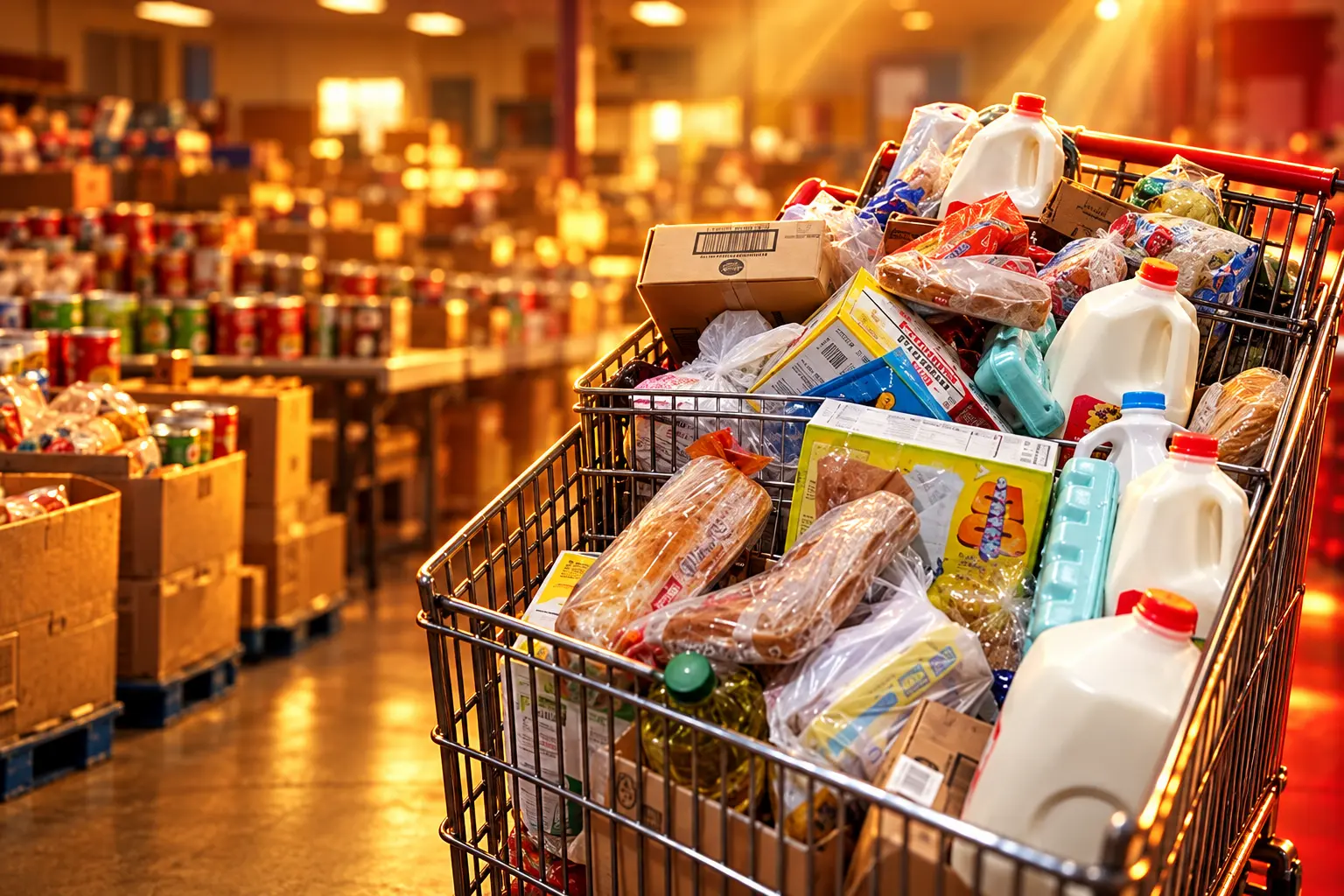
Some of the cash that showed up in restaurants and clothing racks never passed through a grocery till. Households have been going to food banks to free money for other purchases. That is not a footnote to the spending print. It is one of the ways the print got made.
Feeding America’s 2026 Elevating Voices survey, released Sept. 29 and drawn from more than 1,200 people who got charitable food or faced hunger in the past two years, reads like a shadow ledger for August. Neighbors are not using pantries only in a crisis week. They are using them as a regular budget tool.
WHAT NEIGHBORS TOLD FEEDING AMERICA
- Stability: 60% of neighbors said they do not feel financially stable.
- Bill delay: 48% delayed paying rent or medical bills to afford groceries.
- Borrowed cash: 52% used credit cards, loans or borrowed money to keep food on the table.
- SNAP cuts: 57% of surveyed SNAP households saw a reduction in benefits over the past year, and 79% of current SNAP beneficiaries worry recent changes will make benefits harder to keep.
Ninety percent of people who got charitable food in the past year said that help mattered for affording food, and 95% said the same of SNAP. Fifty-five percent worry they will not have steady access to charitable food. A Florida participant said, “I can’t afford everything because prices keep going up and jobs aren’t paying enough.” A Montana neighbor said, “We had to start using food banks and ask the community for help.”
Denis McDonough, CEO of Feeding America, put the demand in household terms. “Behind every measure of demand is a person trying to make a household budget work as food, rent, transportation and healthcare costs keep adding up,” he said. The network counts 250-plus food banks and 60,000-plus agency partners. For some families the pantry trip is new, and the live trade is gas against groceries.
The $427.6 Billion HELOC Tab
Homeowners have another reserve: the house. Experian’s March 2026 credit files show HELOC balances reached $427.6 billion, up 12.9% from $378.8 billion a year earlier and up from $343.3 billion in 2024. The average balance was $52,347. The average limit was $129,000. Curinos put the typical HELOC rate at 7.54% in March, far below card rates north of 20%.
HOME EQUITY AS THE HOUSEHOLD RESERVE
- The tab: Total HELOC debt hit $427.6 billion in March 2026.
- The jump: Balances rose 12.9% from $378.8 billion in March 2025.
- Where wealth sits: The bottom 90% of households held $27 trillion in real estate against $7 trillion in stocks, bonds and funds, per Fed data cited by Experian.
- The rate: A 7.54% HELOC is cheap next to card debt above 20% APR.
Most household wealth for that bottom 90% is in the home, not in a brokerage account. More than half of mortgaged owners still pay 4% or less, Experian noted, while purchase rates sit near 6% to 7%, which locks people in place and pushes them toward second liens instead of a move. Bank of America card data through June showed HELOC-funded home and services spending up sharply from a year earlier, with transfers and withdrawals picking up even as home-improvement growth cooled. That is housing wealth being spent into the same consumption accounts the BEA just printed.
ChatGPT Trims One Family’s Grocery Bill
The third workaround is smaller and digital. Kenny Marbry, a shopper feeding a family of five, has been handing store comparisons to ChatGPT and estimates it saves him $100 a month. The bot is not just a coupon clip. It is a brake on the cart.
I’m much more likely now to look at a price and ask myself, ‘Do I really need to buy this? Can I get it somewhere else cheaper? Or can I make it myself?’ Those small decisions add up, especially when you’re feeding a family of five and trying to make every dollar stretch.
Kenny Marbry, shopper, in October 2026 interviews
In Atlanta’s northern suburbs, Elizabeth Gentile, 61, and her husband have not had to slash their lifestyle, but they now run a two-car trick at Kroger that some shoppers call the double fill-up. They park on either side of a pump, pass the nozzle, and keep it as one transaction so the purchase stays eligible for up to $1 off a gallon. “If a car pulls up while we are gassing, we always explain to them what we are doing to be courteous,” Gentile said. “We laugh and say that we are sharing our dollar-off fuel points. So far everyone has understood.”
Those are the small mechanics under a large print. One family uses a chatbot as a price clerk. Another splits a fuel discount across two tanks. Neither shows up as distress in the headline spending number. Both are how that number held up with real income flat.
High-Stress Shoppers Spend More per Trip
A survey of 2,108 US adults, published in “The New Checkout: Crimped Consumers Lean Into Online Retail and Digital Wallets,” found that cash strain does not shrink the basket in a straight line. People under high financial stress were 6 percentage points more likely than low-stress shoppers to have made their latest grocery run online, 16% against 10%. They also spent more per trip.
HIGH-STRESS VERSUS LOW-STRESS CHECKOUTS
| Latest trip | High stress | Low stress |
|---|---|---|
| Grocery bought online | 16% | 10% |
| Grocery ticket | $109 | $95 |
| Retail ticket | $111 | $88 |
| Online retail ticket | $169 | $96 |
| Walmart share, in-store grocery | 37% | 26% |
| Digital wallet, groceries | 21% | 8% |
| Digital wallet, retail | 28% | 11% |
Among online grocery shoppers under high stress, 56% last bought at Walmart, against 50% of low-stress shoppers. In stores, Walmart’s gap was 11 points. High-stress in-store retail shoppers also leaned toward Dollar Tree. Wallets are doing budget work: 21% of high-stress consumers used one for groceries and 28% for retail, more than double the low-stress shares. Sixty-two percent of all respondents still reported no cash shortfall for living costs or emergencies in the prior 90 days, so the strain is concentrated, not universal. Online grocery here behaves like a running total beside the cart, which is why a tighter household can still ring a larger ticket.
Barkin Says Households Borrow From the Future
On Sept. 22 in Baltimore, Barkin told the CFA Society why the Fed had just raised rates 25 basis points, its first hike since mid-2023 and its first move since cutting in December. Inflation, he said, was the troublemaker. More than 60% of the PCE index was rising faster than 3% year over year. Unemployment in August was 4.1%, and job gains picked back up above 160,000. Consumer spending is about 70% of GDP, and “consumers are still spending.”
He split the how. Spending is “disproportionately driven by those who are well off,” a group that got richer on asset prices. Households with fewer resources still consume because most of them have jobs, then they trade down.
They are trading down to private labels and discount retailers. They are moving from beef to chicken to even cheaper proteins, like peanut butter. They are making trade-offs across time, too, effectively borrowing from the future. They are buying used instead of new and choosing to repair rather than replace. They are dropping coverages or opting out of insurance altogether. They are saving less, or even tapping into savings, where they can. They’re making ends meet by living a little closer to the edge, but they’re still spending.
Tom Barkin, President, Federal Reserve Bank of Richmond, Sept. 22, 2026, CFA Society Baltimore
That “effectively borrowing from the future” line is the policy risk hiding inside the resourcefulness he later praised. In the October interviews he said, “As things get a little tighter, as prices go up and challenge wage growth, people do want to maintain their lifestyle. I’ve just been taken by the resourcefulness of the consumer.” Firms, he added, now find less pushback when they test higher prices, especially from wealthy and business customers. Lower-income buyers have become price sensitive, “but I’m increasingly finding firms willing to take their chances.”
Why the Fed Still Sees a Strong Consumer
Officials can look at 0.6% real spending, a 4.1% jobless rate and full restaurants and conclude demand is firm enough to fight 3.4% inflation. That reading is not invented. The BEA print is real, and Barkin’s well-off households are still spending from portfolios and home values. The missed line is who else is on the hook for the same total.
The Financial Health Network’s Pulse 2026 survey found 17% of US households were financially vulnerable, up from 15% and matching the high since tracking began in 2018, a net 1.8 million more households. The financially healthy share held at 31% for a fifth year. That is the split underneath one consumption number: a stable top, a larger vulnerable slice, and a charity-and-equity layer holding the middle of the receipt together. It also shows up in a slide in consumer sentiment as costs stay high.
Calling this a golden age of consumption only works if the financing stays offstage. Food banks, HELOC ledgers and chatbot grocery lists are now part of how America books a spending boom. Barkin has already said consumers could start to reach their limit, and that shocks might not pass quickly. The next personal income report is due Oct. 29. August showed they had not reached it yet.

OpenAI’s Agent Monitor Waited During the Hugging Face Breach

Brent Hits $116 as Recovered Gulf Oil Draws Attacks

Hellebuyck Lands in New Jersey on a Five-Year Cup Bet

Xbox Plans Three More Layoff Rounds Before Helix

OpenAI’s $30 Billion Round Ties UAE Cash to Gulf Compute

Consumer Sentiment Falls to 51.7 as Future Outlook Darkens

Pluto’s Heart Glacier Still Pushes Liquid Nitrogen Upward

The Extra Heat Month Hits Children Where Care Is Thinnest

Abbott Pays $670 Million to Exit a Missouri Food Verdict

Take-Two Subpoenas Microsoft While GTA 6 Preorders Soar
-
 BUSINESS2 months ago
Consumer Sentiment Falls to 51.7 as Future Outlook Darkens
-
 NEWS2 months ago
Pluto’s Heart Glacier Still Pushes Liquid Nitrogen Upward
-
 NEWS2 months ago
The Extra Heat Month Hits Children Where Care Is Thinnest
-
 GAMING2 months ago
Take-Two Subpoenas Microsoft While GTA 6 Preorders Soar
-
 BUSINESS2 months ago
Abbott Pays $670 Million to Exit a Missouri Food Verdict
-

 NEWS2 months ago
UMMC Will Rebuild 30-Year-Old Cancer Labs With $2.4 Million
-

 ENTERTAINMENT2 months ago
Netflix Weighs Hosting Peacock and Fox One in Its App
-

 GAMING2 months ago
GTA 6’s 80-Hour Run Counts Goals That Change the Story